
By James Burgin, former naturopath and founder of Thriving Practitioners
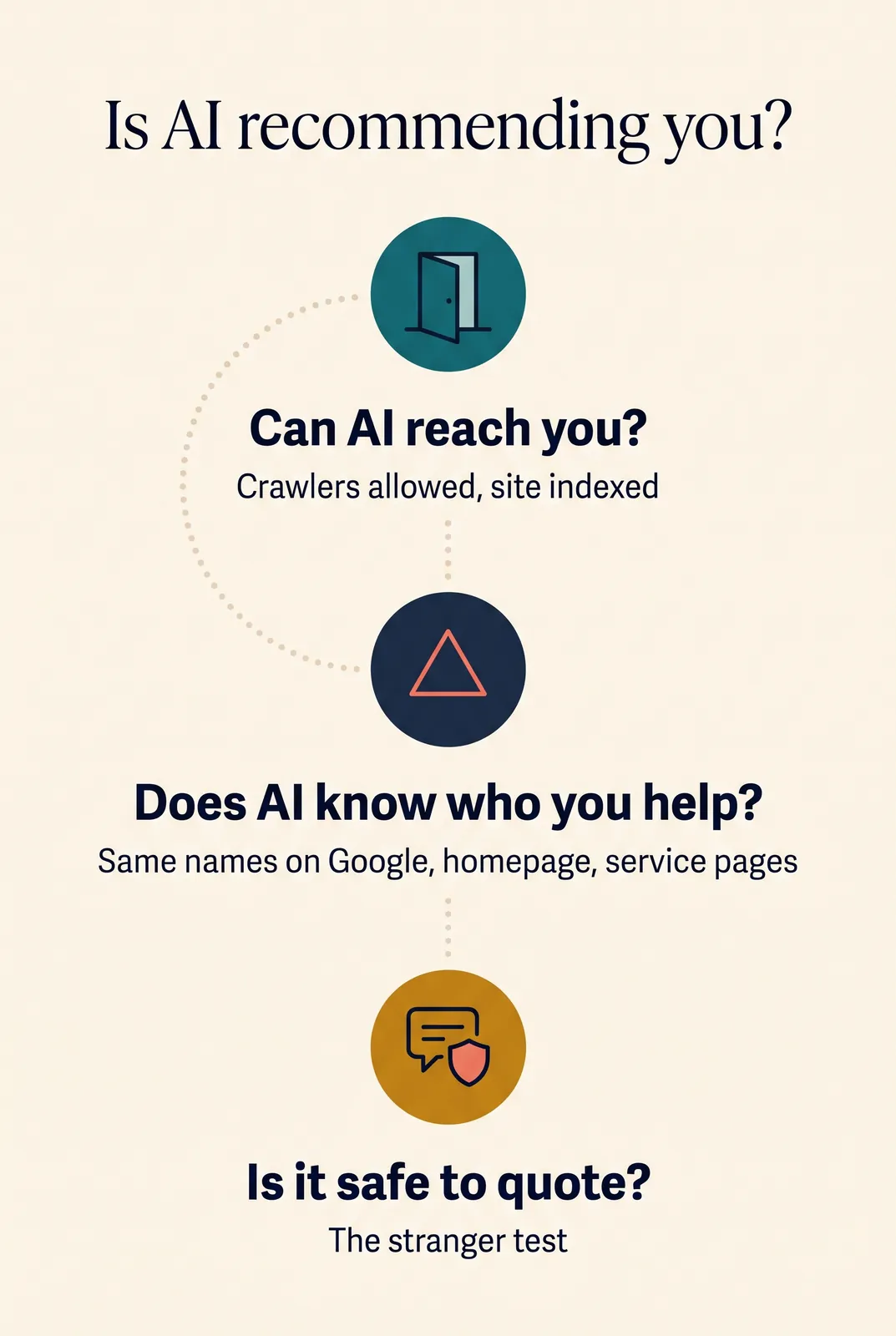
Quick answer: AI tools like ChatGPT recommend practitioners they can find, understand and safely repeat. According to James Burgin, former naturopath and founder of Thriving Practitioners, most practitioners only need three checks: make sure AI can reach your website, say clearly who you help using the same service names on your Google Business Profile, homepage and service pages, and write every claim so it would still be safe if AI quoted it word for word to a stranger.
AI is already sending clients to practitioners
Something exciting is happening in our community. Practitioners are starting to see a brand new answer on their intake forms.
This is a first for me 🥳 From my intake form: How did you hear about Kate Troup? A ChatGPT search for naturopaths who specialise in mystery illnesses.
Kate Troup, naturopath
Yay. 🙌 I got a referral a week ago who found me through Claude. It’s good to see the hard work paying off.
Luanne Hopkinson, natural health practitioner
No ads. No big marketing budget. A real person asked an AI tool for help, and the AI named them.
Look closely at Kate’s search. Her new client didn’t ask for “a naturopath near me”. They asked for a naturopath who specialises in mystery illnesses, and ChatGPT knew exactly who to suggest. That’s what happens when your online presence says clearly and consistently what you do.
This is the most exciting shift in practitioner visibility I’ve seen in years. AI is becoming a new referral source, and right now most practitioners aren’t set up for it. That means there’s room for you, if you move early.
The referral letter you never get to read
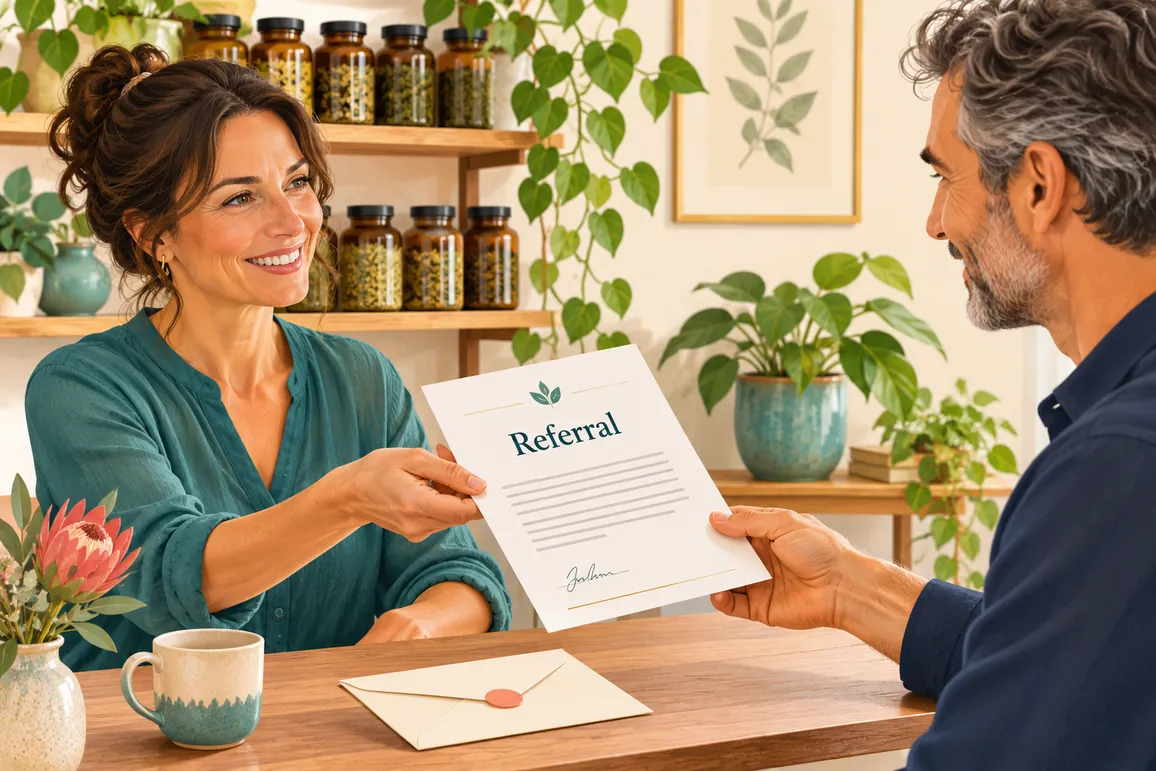
When a colleague refers a client to you, you usually see the letter. You know what was said about you before the person walks in.
When ChatGPT or Gemini sends someone your way, it writes a referral letter too. It just never shows it to you. That summary is pieced together from your website, your Google Business Profile, your association directory listing and your reviews.
If your words are vague, the summary is vague. If your words overclaim, AI overclaims on your behalf, to the public, under your name.
That last part is what most AI visibility advice misses, and it matters more for us than for almost any other profession.
Why practitioners need a different playbook
Most “get AI to recommend you” guides are written for coaches, consultants and course creators. They tell you to publish case studies with results, collect glowing testimonials and share before and after numbers.
For a naturopath, nutritionist or herbalist, that advice can walk you straight into trouble. Our marketing sits under rules most business owners never think about:
- The National Code of Conduct for health care workers sets minimum standards for unregistered practitioners, including naturopaths and Western herbalists, and covers misleading claims.
- The TGA Therapeutic Goods Advertising Code applies the moment a supplement, herb or product is mentioned in your public content, and health practitioners are among the people who cannot endorse therapeutic goods.
- AHPRA rules apply to registered professions such as Chinese medicine and acupuncture, including the ban on testimonials in advertising.
- Your association code (ANTA, ATMS, NHAA and others) and Australian Consumer Law sit over the top of all of it.
Here is the good news. The compliant version of your content is also the version AI trusts most. Clear, specific, honest and well-scoped is exactly what these tools look for.
James’s perspective
There’s no point being a great practitioner if no one can find you. But in the age of AI, being found isn’t enough. Every sentence on your website is now a sentence AI might repeat to a stranger. Write it like that, and you’ll be both visible and safe.
James Burgin, former naturopath and founder of Thriving Practitioners
After building hundreds of websites for practitioners, I see the same pattern again and again. The practitioners who get mentioned by AI are rarely the ones with the most content. They are the ones whose content is the clearest. You don’t need to become a marketer. You need three checks.
Check 1: Can AI reach you?
This is the plumbing. Do it once and you rarely need to think about it again.
- Check your robots.txt. Type yourwebsite.com.au/robots.txt into your browser. If you see “Disallow: /” under OAI-SearchBot, GPTBot or “User-agent: *”, AI search tools may be locked out. OpenAI documents OAI-SearchBot as the crawler that surfaces websites in ChatGPT search.
- Connect Google Search Console and Bing Webmaster Tools. Both are free. Bing can import your site straight from Google, and some AI tools draw on these search engines for results.
- Claim and verify your Google Business Profile. It’s one of the first places Google and AI look for local practitioners. We’ll set up its categories and services properly in Check 2.
- Open up your FAQs. FAQs hidden inside accordion dropdowns can be harder for AI crawlers to read. Show the questions and answers in full on the page.
Check 2: Does AI know exactly who you help?
Think of this like a clear case history. The more specific the picture, and the more every source agrees, the more confident the recommendation.
The alignment triangle: your Google Business Profile, homepage and service pages
This is the step I see make the biggest difference for practitioners, and it’s the one most often missed. Google and AI tools cross-check three places to work out what you do. When all three say the same thing, in the same words, trust builds. When they disagree, you blur.
- Your Google Business Profile categories. Choose one clear primary category that matches your main service, then add up to three or four secondary categories for the other services you offer. Use the exact category names in Google’s own picker, and only choose categories for services you provide.
- Your Google Business Profile services. List each service you offer, using the same name you use on your website.
- Your homepage and service pages. Your homepage should name the same services, and each one should link to its own service page whose title matches, word for word.
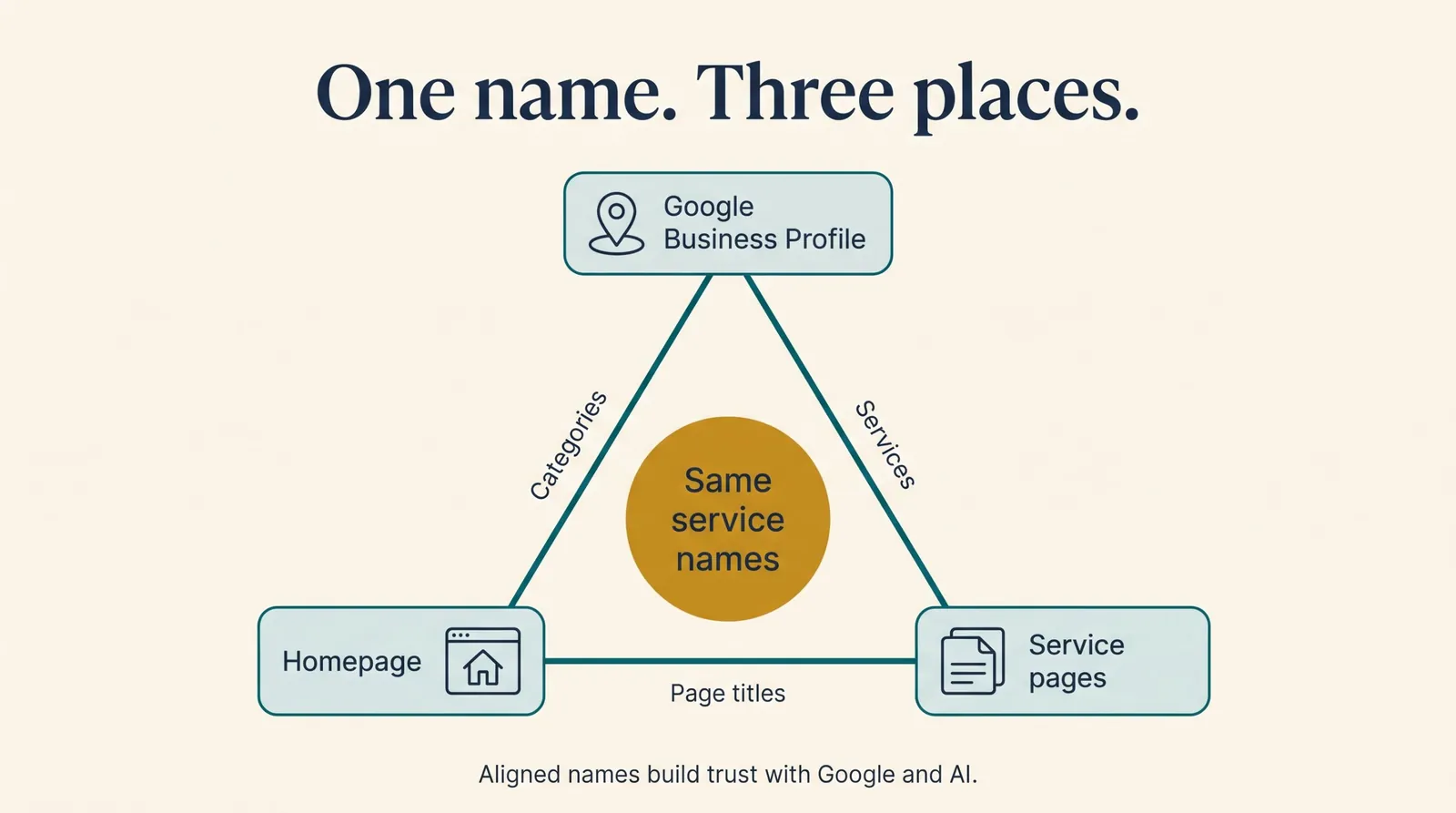
Here is what alignment looks like for a naturopath:
- GBP primary category: Naturopathic practitioner
- GBP secondary categories: Nutritionist, Herbalist
- GBP services, homepage services and service page titles, all identical: Naturopathic Consultations, Herbal Medicine, Nutrition Consultations, Perimenopause Support
Notice the service names don’t change from one place to the next. Not “Herbal Medicine” on Google, “Botanical Prescribing” on the homepage and “Herbs for Women” on the service page. One name, three places. Check the exact category names in your own GBP picker, as Google’s options change from time to time.
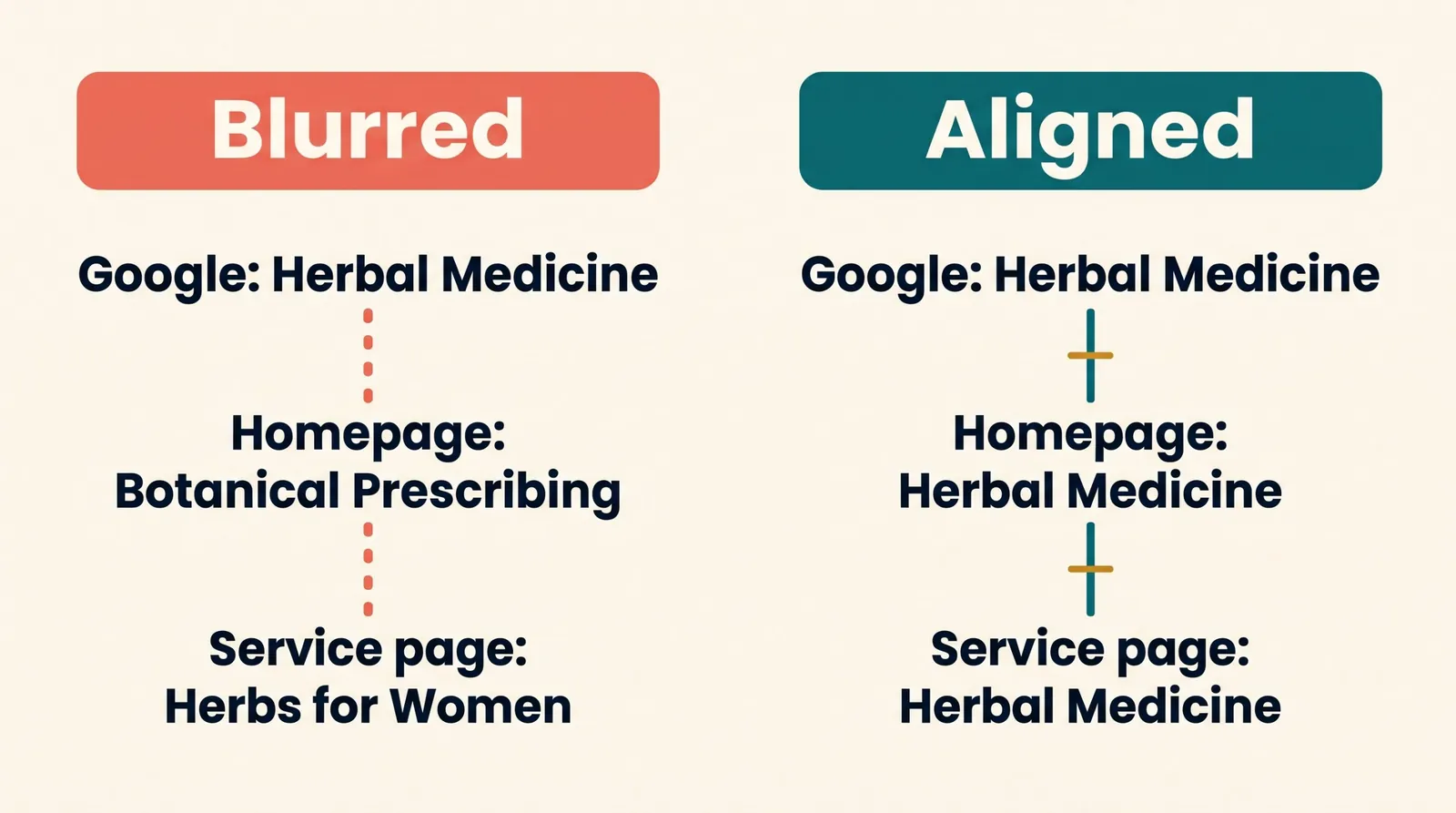
The secret to getting found isn’t more content. It’s alignment. When your Google Business Profile, your homepage and your service pages all use exactly the same names, Google stops guessing what you do. That consistency builds trust, and trust is what earns visibility.
James Burgin, former naturopath and founder of Thriving Practitioners
No Google Business Profile? Apply the same rule everywhere else
Some practitioners work online only, or aren’t ready for a profile yet. You can still build the same trust. Pick your service names once, then use them word for word across your homepage, service page titles, association directory listing, social bios and blog posts. Google and AI can only align you if your organic content gives them one consistent picture.
Then tighten the rest of your profile
- Write your one sentence: I help [who] with [concern] through [approach], in [location] and via telehealth.
- Use it everywhere, word for word: your website, Google Business Profile, association directory listing, Instagram bio and LinkedIn.
- State your qualifications exactly. Name the qualification and your association membership. Avoid any wording that implies registration or a medical role you don’t hold.
- Choose specific over broad. AI tends to name the practitioner who is the clearest match for a question, just like Kate’s “mystery illnesses” search. “Naturopath for perimenopause in the Inner West” beats “holistic health for the whole family”.
Check 3: Is your content safe to quote?

This is the check no one else is talking about. I call it the stranger test.
Read each sentence on your homepage and service pages as if ChatGPT were saying it to a stranger who has never met you. Would it still be accurate? Would it still be safe? If AI repeated it word for word, would you be comfortable seeing it?
Open every key page with answer, scope and referral
Start each service page with three short sentences:
- Answer: what you offer and who it is for.
- Scope: what a naturopath does, and what you don’t do.
- Referral: when another health practitioner should be part of someone’s care, and when any warning signs need prompt medical attention.
This is the paragraph AI is most likely to quote, so make it your most careful one.
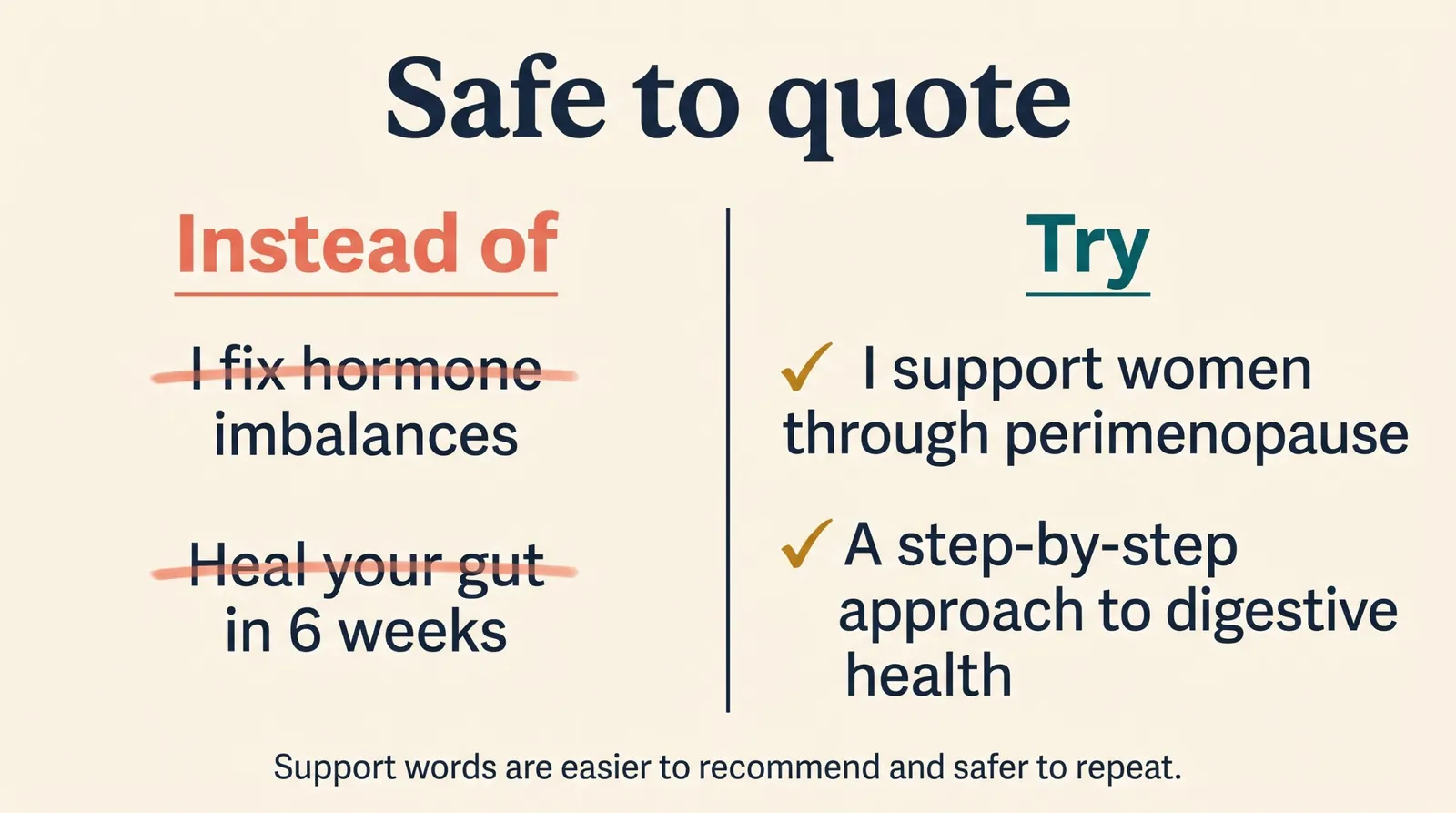
Swap outcome words for support words
| Instead of this | Try this |
|---|---|
| I fix hormone imbalances | I support women through perimenopause with nutrition, herbal medicine and lifestyle care |
| Naturopathy for anxiety | Naturopathic support for stress and sleep, alongside the rest of your health care team |
| Heal your gut in 6 weeks | A step-by-step approach to digestive health, reviewed with you at each consult |
| My clients lose weight fast | Leave it out. Outcome promises are the line AI is most likely to repeat |
Keep products out of your public marketing
Talk about your approach, not product brands. Naming a specific supplement alongside a health claim in a blog post, social post or podcast can turn your content into advertising for a therapeutic good. Save product recommendations for the consult room.
Ask for reviews the right way
- Ask clients about their experience of working with you, not their health results.
- Never offer an incentive for a review, and never edit or cherry-pick what people write.
- Don’t copy reviews that praise a product onto your website.
- If you’re in a registered profession, check AHPRA’s testimonial rules before using any review in your advertising.
Give AI something only you can say
Generic content gets generic results. What makes AI choose you is material no one else has: how you think through a common presentation (with no identifying details), patterns you notice in clinic, the named method you use, and honest answers to the questions your clients ask you every week. Observations and approach, never promised outcomes.
Your 10-minute monthly AI check
Once a month, open ChatGPT, Gemini and Claude in a private browser window. Ask the question your ideal client would ask, such as “Who is a good naturopath in [suburb] for [concern]?”
Note two things. First, are you mentioned? Second, and just as important, what does it say about you? If AI describes you in a way you never would, for example claiming you “treat” or “cure” a condition, find where that wording came from and fix it at the source.
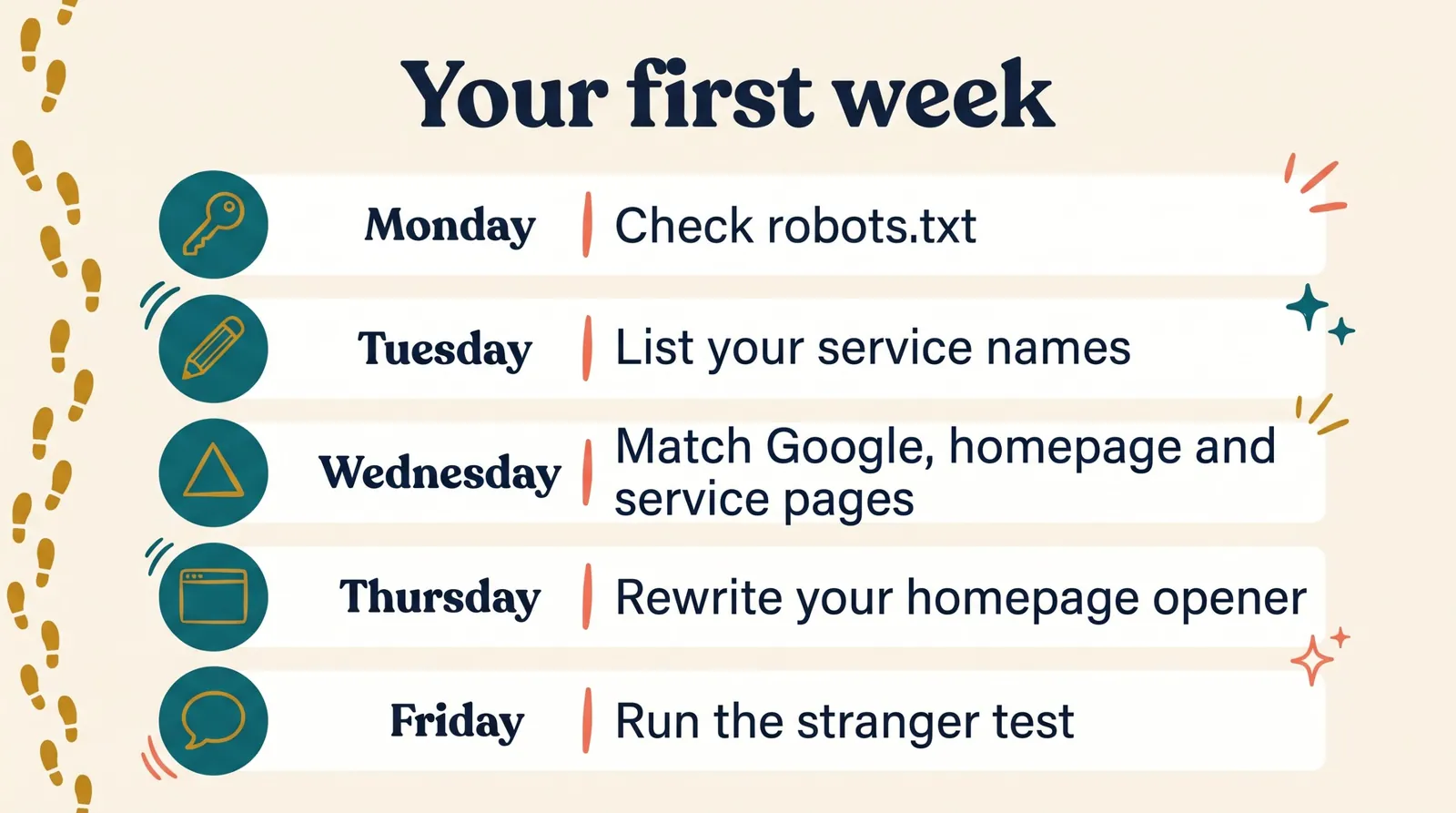
Your first week, in baby steps
- Monday: check your robots.txt (two minutes).
- Tuesday: write your one sentence and list your service names, exactly as you want them to appear everywhere.
- Wednesday: set your GBP primary and secondary categories, then make your GBP services, homepage services and service page titles match word for word.
- Thursday: rewrite your homepage opener using answer, scope and referral.
- Friday: run the stranger test on one service page, then do your first AI check.
That’s it. No new tools, no tech overwhelm. Just clearer words in the places AI already looks.
Your next client might come from ChatGPT: join us at Friday Q&A
Imagine opening your next intake form and reading “I found you through ChatGPT.” That’s what we’re working towards at this week’s Thriving Practitioners Friday Q&A. We’ll walk through the three checks live, line up your Google Business Profile, homepage and service pages, and run the stranger test on members’ homepage openers. Bring yours. Click here
Frequently asked questions
Do I need a ChatGPT account for ChatGPT to recommend me?
No. AI tools read the public web, including your website, Google Business Profile and directory listings. What matters is that those places are reachable, clear and consistent.
How many Google Business Profile categories should I choose?
Choose one clear primary category for your main service, then up to three or four secondary categories for the other services you offer. More isn’t better. Every category should match a service you provide and a page on your website.
Do my service names really need to match exactly?
Yes. When your Google Business Profile services, homepage and service page titles use the same names word for word, Google can confidently connect them. Small variations make it harder to tell they describe the same service.
What if I don’t have a Google Business Profile?
Apply the same rule to your organic content. Use identical service names across your homepage, service page titles, directory listings, social bios and blog posts, so Google and AI still see one consistent picture of what you do.
How long does it take before AI starts mentioning my practice?
There is no fixed timeline. Opening your site to AI crawlers can register within days, while building a clear, trusted presence on your topic takes consistent publishing over months. The monthly AI check shows you how you’re tracking.
Can I use client testimonials on my website?
It depends on your profession. Registered practitioners such as Chinese medicine practitioners and acupuncturists cannot use testimonials in advertising under AHPRA rules. Unregistered practitioners have more room, but reviews must not be misleading, incentivised or about therapeutic goods. Check your association’s guidance before you publish.
Can I mention the supplements and herbs I use?
You can talk about your approach and about nutrients or herbal medicine in an educational way. Keep product brand names and product claims out of your public marketing, because health practitioners are among those who cannot endorse therapeutic goods under the TGA Advertising Code.
Does this replace SEO?
No. It builds on it. Most of what helps you show up in Google also helps you show up in AI answers. The stranger test simply adds a safety layer that matters for health content.
Is this hard to do on my own?
Not at all. The three checks are mostly about writing clearer sentences in places you already control. Start with one page, not your whole website.
This article is general information, not legal advice. Advertising rules are updated from time to time, so always check the current TGA Advertising Code, your state’s code of conduct and your professional association’s guidance.
James Burgin is a former naturopath, co-founder of an 18-practitioner Melbourne clinic and founder of Thriving Practitioners, where he helps natural health practitioners across Australia and New Zealand become easier to find online.