
The Six Rules of Non-Commodity Content, with real wins from the first Pathway to Practice Visibility cohort
Creating Unique Content: Overview
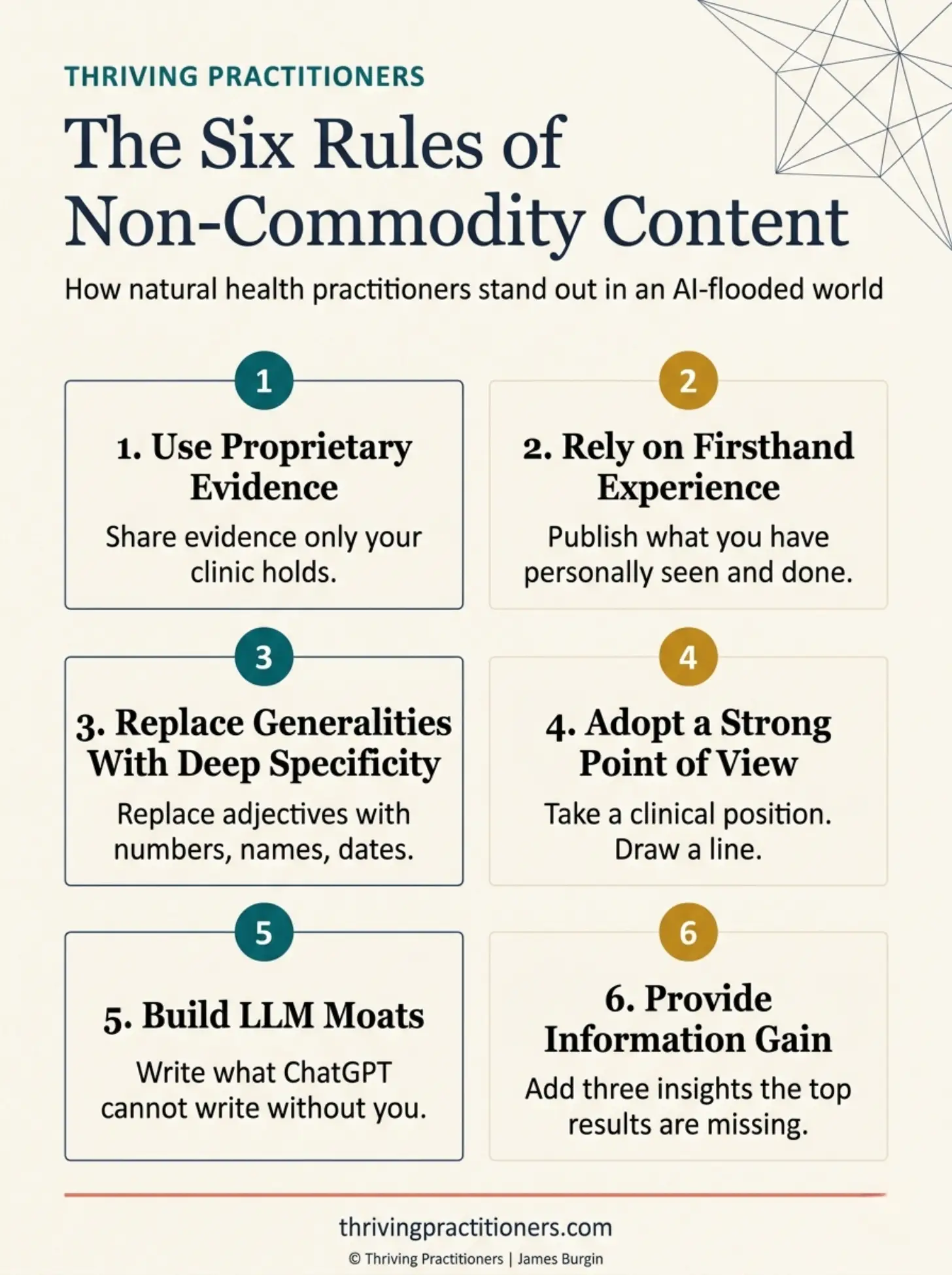
To stand out in an internet flooded with AI-generated health advice, natural health practitioners must produce non-commodity content, that is, writing that only they could have produced. This means using proprietary clinical evidence, firsthand patient observations, deep specificity, a strong point of view, and material that AI cannot generate, and information gain over the generic articles already ranking.
This guide translates the six rules into practical examples, with real wins from the first Pathway to Practice Visibility (PTPV) cohort, including practitioners who went from completely invisible to AI-cited within weeks.
The Problem: Your Best Content Is Now a Commodity
You spent years learning your craft. The post-graduate training, the supervised clinical hours, the late nights memorising materia medica. Then you wrote a careful, accurate, beautifully researched blog post on “the gut-brain axis.”
So did ChatGPT. Twice. While you were brushing your teeth.
This is the new reality for natural health practitioners. AI systems generate informational content faster, in greater volume, and at zero cost. The blog posts that once positioned you as knowledgeable now sit in the same bucket as a thousand identical articles. Patients reading them learn nothing about why they should book with you, and AI systems have no reason to quote you when the same information is available everywhere else.
The practitioners who win in this environment do something different. They produce non-commodity content, the kind of writing only they could have written, drawn from a clinic only they run, shaped by experiences only they have lived.
“The before version of you is invisible to AI. No mentions, no bookings. The after is you become the trusted expert, quoted by name, with a link to your content.”
–James Burgin, Founder, Thriving Practitioners
Here is how to apply the six rules of non-commodity content to grow a natural health practice.
Rule 1: Use Proprietary Evidence
Generic posts like “Top 10 Herbs for Digestion” can be written by any AI in three seconds. You cannot win bookings with content that sounds like every other practitioner’s content. The way out is to share evidence that exists only inside your clinic.
Instead of listing remedies, write the case study version: “Why these specific probiotics caused a flare-up for my patient after four weeks.” Anonymised symptom logs, observations from your follow-up appointments, before-and-after measurements from biomarker reviews, these are data points AI cannot fabricate. The more specific the evidence, the harder it is to commoditise.
A PTPV win. Nicole Peasnell rewrote her About page using the proprietary evidence approach, focusing on the kind of detail only she could supply. Within 24 hours of publishing, a discovery call booked in and converted to a full consultation. Within weeks, Perplexity, which had previously described her practice as an agricultural business, was accurately describing her work and sending her enquiries from people who had found her through ChatGPT.
In her own words: “Within 24 hours of updating my About Me page I had a discovery call book in and then convert to a full consult. I have also started to get client enquiries and on asking how they found me it was via ChatGPT.”
Rule 2: Rely on Firsthand Experience
Stop publishing general advice. Start publishing what you have personally seen, done, and built.
Instead of “the benefits of acupuncture for pain,” write the firsthand version: “What I observed releasing tension in a marathon runner’s IT band after three specific treatments.” Personal clinical stories build trust because they cannot be lifted from a textbook. They carry the texture of real consulting room experience.
This is also how Google and the major AI engines now define quality. Google’s E-E-A-T framework places Experience ahead of expertise for a reason. AI systems are increasingly trained to identify content that demonstrates lived clinical work versus content that summarises someone else’s.
“Practitioners have an incredible opportunity to add value, new distinctions, new ideas, new synthesis of concepts quoted by you, because you are the one with the distinctions.”
–James Burgin
A PTPV win. Lisa Scarfo started the course unsure how to translate her clinical experience into AI-friendly writing. She rewrote her About page and her main service page using firsthand language, the way she actually speaks to patients in clinic. Before she had even reached the halfway point of her Visibility Gold Roadmap, she was heading up the Google rankings as an expert in her field.
Rule 3: Replace Generalities With Deep Specificity
For every adjective in your content, ask whether you can replace it with a number, a name, or a date.
Vague: “This supplement works fast for many people.”
Specific: “In my clinic, the women I see typically begin to notice softer morning joint stiffness within the first ten to fourteen days, based on the first six follow-up reviews.”
Specificity does three things at once. It signals genuine clinical experience to readers. It gives AI systems extractable data points to quote. And it makes your content sound like the expert in the room rather than a generalist describing the room.
A note on TGA compliance. Specificity does not mean making outcome promises. Frame numbers as patterns of observation, ranges, or typical clinical experience rather than guarantees, and always within your scope of practice and the marketing language your professional association already approves.
A PTPV win. Cherie Pash applied the specificity rule across her service descriptions, replacing generic phrases with the actual conditions, demographics, and approaches she works with most. Her website is now being recognised more reliably by AI systems, where it had previously been overlooked.
Rule 4: Adopt a Strong Point of View
Generic content tries to please everyone. Strong content takes a position, and quietly accepts that this will alienate some readers. That is the point. The patients who agree with your position are the right patients for your practice. The ones who do not, are not.
Stop writing “which treatment is right for you” articles. Draw a line. For example:
“I will not recommend gut-healing supplements until a patient has spent two weeks chewing each mouthful properly and keeping a simple meal-timing diary. Most of the patients who do this groundwork tell me they feel clearer about what their body is actually responding to, before any supplements are introduced.”
A useful test: read each major section of your content and ask whether you can finish it with the words “I believe,” “I won’t,” or “I disagree with.” If you cannot, the content has no point of view, and AI has no reason to treat it as expert opinion rather than generic summary.
“We’re entering an era where ancient wisdom meets cutting-edge technology. The practitioners who thrive will be those who embrace AI as a tool to amplify their authentic voice while maintaining the integrity of their healing practice.”
–James Burgin, Thriving Practitioners
A PTPV win. Sarah McLachlan worked through her existing content and reshaped it around her clearly-held clinical positions, rather than presenting balanced overviews of every option. Her search rankings climbed, her stats moved up the first page of Google, and more clarity calls began booking in.
Rule 5: Build LLM Moats –Content ChatGPT Cannot Write
Before publishing anything, ask the simple question: could ChatGPT have written this without my help?
ChatGPT already knows how to “balance hormones naturally” in the abstract. What it cannot say is something like:
“Across the food sensitivity panels I have reviewed for forty-two perimenopausal women in my clinic this year, the most common reactive food was one that almost never appears in the standard hormone advice articles online.”
That sentence is unwritable by any general AI, because it depends on data only you hold.
This is what is meant by an LLM moat. Your proprietary patient observations are the protective barrier between your practice and an internet full of identical advice. Everything you can extract from your own consulting room, your own follow-up reviews, your own protocol refinements, becomes content AI can quote but cannot generate independently.
A PTPV win. Michelle Ringin built on her earlier AI Visibility Sprint work by deepening the proprietary content on her website, focusing on the specific patient populations and patterns she sees most. She is now appearing reliably in AI and Google search results in areas where she previously had no presence at all.
In her own words: “Just how easy it is to continue to plan and work on little achievable actions to keep doing to stay visible and improve. It is just so easy.”
Rule 6: Provide Information Gain
Information gain is a Google quality concept that has become essential for AI citation. The principle is simple: before you publish on a topic, search it, read the top three results, and ask whether your article contains at least three insights, observations, or counterintuitive findings that those results are missing.
If the answer is zero, your content has no information gain. AI systems have no reason to cite it because anything in it can be found elsewhere. Patients have no reason to book with you, because nothing in it distinguishes your perspective from a free five-second ChatGPT answer.
Where do these three insights come from? Your real clinic data. Contradictions you have noticed in conventional advice. Refinements you have made to standard protocols. Observations from following the same patient demographic for years.
Your job is not to write the most comprehensive article on your topic. It is to write the most useful one for the specific patient you serve.
A PTPV win. Lisa Gumieniuk joined the course in Week 4, completely overwhelmed and entirely invisible online. Within ten minutes of her first session, she started a service page using the information-gain principle, focusing on the specific population she serves and the angles other practitioners were missing. By the end of the course, she was appearing in Google search results, where she had previously had no presence at all.
How These Rules Work Together: The GEO Trinity
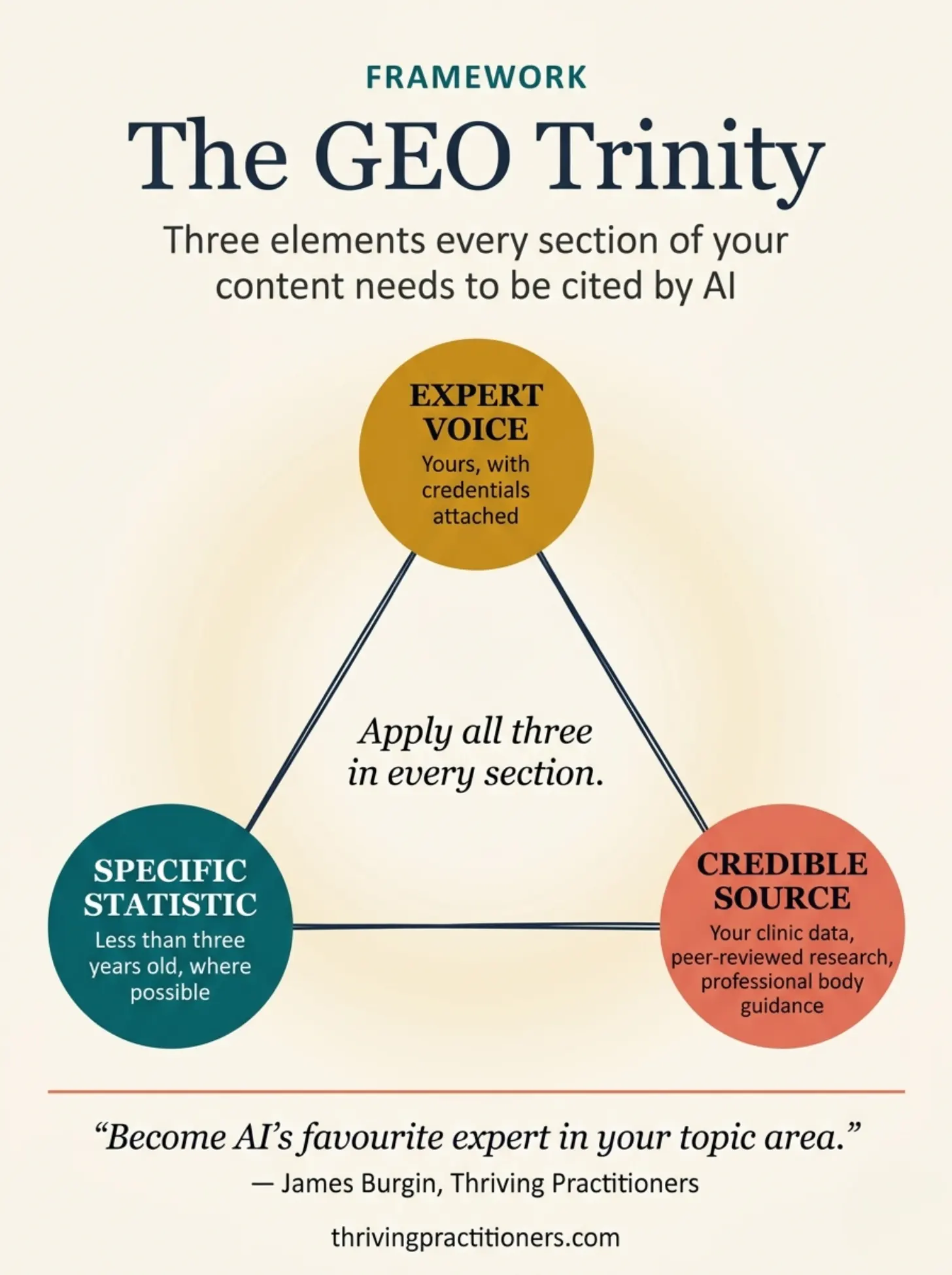
The six rules describe what to write. The GEO Trinity describes how to structure each piece so AI systems can extract and cite it.
Every section of your content should contain three elements:
- An expert voice, preferably yours, with credentials clearly attached
- A specific statistic or measured observation, ideally less than three years old
- A credible source, whether that is your own clinic data, peer-reviewed research, or professional body guidance
Apply the GEO Trinity to non-commodity content and you produce writing that is impossible to commoditise, easy for AI to cite, and clearly more valuable than the generic version a patient could get for free.
Step Two: From AI-Cited to Genuinely Chosen
The strongest test of any framework is what happens when you apply it to real practitioner content. Lisa Gumieniuk, whose Week-4 PTPV story appears in Rule 6 above, recently published a long-form article on memory reconsolidation. (You can read it here.) It is a useful teaching case, because it shows exactly what happens when the structural rules are applied beautifully but the deeper non-commodity rules slip.
This is the second step of the PTPV journey, and the one that is harder to see.
What is working
- The AEO architecture is textbook. H1 question, fifty-word direct answer, H2 questions throughout, FAQ section, Key Takeaway box, expert quotes with full credentials.
- The GEO Trinity is genuinely applied. Nader 2000 in Nature, Feinstein 2025 in Frontiers in Psychology, Zhang 2023 in Science Advances. Recent, peer-reviewed, expert-attributed sources.
- Two anonymised client case studies that nobody else could have written. “From 25 to 40 percent capacity in one session.” “My cells feel open. I want to keep them that way.” This is Rule 1 and Rule 2 at their best.
Structurally, this is better than ninety-five percent of practitioner content on the same topic. It is exactly what step one of the PTPV journey is meant to produce.
What stops it short of non-commodity
Read the same article through Rules 3, 4, 5, and 6, and a different picture emerges.
- Rule 5 (LLM Moats). Strip out the two case studies and the disclaimer, and most of the remaining 2,500 words are a competent synthesis of well-known material. ChatGPT could produce something eighty percent identical from a clear prompt. The proprietary content represents perhaps fifteen percent of the article’s length.
- Rule 4 (Strong Point of View). Try to finish any major section with the words “I won’t,” “I disagree with,” or “most programs get this wrong because…” You will struggle. The article agrees with the neuroscience, agrees with Ecker, agrees with Feinstein, agrees with all six modalities equally. There is no hard line. No risk. No alienation.
- Rule 6 (Information Gain). Google “memory reconsolidation chronic illness” and the existing top three results already contain the Nader study, the three-step Reactivation, Mismatch, Repetition sequence, the EFT mechanism explanation, and the window-of-tolerance framing. The two case studies are real information gain. The other 2,500 words are not.
- The voice gives it away. Lines like “It is not about forgetting or reliving the past. It is about giving your nervous system a new experience” repeat across the article in a parallel “it is not X, it is Y” cadence. That is one of the most recognisable signatures of AI-assisted prose. The article’s own footer notes that AI tools were used, so the question is not whether AI was involved. The question is whether the practitioner’s voice survived the polish.
This is the trap I want every PTPV graduate to watch for. AI tools can produce content that looks excellent and ticks every structural box, while quietly stripping out the two things that make content non-commodity: the practitioner’s hard line, and the patient detail nobody else has.
“Use AI as a writing assistant, not as a content generator. The non-commodity material has to come from you.”
–James Burgin
How I would lift this article
If this were sitting in front of me as a coaching draft, I would say three things, in this order:
- Halve the science explainer, double the case studies. The mechanism explanation competes with twenty other articles ranking on the same terms. The case studies do not compete with anything. The strongest version of this piece spends most of its words inside the consulting room, not the textbook.
- Replace the modalities bullet list with a strongly-held position. Right now there is a list of six modalities described neutrally. That is commodity content. The non-commodity version reads: “Here is why I lead with EFT in the first phase, why I rarely use Brainspotting with chronic fatigue clients in the early sessions, and why I will not move to EMDR-style work until a client has shown a regulated baseline for at least four sessions.” That is a moat ChatGPT cannot fill in.
- Find one sentence the practitioner would not dare write if she were trying to please everyone. Something like: “Most chronic illness programs activate the system before it has been resourced enough to update, and that is why so many clients relapse.” Then put it in. The point of view is the engagement.
The bones of this article are right. The voice is being quietened by the polish.
The journey from invisible to AI-cited is step one. The journey from AI-cited to genuinely chosen is step two, and it is written one hard line and one patient detail at a time.
Frequently Asked Questions
Will writing this kind of content actually increase patient bookings?
Yes, and faster than most practitioners expect. Within the first PTPV cohort, several practitioners reported new bookings, discovery calls, and AI citations within weeks, including some before they had finished implementing their full Visibility Gold Roadmap. Nicole Peasnell converted a discovery call to a full consultation within 24 hours of updating her About page using these principles.
How long does non-commodity content take to write?
A proprietary case study or firsthand article generally takes longer than a generic post on the same topic, because the raw material is your clinical experience rather than a quick AI summary. The trade-off is worth it. One specific, citation-worthy article will outperform ten generic ones for both AI visibility and patient conversion.
Do I have to write every word myself?
No. AI tools can structure, edit, and tidy your content. What they cannot do is supply the proprietary evidence, the firsthand observation, and the strong clinical position. Use AI as a writing assistant, not as a content generator. The non-commodity material has to come from you.
How do I do this without breaching TGA or professional body guidelines?
Stay in your scope of practice. Frame outcomes as observations or typical patterns rather than guarantees. Avoid therapeutic claims about specific products. Use the marketing language your professional association already approves. Specificity and compliance are not in conflict, they reinforce each other when handled well.
Where should I start if I have never written this way before?
Start with your About page and your single most important service page. Rewrite both using firsthand language, proprietary observations, and a clear point of view. Most PTPV practitioners saw their first AI visibility wins from these two pages alone.
Does this work for practitioners outside Australia?
Yes. The principles apply wherever AI search is being used, which is now most of the world. The PTPV cohort included practitioners across Australia and New Zealand, and the structural rules translate directly to UK, US, and European markets. The compliance language will need to match your local regulatory framework.
Your Next Step
Pick one piece of existing content. Read it through the six rules above. Mark every sentence ChatGPT could have written without your help. Replace those sentences with proprietary evidence, firsthand observations, and a position you actually hold. Publish, and watch what happens to your AI search results over the following weeks.
The practitioners who win in an AI-flooded world are not the ones who shout the loudest. They are the ones who write the things only they could have written.
“AI isn’t about replacing the human touch in healthcare, it’s about amplifying your authentic voice so more people can discover your healing gifts.”
–James Burgin, former naturopath and digital marketing strategist, founder of Thriving Practitioners
If you want a structured pathway through this, the next intake of Pathway to Practice Visibility walks you through the full process: a personalised Visibility Gold Roadmap, complete content templates, and live group sessions where you build your About page, service pages, and first GEO Trinity FAQ answer alongside other practitioners.