
Every week, you sit with people who are confused, scared, or exhausted by their health. You ask the right questions. You spot the patterns. You explain complex ideas in ways that finally make things click for them. And then the appointment ends, the notes get filed, and everything you just said disappears.
That conversation – the one that happened inside your consultation room this morning – is exactly what AI systems are looking for. It just never made it to your website.
The Content Problem That Isn't Really a Content Problem
When practitioners tell me they struggle to create content, I ask them one question: “What do your clients ask you most often before they book?”
Without exception, they have an answer. Usually several. The questions pour out – sometimes with a laugh of recognition, sometimes with a sigh of how often they say the same thing. “Does what I eat really affect my anxiety?” “Is it worth trying naturopathy if my doctor says my bloods are normal?” “How long before I start to feel different?”
These practitioners do not have a content problem. They have a translation problem.
The knowledge is there. The lived clinical experience is there. The authentic, specific, trustworthy voice that AI systems are actively looking for is there. It has simply not made the journey from the consultation room to the website yet. And until it does, no amount of browsing content ideas or scrolling for inspiration will close that gap.
“AI isn’t about replacing the human touch in healthcare – it’s about amplifying your authentic voice so more people can discover your healing gifts.”
James Burgin, Former Naturopath & Digital Marketing Strategist
Why Your Clinical Voice Is Exactly What AI Is Looking For
Here is something worth understanding about how AI systems decide who to recommend.
When someone asks ChatGPT or Perplexity, “Should I see a naturopath for IBS?” the AI does not just pull from any website that mentions naturopathy and IBS. It looks for content that demonstrates genuine expertise, specific clinical insight, and a clear, structured answer to the question. Content that adds something real. Content that could only have come from someone who has actually sat across from a patient with that problem.
This is what researchers and content strategists call information gain – the idea that AI systems reward content that adds unique value, not content that simply repeats what is already everywhere online.
Your clinical observations are, by definition, unique. The patterns you notice across dozens of clients with the same presenting complaint. The nuances you have learnt to listen for. The things you know from experience that do not appear in textbooks. That is not generic filler – that is exactly the kind of content that gets cited.
The only problem is that most of it is still inside your head.
The Gap Between What You Know and What You've Published
Think about the last client you saw with a complex presentation. You probably drew on years of study, clinical experience, and your own evolving understanding of that condition. You made connections. You asked questions nobody else had thought to ask. You offered a genuinely helpful perspective.
Now ask yourself: is any of that on your website?
For most practitioners, the answer is no. And it is not due to a lack of effort or intelligence. It is because the systems for capturing clinical knowledge and turning it into published content simply do not exist yet in most practices. So the expertise stays in the room, and the website stays thin, and Google – and AI – has very little to work with.
The good news is that this gap is far easier to close than it looks.
A Simple System for Turning Consultations into Content
You do not need to become a writer. You do not need to spend hours staring at a blank page. What you need is a way to capture what is already happening in your practice and give it a pathway to your website.
Here is a practical starting point.
The next time a client asks you a question you have answered before – and you will know it because you will feel that small flicker of “I say this to everyone” – make a note of it. Just the question and the essence of your answer. A voice memo on your phone works perfectly well. So does a quick note in the app you already use for clinical records.
At the end of the week, you might have three or four of these. Each one is a piece of content. Not a finished article – just the raw material. The question becomes your heading. Your answer becomes the body of the piece. Your clinical context – the “why this matters,” the “what I typically see,” the “here is what most people miss” – becomes the expert insight that no generic health website can replicate.
That structure, repeated consistently, is what AI systems are trained to surface as authoritative answers.
Using AI as a Transcription and Drafting Tool, Not a Ghostwriter
This is where AI tools genuinely earn their place – not as a replacement for your voice, but as a way to move your voice more efficiently from spoken word to published page.
A workflow that many practitioners find surprisingly effective goes like this. At the end of a consultation, or at the end of a day, record a two or three-minute voice note explaining something you covered with a client. No structure needed – just speak naturally, as if you are explaining it to a colleague. Then use a transcription tool to convert that audio to text, and paste it into Claude or ChatGPT with a simple prompt: “This is a voice note from a natural health practitioner explaining a clinical concept. Please turn it into a clear, readable blog section while keeping my voice and perspective intact.”
What comes back is a draft. Your draft, shaped from your words, is formatted for a reader rather than a listener. You review it, add anything that is missing, soften anything that sounds off, and publish it.
The whole process – from voice note to ready-to-publish content – can take less than twenty minutes. And the result is something no AI could have invented: content that is genuinely yours, grounded in real clinical experience, and formatted in exactly the way answer engines are looking for.
What This Looks Like in Practice
A naturopath who specialises in women’s hormonal health might spend five minutes at the end of a Tuesday clinic recording this: “I keep explaining to clients why they feel worse in the two weeks before their period, even when their progesterone is technically within range. The range is not the whole story. What matters is the ratio and whether their liver is clearing oestrogen efficiently. Most GPs are not looking at that.”
That voice note, transcribed and shaped into a short article, becomes a page on her website titled something like “Why You Feel Terrible Before Your Period Even When Your Hormones Test Normal.” It answers a question her ideal clients are typing into AI search right now. It demonstrates clinical expertise that only comes from years of practice. And it positions her, by name, as someone who understands something specific that most providers miss.
That is the content AI recommends. And it started as a Tuesday afternoon voice note.
The Shift Worth Making
Content creation does not have to feel like marketing. For practitioners who entered this field to help people, framing it that way often creates resistance. Understandably.
But consider this: when someone searches for answers about their health and finds a vague, generic article that tells them nothing useful, they are no closer to getting help. When they find your specific, experience-grounded explanation of exactly what they are going through – and a clear invitation to book a consultation – something genuinely useful has happened.
“I’ve learnt that the most successful practitioners aren’t necessarily the most talented clinically – they’re the ones who understand that helping people find you is just as important as helping them heal.”
James Burgin
Publishing your clinical knowledge is an extension of your clinical care. It just reaches people before they walk through your door.
Your First Step
This week, write down three questions your clients ask you repeatedly. Not the questions you think they should be asking – the ones they actually ask, in the words they actually use.
Those are three pieces of content. Three opportunities for an AI system to find you, understand what you do, and recommend you by name to someone who needs exactly what you offer.
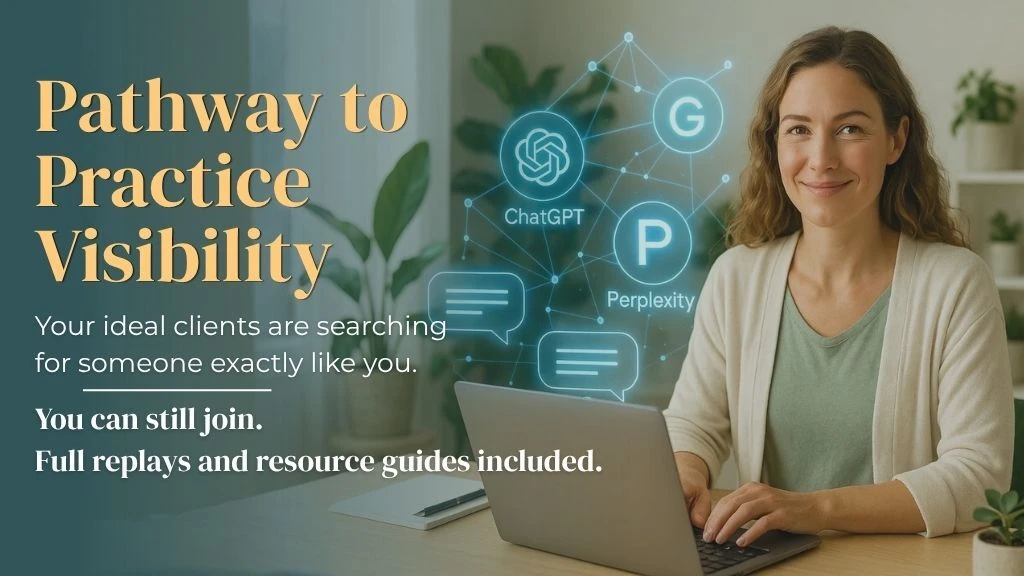
If you want help building a system for this – one that fits around a clinical schedule and does not require you to become a full-time content creator – the Pathway to Practice Visibility program is where we work through it together, with your own practice as the starting point.
About James Burgin James Burgin is the founder of Thriving Practitioners and a former naturopath and clinic owner with 15+ years of digital marketing experience. He created the Metaphysical SEO methodology and helps natural health practitioners across Australia build AI-powered practice visibility through ethical, practical content strategies.