
AI marketing for naturopaths means shaping your online presence so AI tools such as ChatGPT, Google’s AI Overviews and Perplexity can recognise you, understand what you do, and recommend you when someone asks for help.
It is less about chasing a Google ranking and more about becoming the answer the AI gives. The work has three parts:
- Help AI see you as a distinct, real practitioner
- Structure your content so AI can quote it
- Build the trust signals that make AI confident enough to name you.
If you have ever felt invisible online despite being excellent in clinic, this is the most important shift to understand in 2026.
The ‘front door’ to your practice is changing, and it is changing fast.
Your next client is asking an AI, not Google
The first conversation a person has about their health is increasingly with a chatbot, before any website is opened. ChatGPT alone reached around 900 million weekly users in 2026 (Reuters), and health is one of its largest uses.
OpenAI reported that roughly 40 million health questions are asked of ChatGPT every day, and that about one in four regular users sends a health-related prompt each week.
Your prospective clients are already there. The only open question is whether AI mentions you when they ask.
As I often say to the practitioners I work with:
“AI is not about replacing the human touch in healthcare. It is about amplifying your authentic voice so more people can discover your healing gifts.”
How is AI marketing different from old-style SEO?
Old SEO tried to win a click from a list of ten blue links – the links on the first page of a Google search.
AI marketing aims to get a mention within a single, synthesised answer. That is a different game with different rules.
Search has changed shape three times.
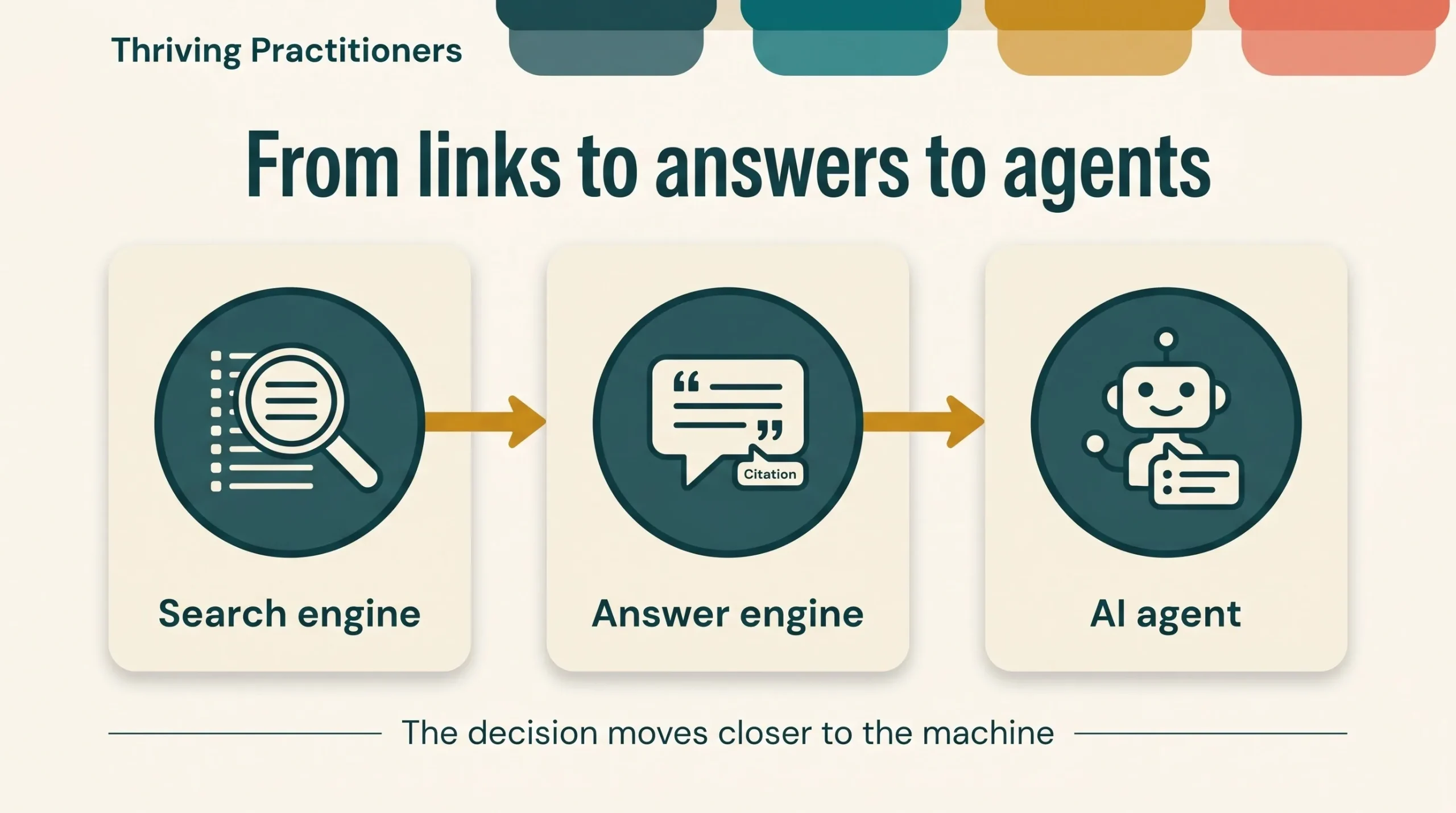
- First came the search engine, where a person browsed links and chose for themselves.
- Then came the answer engine, where tools like ChatGPT, Perplexity, and Google’s AI Overviews write a single answer and cite a few sources.
- Now we are entering the era of the AI agent, where the AI compares practitioners and shortlists them before a person ever sees a list.
Each step moves the decision further from your website and closer to the machine.
This has a name. Optimising to be the cited answer is called Answer Engine Optimisation, or AEO. Optimising specifically for AI-generated answers is often referred to as Generative Engine Optimisation (GEO). Both sit alongside traditional SEO rather than replacing it.
| SEO | AEO | GEO | |
|---|---|---|---|
| Full name | Search Engine Optimisation | Answer Engine Optimisation | Generative Engine Optimisation |
| Goal | Rank in a list of ten blue links | Be the cited answer in an AI summary | Be named or quoted by a generative AI tool |
| How AI sees you | One of many results | A trusted source | The recommended practitioner |
| Key signal | Backlinks + keyword relevance | Clear, answer-first content structure | Statistics + citations + expert voice |
| Where it shows up | Google organic results | Google AI Overviews, Bing Copilot | ChatGPT, Perplexity, Gemini |
| Best page type | Service pages, location pages | FAQ pages, explainer pages | Comparison pages, concern pages |
| Wins when you… | Build authority over time | Answer questions directly and plainly | Apply the GEO Trinity to every piece |
| For naturopaths | "Naturopath Sydney" rankings | "What does a naturopath treat?" answers | "Best naturopath for perimenopause" recommendations |
Good SEO is still the foundation for AEO and GEO.
A practitioner can succeed with ‘AI marketing for naturopaths’ by refining how they present their content online to satisfy humans, who want emotional resonance, and AI, which is looking for facts and well-structured content.
Why are my Google impressions not turning into clicks?
Because the click itself is shrinking. When Google places an AI summary at the top of the results, far fewer people click through to any website at all.
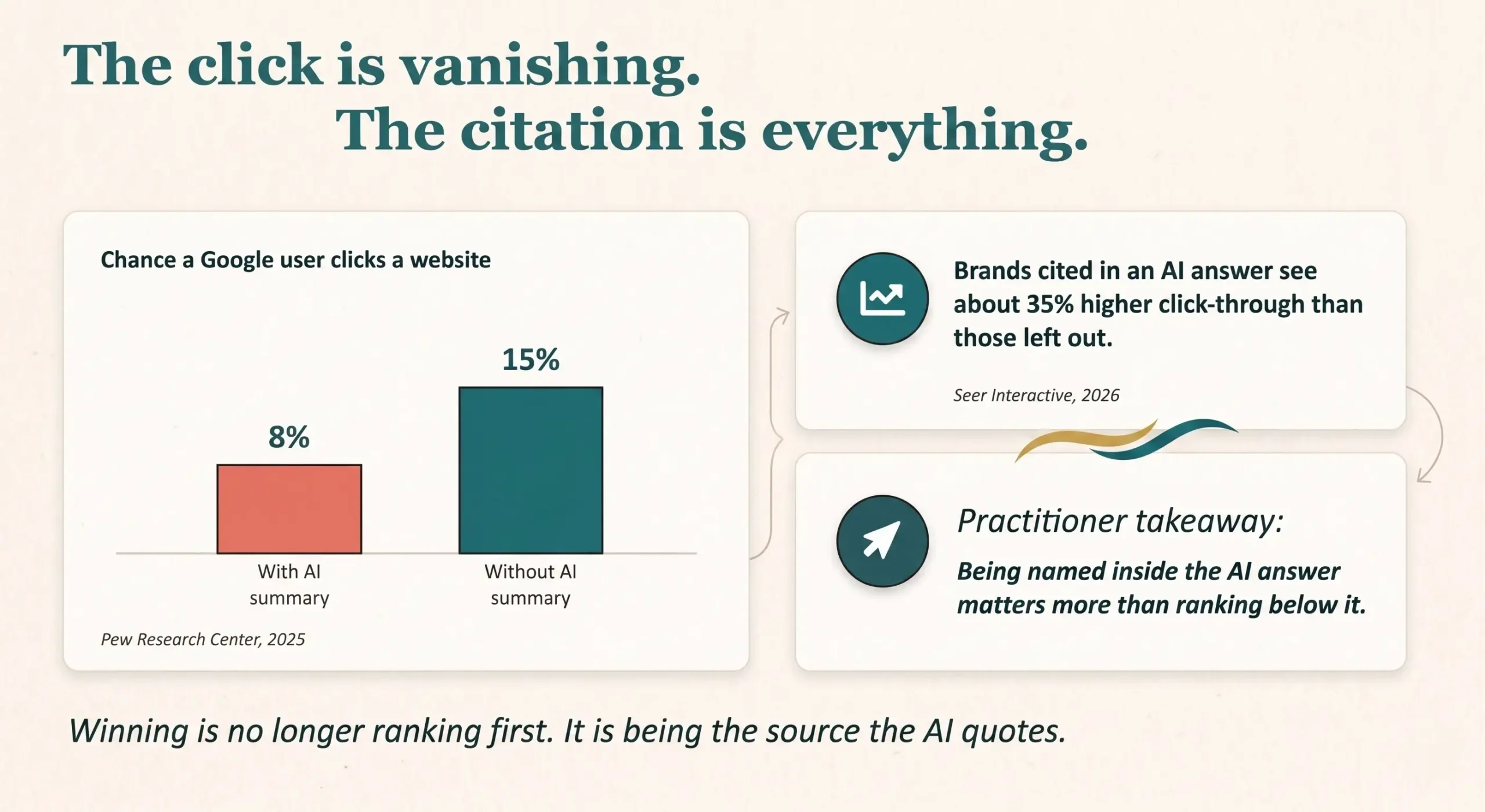
The Pew Research Centre studied tens of thousands of real Google searches in 2025. When an AI summary appeared, users clicked a traditional result only 8 per cent of the time, compared with 15 per cent when no summary appeared.
The links cited inside the AI summary were clicked just 1 per cent of the time. So a high-impression search term can deliver almost no clicks, not because your listing is wrong, but because the answer is being read on the results page instead.
The takeaway for naturopaths is simple and a little confronting. Winning is no longer about ranking first. It is about being the source of the AI quotes.
Well-structured, informative and authoritative content that also shows your experience and expertise can win the game.
The good news: AI cites the clearest, not the biggest
Here is the part that should encourage you.
Answer engines do not simply pick the largest brand with the biggest budget. They pick the source that is best structured, most specific, and easiest to trust.
Often, that is a smaller, well-focused practitioner site.
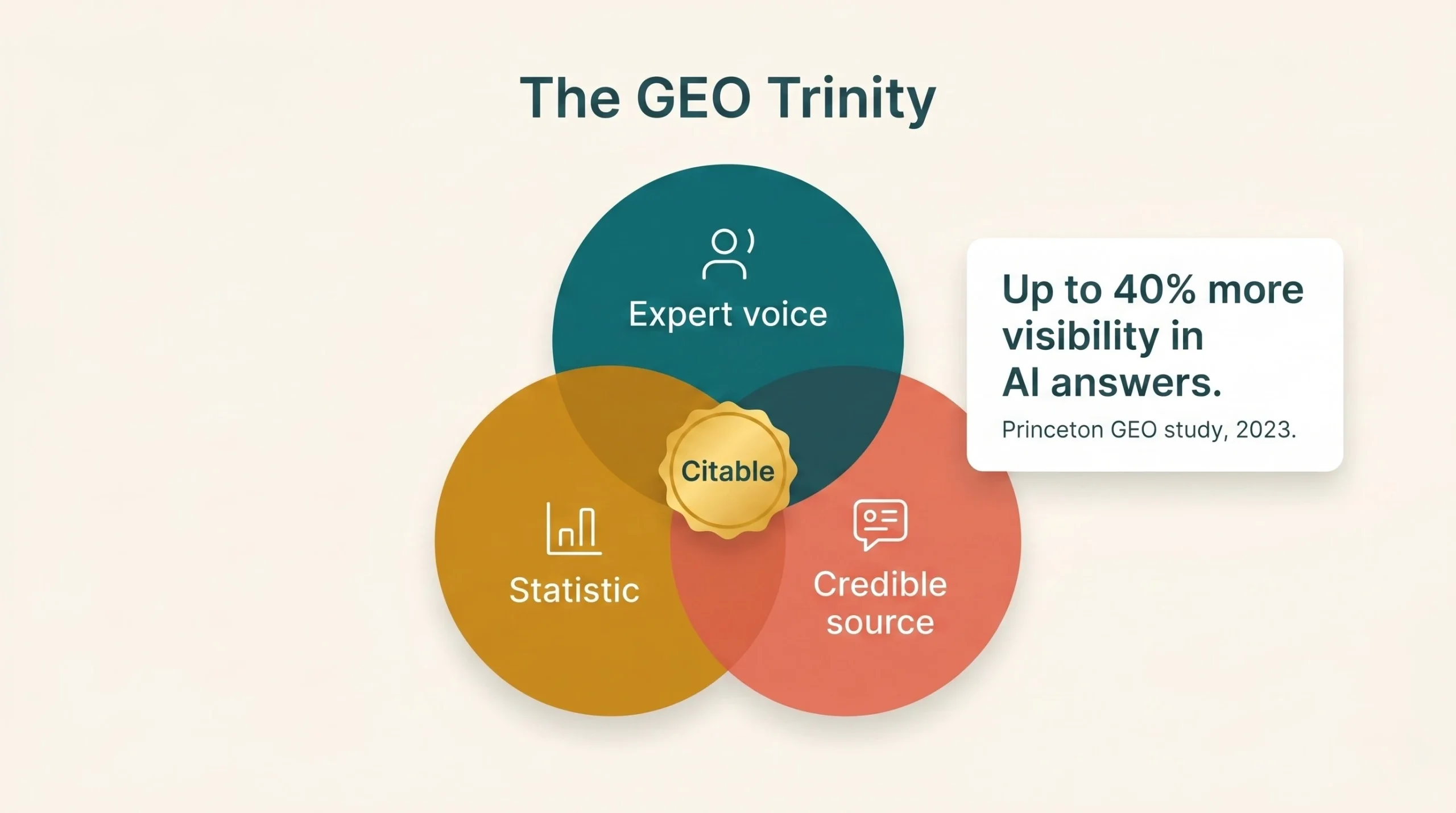
A Princeton study on Generative Engine Optimisation (Aggarwal and colleagues, 2023) found that adding clear statistics, quotations and citations from credible sources lifted a page’s visibility in AI answers by up to 40 per cent, and that smaller, lower-ranked sites gained the most from getting their content right.
Your clinical specificity – your clear niche focus – is an advantage that a generic health site cannot match. AI tends to cite the most specifically positioned practitioner, not the most comprehensive one.
The window to claim your niche is open now, and it will not stay open. The practitioners who establish their authority this year are the ones AI learns to recommend.
“This is the time to strike. In the early days of Google, businesses were climbing so fast and growing so fast. We are in the same early days of being recommended by ChatGPT, Perplexity or Google AI Mode. Even if you fast forward a year or two from now, while it will still be very doable to get ranking – it just becomes more competitive, it takes longer, and it becomes more expensive.”
~ Neil Patel, founder of NP Digital and co-founder of Crazy Egg, speaking to Campaign Asia, September 2025
Whether you are a naturopath, nutritionist, herbalist or other natural health practitioner, the method that follows is the same.
“Of the 800 million people who use ChatGPT each week, one in four submits a health or healthcare-related prompt each week. That comes out to about 40 million people per day. So this is an incredible opportunity, but it’s also a responsibility to treat these questions with the care and nuance that they deserve.”
~ Dr Nate Gross, co-founder of Doximity and VP of Health at OpenAI, speaking at the OpenAI Healthcare Forum, January 2026
How do I check what AI says about me? (the three-layer audit)
AI marketing for naturopaths needs and inital diagnosis, and then the right protocol.
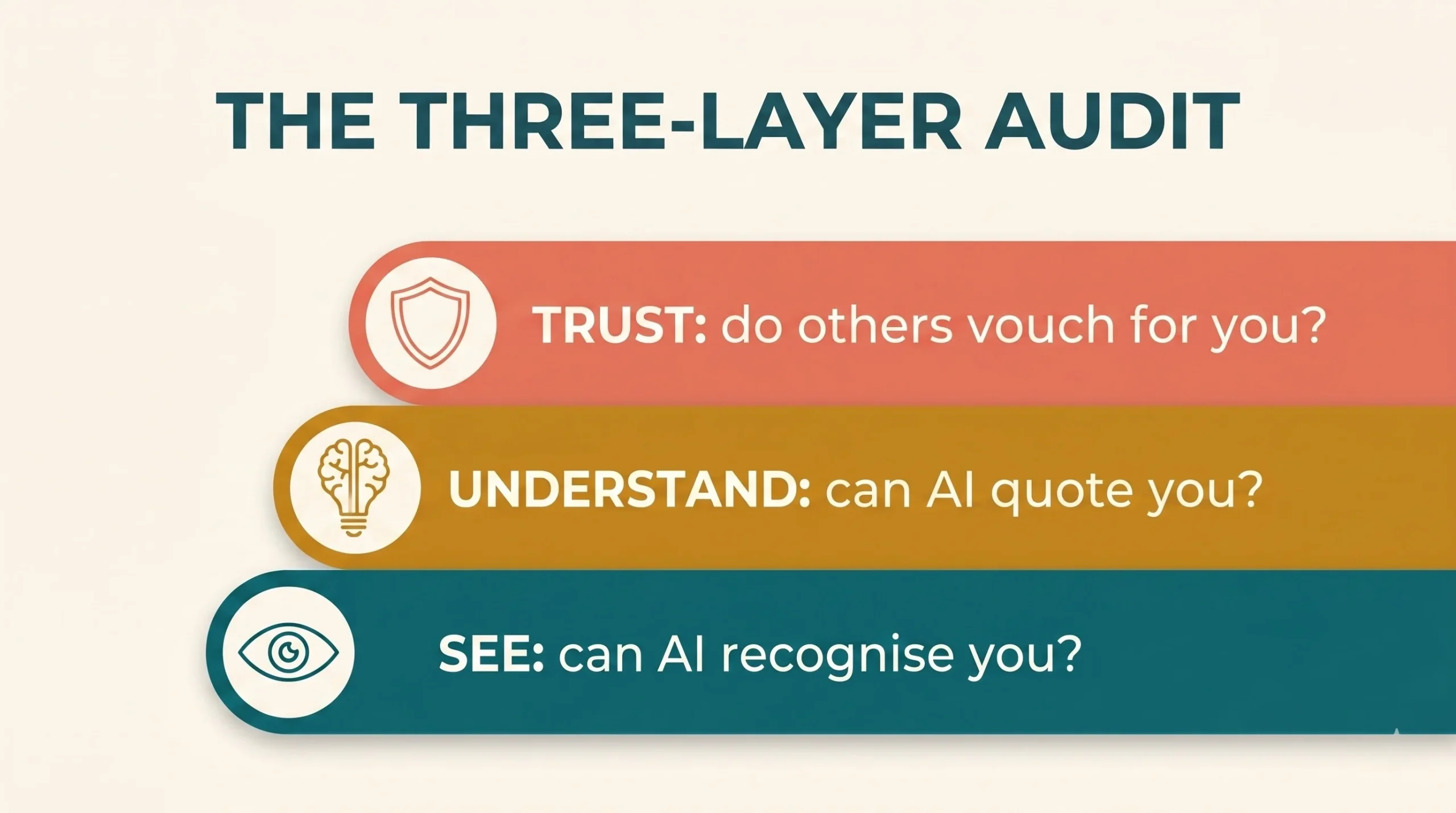
Before you change anything, audit across three layers. Ask one diagnostic question for each layer. A gap at any single layer is enough to keep you out of the answer.
Layer one, See. Can AI recognise you as a real, distinct practitioner? This depends on your name, location and specialty being consistent everywhere, a complete Google Business Profile, and content that carries a named author.
Layer two, Understand. Can AI extract clear answers from your content? This depends on question-led headings, plainly stated pricing and scope, open FAQs rather than hidden ones, and pages that answer the exact questions clients ask.
Layer three, Trust. Do sources AI already respects vouch for you? This depends on recent reviews, listings in reputable directories, your registrations and memberships, and radical transparency about how you work.
The mirror test you can run today
The fastest way to start is to ask the machines what they already say about you. Open ChatGPT, Google Gemini and Perplexity, and paste this prompt, filling in the brackets:
“I am a [specialty/modality] practitioner in [location]. My ideal clients are [who]. What are 15 questions these clients would ask an AI, and which practitioners would you recommend?”
For each answer, note four things.
- Are you named?
- Who is named instead?
- Where are the gaps?
- Which websites get cited?
Perplexity is especially useful here because it shows you its sources.
This one exercise becomes your entire content plan, because it shows you exactly where you are invisible and who is being recommended in your place.
For clear step-by-step guidance on this process, you may be interested in our program, Pathway to Practice Visibility…
Four moves that make a naturopath citable
Once you know your gaps, four moves turn them into citations. None of these requires you to be technical.
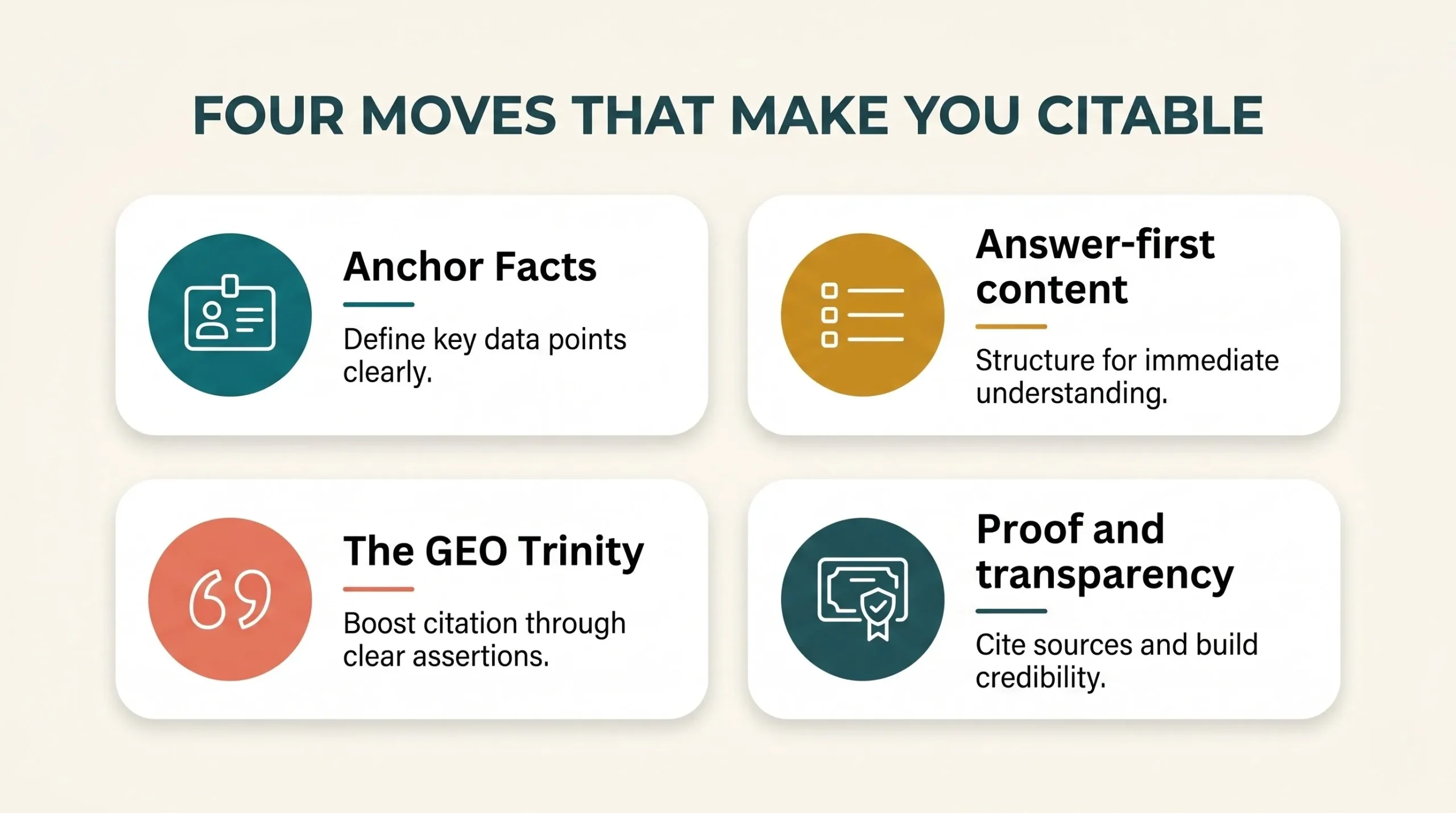
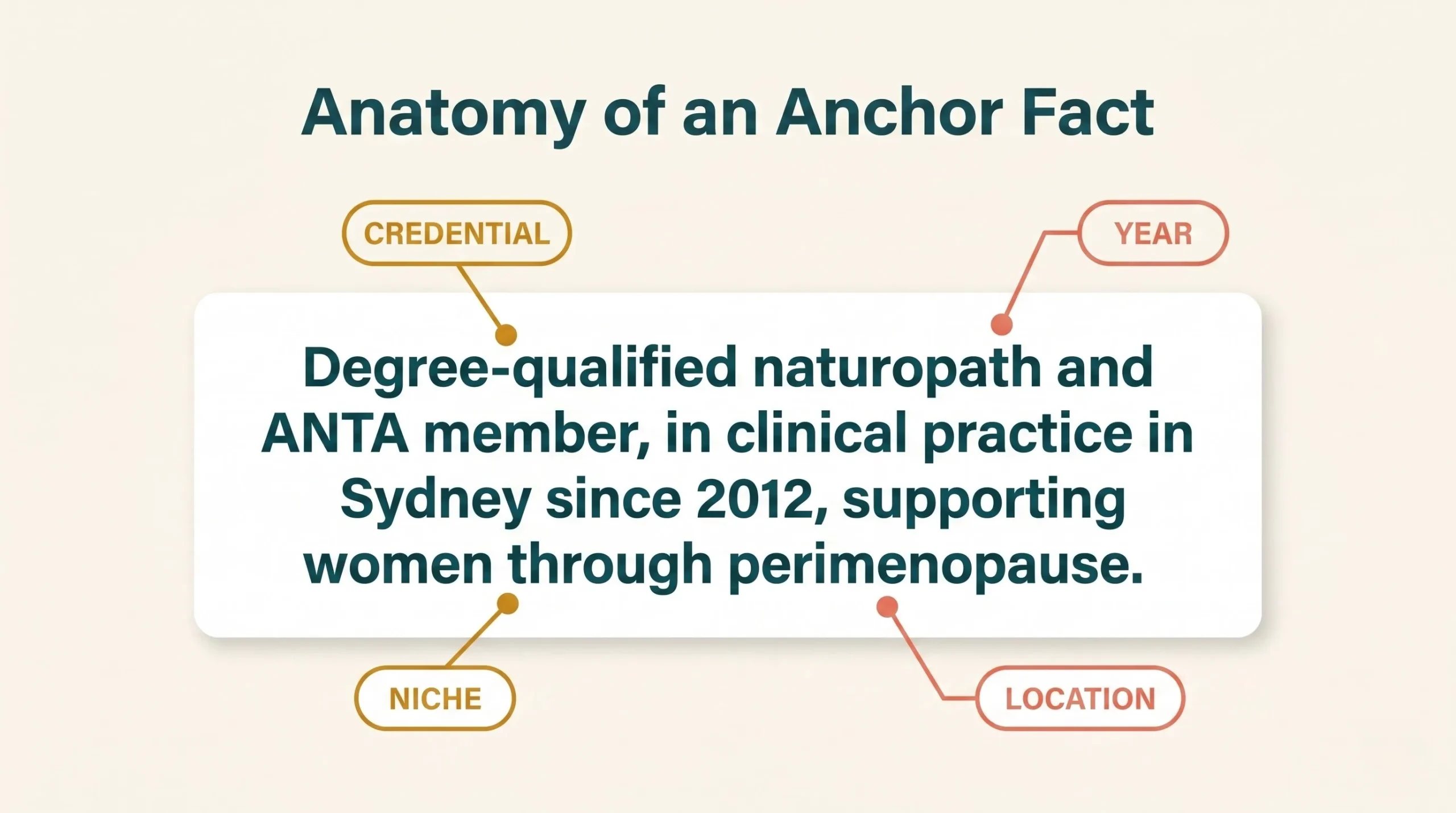
- Write your Anchor Facts. Anchor Facts are a small set of specific, verifiable statements about your practice that you repeat word for word across your website, bios, Google Business Profile and directories. Say the same true things in the same way often enough, and AI learns them as fact and repeats them back. “Degree-qualified naturopath and ANTA member, in clinical practice since 2012, supporting women through perimenopause” is an Anchor Fact. “Very experienced and passionate” is not.
- Lead with the answer. Structure each page around a real client question as the heading, then answer it plainly in the first sentence. Keep your FAQs open on the page rather than hidden inside click-to-expand widgets, because hidden content is harder for AI to read. Comparison pages, such as “naturopathy and your GP, how they work together”, are exactly the kind of pages AI reaches for.
- Use the GEO Trinity in everything you publish. In every piece of content, include three things: an expert voice, a statistic, and a credible source. This is the single most reliable way to get quoted by AI, and it is also, not by accident, simply good clinical communication. You will notice this very article uses the same approach.
- Show your proof and be transparent. Display your registrations, your reviews, your scope of practice and your process. Transparency is the basis of AI trust. It is what turns a passing mention into an actual recommendation.
Which pages get a naturopath cited?
Some page types earn citations far more often than a generic list of services. If you are deciding where to start, build these first.
Concern and support explainers. A clear, separate page for each thing you support, such as “Naturopathy for perimenopause: what to expect”. Lead with the question your client actually types, and keep the framing observation-based.
Context and comparison pages. Pages like “How naturopathy works alongside your GP” match the way people phrase questions to AI, and they are exactly the kind of balanced, transparent content answer engines like to quote.
What-to-expect pages. How a first consultation works, what testing might be involved, realistic timeframes, and your fees. Transparency here is rewarded twice, once by clients and once by AI.
Local pages. “Naturopath in [your town]”, with your Anchor Facts and Google Business details aligned word for word.
Each page should answer one real question completely, then link to the next related page. That hub-and-spoke structure is how a small, focused practitioner site earns authority across a whole topic, rather than relying on a single page to do everything.
Is AI marketing for naturopaths TGA compliant?
Yes, when it is done with care. AI marketing changes how people find you, not what you are allowed to claim. Every rule you already follow under the Therapeutic Goods Administration advertising code still applies to the content AI reads.
In practice this means framing your content around support and observation rather than cures, outcomes or guarantees. Describe what you do and who you help, not what you promise to fix. The reassuring news is that transparent, carefully worded, observation-based content is also exactly the kind of content AI trusts and cites. Compliance and visibility pull in the same direction, not against each other.
This is educational information for practitioners about marketing, and it is not a substitute for your own professional and regulatory obligations. Always check your claims against current TGA guidance and your association’s code.
Your first week: five quick wins
You can claim real ground this week with small, specific, repeatable actions.
- Run the mirror test in ChatGPT, Gemini and Perplexity, and save what you find.
- Complete and tidy your Google Business Profile.
- Write your Anchor Facts and paste them into your About page and bios.
- Turn your top five client questions into open, answer-first FAQ headings.
- Add one expert voice, one statistic and one credible source to your most important page.
Small and specific is how authority compounds. You do not need to do everything. You need to start being the clearest, most specific answer in your niche.
Frequently asked questions
Can naturopaths use AI for marketing?
Yes. Naturopaths can use AI both as a research and writing assistant and, more importantly, as a discovery channel to optimise for. The goal is to help AI tools recognise, understand and recommend your practice, while keeping all content within TGA advertising rules.
What is the difference between SEO, AEO and GEO?
SEO optimises to rank in a list of search results. AEO, or Answer Engine Optimisation, optimises to be the cited answer when an AI summarises. GEO, or Generative Engine Optimisation, focuses specifically on generative tools like ChatGPT and Perplexity. They work together rather than replacing one another.
How do I get ChatGPT or Google's AI to recommend my practice?
Make yourself easy to recognise, easy to quote and easy to trust. That means consistent Anchor Facts across every profile, answer-first content that addresses real client questions, and strong proof such as reviews, registrations and transparent information about your services.
Do I need to be technical to do AI marketing as a naturopath?
No. The highest-impact actions, such as running the mirror test, tidying your Google Business Profile, writing Anchor Facts and answering client questions clearly, require no coding at all. They simply require clarity and consistency.
Is AI going to replace naturopaths?
No. AI changes how people find practitioners, not the value of the human care you provide. Used well, it helps more of the right people discover your work. The practitioners who thrive will be those who use AI to amplify their authentic voice while protecting the integrity of their practice.
A year from now, I hope success feels like feeling less alone, less overwhelmed, feeling like you have a trusted place to make sense of things or prepare for conversations with clinicians – without feeling judged or talked down to.”
~ Dr Nate Gross, VP of Health, OpenAI – OpenAI Forum, January 2026
Is AI marketing for naturopaths TGA compliant?
Written by James Burgin, founder of Thriving Practitioners. James is a former naturopath and clinic owner who now helps natural health practitioners across Australia and New Zealand become visible in the age of AI search. He is the creator of the Metaphysical SEO and Answer Engine Optimisation methods taught through Thriving Practitioners.