Quick Answer: Yes – more than ever. AI tools like ChatGPT and Perplexity generate health recommendations by reading websites. If your website lacks depth, specificity, and well-structured content, AI has nothing to cite – and no reason to recommend you by name.
By James Burgin, Founder of Thriving Practitioners | Former Naturopath and Digital Marketing Strategist
Why Natural Health Practitioners Could Be Misreading the Traffic Drop
Many practitioners are watching their website visitor numbers decline and drawing a dangerous conclusion: that their website no longer matters.
The traffic drop is real. The conclusion is wrong.
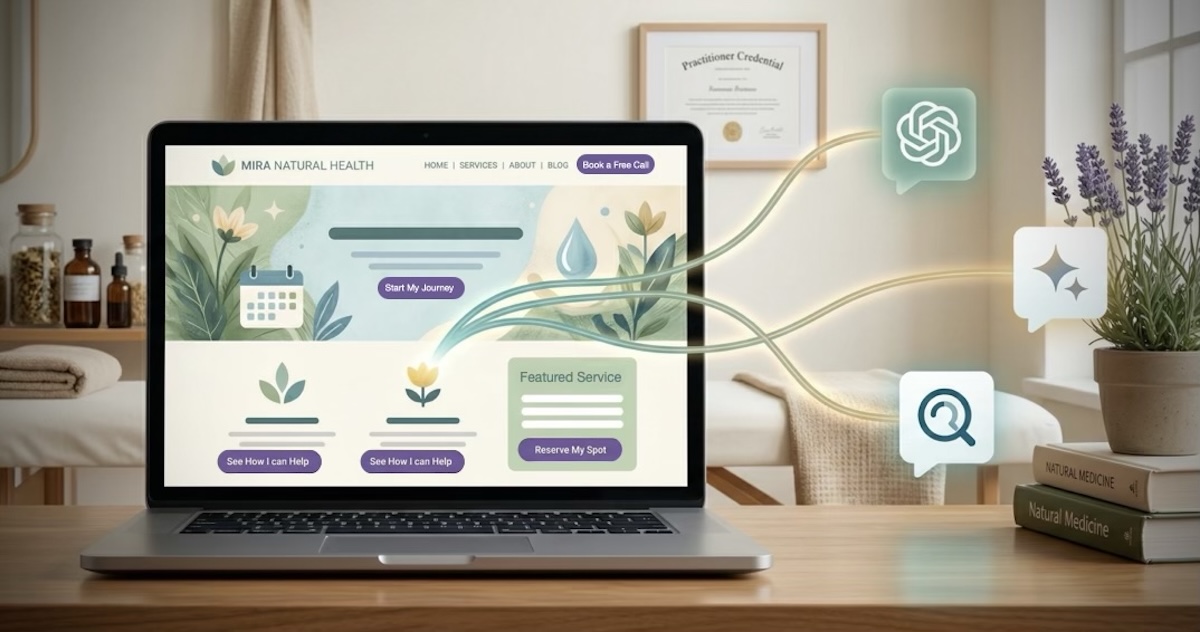
Traffic patterns are shifting because potential clients are increasingly getting initial answers directly from AI tools without clicking through to a website. But here is the critical thing to understand – every one of those AI answers had to come from somewhere, and that somewhere is a website.
“AI isn’t about replacing the human touch in healthcare – it’s about amplifying your authentic voice so more people can discover your healing gifts.”
James Burgin, Former Naturopath and Digital Marketing Strategist, Pioneer of AI-Powered Practice Growth
The practitioners who thrive over the next few years will be the ones who recognise this shift for what it is: not a threat to their website, but a fundamental change in what their website needs to do.
What Does AI Actually Do When Someone Searches for a Natural Health Practitioner?
Direct answer: AI tools read website content to build their recommendations. When a potential client asks “Can you recommend a naturopath in Brisbane who specialises in women’s hormonal health?” – the AI searches the web, reads relevant pages, and recommends the practitioners whose websites provide the most specific, credible, and helpful information.
Here is what this means in practice:
Is a Google Business Profile Enough for AI Visibility?
No. A Google Business Profile contains meta information – your location, hours, a short description. AI systems need far more than that to recommend you with confidence.
Think of it this way:
- A directory listing tells AI where you are.
- A well-structured website tells AI who you are, what conditions you work with, who you help best, and why someone should trust you.
There is an enormous difference between these two things.
Professional association listings and directory entries face the same limitation. They confirm your credentials but do not provide the detailed, specific, helpful content AI systems need to confidently surface your name in a recommendation.
Key insight: According to James Burgin, Founder of Thriving Practitioners and creator of the Metaphysical SEO methodology: “The question isn’t whether your clients use AI for health research. It’s whether AI mentions your practice when they do.”
What Is "Dark Traffic" and Why Does It Matter for Your Practice?
When AI recommends your practice by name, many potential clients will open a new browser tab and visit your website directly to investigate further. They want to see your face, read how you describe your work, and feel confident before making contact.
This is sometimes called “dark traffic” – visitors who arrive at your site without a referral source showing in your analytics. They came because AI pointed them your way, but the journey looks like a direct visit.
This has two important implications:
- Your website may already be doing more work than your analytics show
- The quality of what potential clients find when they land on your site matters enormously
If AI has recommended you and a curious potential client visits your website to find a vague homepage and a five-dot-point services list, you have just squandered that recommendation.
What Type of Content Does AI Prefer to Cite?
AI systems strongly favour content that is specific, plain-spoken, and directly answers real questions.
Pages built around vague language – “holistic healing journey,” “whole-person wellness approach” – without any concrete detail get passed over. Pages that explain exactly what you treat, who you work with, what outcomes are realistic, and what makes your approach different are the ones that earn citations.
The three highest-impact content types for practitioner AI visibility:
1. Dedicated service or condition pages
Not a single “Services” page with a list. Each condition or approach you treat needs its own page with genuine depth. A dedicated page on, say, hormonal health for women over 40 – covering what it involves, who it suits, and what makes your approach different – gives AI far more reason to recommend you specifically.
2. FAQ sections answering real client questions
When potential clients ask AI tools questions about their health, the AI looks for websites that have already answered those exact questions well. Practitioners with structured FAQ content covering the real questions their clients ask appear in those answers far more often.
3. A specific, credential-rich "About" page
Not a paragraph about your philosophy. A clear articulation of your qualifications, years of practice, areas of specialisation, and the specific populations you work with. AI systems need those signals to establish authority and trust.
Remember: Your website is now, in part, training data. Every page you publish teaches AI what your practice is about, what you know, and who you serve.
Why Does Your Website Matter More Than Your Social Media Presence for AI?
Your website is the only digital asset you fully own and control.
- Your Facebook page can be restricted
- Your Instagram account can be hacked
- Your Google Business Profile can be suspended
- Your listing on a professional directory can be removed if policies change
Your website, on a domain you own, with content you have written, cannot be taken from you.
For practitioners building practices intended to serve clients for years and decades, this is not a small distinction. Every other channel is someone else’s platform with someone else’s rules about what gets shown to whom.
AI answers are no different – the model decides what to include and whether to mention you at all. But you can significantly influence that decision by writing content worth pulling in. And the only place that content truly lives, in a form you control, is your website.
Frequently Asked Questions: Websites and AI Visibility for Natural Health Practitioners
Does declining website traffic mean AI is hurting my practice?
Not necessarily. Traffic patterns are shifting as more people get initial answers from AI tools directly. But many of those AI answers lead people to search for your name directly – arriving at your site as “direct” traffic rather than a tracked referral. Measure the quality and source of new client enquiries, not just raw traffic numbers.
How long does it take for website changes to improve AI visibility?
AI systems update their knowledge bases at varying rates. Well-structured content improvements can begin influencing AI recommendations within weeks to a few months, though this varies by platform and how frequently they crawl and re-index content.
Do I need a completely new website to improve my AI visibility?
In most cases, no. The most impactful improvements – adding dedicated service or condition pages, building FAQ sections, and strengthening your “About” page with specific credentials – can be made to your existing site. Structure and specificity matter more than a redesign.
Which AI platforms are most important for natural health practitioners to appear in?
ChatGPT and Perplexity are currently the most active AI health research tools used by consumers in Australia. Google’s AI Overviews (appearing at the top of Google search results) are also significant and draw from your existing website content and SEO signals.
What is the most important first step to improve my website's AI visibility?
Audit your service pages. If you do not have at least one dedicated, in-depth page for each condition or approach you specialise in, that is your most urgent opportunity. Specificity is what AI systems reward.
The Practical Shift: From Traffic Destination to Authority Document
Here is the reframe that changes everything.
Stop measuring your website’s value in visitor numbers alone. Start measuring it in AI citations, quality of enquiries from people who already feel they know you, and direct bookings from people who found you through AI tools.
Your website is no longer primarily a traffic destination. It is your most important authority document – the single richest source of information about who you are, what you do, and why someone should trust you with their health.
“I’ve learnt that the most successful practitioners aren’t necessarily the most talented clinically – they’re the ones who understand that helping people find you is just as important as helping them heal.”
James Burgin
The practitioners who maintain and deepen their website content right now are building an AI visibility advantage that will compound over the next two to three years. The practitioners who let their websites stagnate while chasing social media metrics are building on borrowed ground.
Your Next Three Steps
Step 1 – Audit your service pages. Does each condition or approach you treat have its own dedicated page with real depth? If not, that is your highest-priority opportunity.
Step 2 – Build FAQ content. What questions do your clients ask before booking? Write clear, specific answers to each one. This is the single most powerful thing you can add to your website for AI visibility right now.
Step 3 – Strengthen your “About” page. List your qualifications, years of practice, professional memberships, and areas of specialisation clearly and specifically. AI needs those signals to recognise and recommend you.
The 24-month window for natural health practitioners to establish AI visibility authority before this space saturates is still open. Your website is the foundation every other strategy is built on.
James Burgin is the founder of Thriving Practitioners and creator of the Metaphysical SEO methodology. A former naturopath and 18-practitioner Melbourne clinic owner, James helps natural health practitioners across Australia build AI-powered practice growth strategies. Learn more at thrivingpractitioners.com.