
Should AI in Practice be All or Nothing?
AI in your practice is not an all-or-nothing decision. Stanford researchers developed the Human Agency Scale, a five-level framework that maps how much of any task should sit with you and how much can sit with AI.
AI context for natural health practitioners…
- The consultation stays fully human
- Clinical thinking stays practitioner-led
- Marketing becomes an equal partnership
- Client education runs AI-led with your oversight
- Admin can be fully automated
Map your ten highest-value weekly tasks against these five levels and you will know exactly where AI belongs in your practice, and where it never will.
You have probably felt it. The quiet worry that using AI in your practice means handing over the very thing that makes your work matter: the human connection your clients come for.
So you either avoid AI altogether, or you use it for everything and feel vaguely uneasy about both.
Here is the good news. That all-or-nothing framing is the actual problem, and researchers at Stanford have given us a much better way to think about it.
What is the Human Agency Scale?
A five-level framework
The Human Agency Scale (HAS) is a five-level framework developed by Stanford University researchers in 2025. It measures how much of a task should sit with a human and how much with AI, ranging from H5 (fully human) down to H1 (fully automated). Instead of asking whether to use AI, it asks how much agency each task deserves.
The framework comes from a Stanford study on the future of work with AI agents, led by researcher Yijia Shao and colleagues.
Rather than treating AI adoption as a switch you flip, the researchers built a shared language for the space between doing everything yourself and automating everything away.
Business strategist Matt Kesby describes it neatly, using driving as a metaphor. Parking sensors help while you stay in control. Lane assist shares some of the work. Adaptive cruise takes over more while you keep watch. Some cars now drive themselves. You choose a different level of control for every journey, and Matt’s point is that AI in your business deserves the same choice.
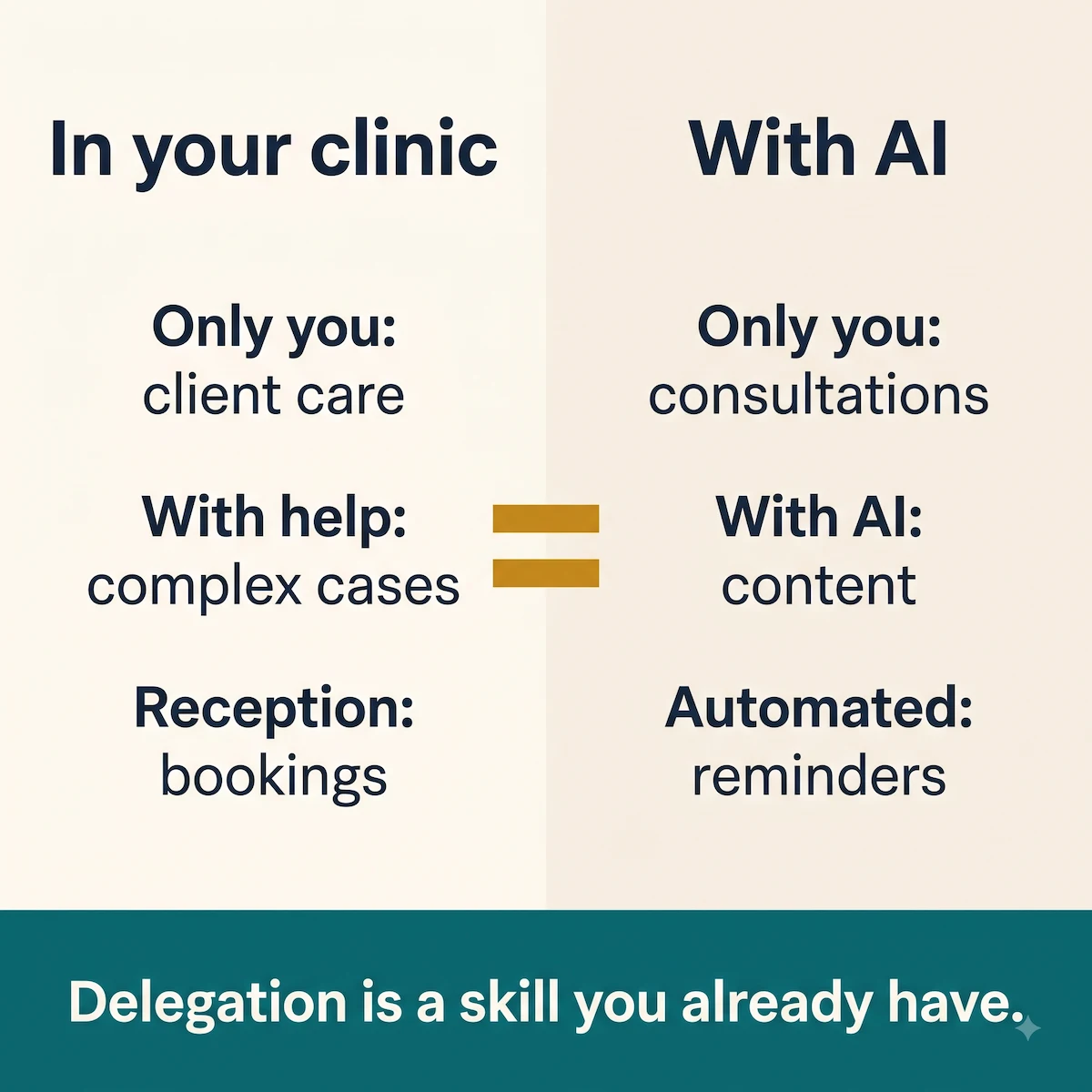
For practitioners, though, there is a frame even closer to home. If you have ever worked in or run a multi-practitioner clinic, you already make these decisions instinctively. Some things only you do. Some things a practice assistant helps with. Some things reception handles end-to-end without you having to think about them once. AI is simply a new team member who needs the same kind of job description.
What do the five levels look like in a natural health practice?
The short answer…
H5 is your consultation room, fully human. H4 is your clinical thinking, practitioner-led with AI assistance. H3 is your marketing, an equal partnership. H2 is client education and follow-up, AI-led with your oversight. H1 is your admin, fully automated. Each level matches the task, not the technology.
Here is the scale translated from the research language into your working week.
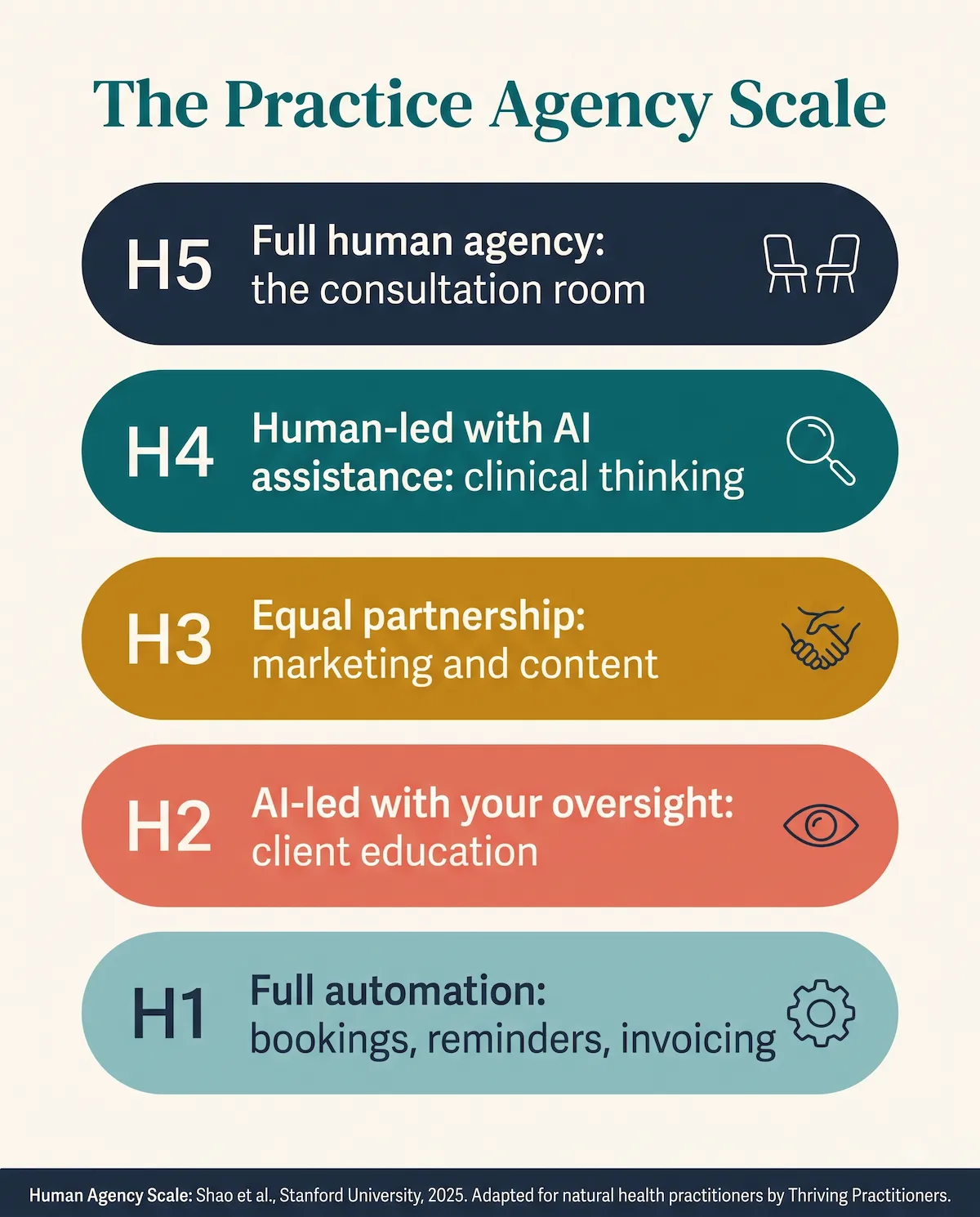
H5: Full human agency. The consultation room.
Case-taking, rapport, clinical intuition, hands-on work, and the moment a client feels truly heard. This is the irreplaceable core of your practice, and no part of it belongs to AI. Naming this clearly matters, because most practitioner anxiety about AI is really anxiety about this level. It is not up for negotiation, and it never was.
H4: Human-led with AI assistance. Your clinical thinking.
You own the reasoning behind every treatment plan. AI acts like a second set of eyes: helping you structure a complex case summary, surfacing questions you might want to ask at the next appointment, or organising your notes. Like parking sensors, it helps you see what you might have missed while you remain completely in control.
H3: Equal partnership. Your marketing and content.
This is where the leverage lives for most practitioners. You bring the clinical stories, the voice, the positioning and the lived experience. AI brings the drafting horsepower: turning one Q&A session into a blog article, a carousel and an email. Neither of you could do the job alone at the quality and pace you can do it together.
H2: AI-led with human oversight. Client education and follow-up.
Welcome sequences, appointment follow-up emails, FAQ answers on your website, article metadata. AI produces; you review before anything goes out. For Australian and New Zealand practitioners, this oversight step is not optional. Therapeutic goods advertising rules mean a human eye checks every claim before it is published, which is exactly what this level is designed for.
H1: Full automation. The admin layer.
Booking confirmations, appointment reminders, invoicing, calendar sync, review requests. Nobody’s healing work is diminished by automating an SMS reminder. This is the level where full automation is not a compromise. It is simply good practice management, and every hour it returns to you is an hour that can go back into H5.
Why is marketing the sweet spot for AI in a naturopathic practice?
The short answer
Marketing sits at H3, equal partnership, because it needs both your authentic clinical voice and AI’s production capacity. You cannot delegate your positioning, and you should not hand-write every draft. The partnership produces content that sounds like you, publishes consistently, and gets found by the AI systems your future clients are already asking.
Think about why client acquisition has always been hard for skilled practitioners. It is not a talent problem. It is a capacity problem. After a full clinic day, the blog article, the Google Business Profile update and the email to your list all compete with dinner and sleep. They usually lose.
An H3 partnership changes the economics of that evening. You speak your clinical insight once, in your own voice, and AI does the structural heavy lifting: the article draft, the headings that answer real client questions, the metadata, the social versions.
Your role shifts from producing every word to directing and approving the work, the same shift a clinic owner makes when the practice grows beyond one room.
There is a second reason marketing rewards this partnership. The way clients find practitioners is changing.
People increasingly ask AI systems for recommendations, and those systems cite practitioners whose content is specific, well-structured and clearly attributed.
Content built in an H3 partnership can be shaped for that from the first draft: question-format headings, direct answers, your credentials attached. Handwritten content rarely gets that treatment, because by 9 pm nobody has the energy for schema markup.
“AI isn’t about replacing the human touch in healthcare. It’s about amplifying your authentic voice so more people can discover your healing gifts.”
James Burgin, Former Naturopath and Digital Marketing Strategist, Pioneer of AI-Powered Practice Growth
Keep learning with the community
Exercises like the Practice Agency Map are exactly what we work through together in the Thriving Practitioners Growth Hub: weekly Friday Q&A sessions, a full replay library, step-by-step Action Plans, and a WhatsApp group where practitioners share what they are building. $49 per month, cancel any time.
What did the Stanford research actually find?
The short answer
The Stanford team gathered preferences from 1,500 workers and capability assessments from AI experts across more than 844 tasks in 104 occupations.
A key finding: workers often wanted more human involvement in tasks than experts judged the technology required.
Your instinct to protect the human parts of your practice is not technophobia. It is accurate task-matching.
The study, published through the Stanford Digital Economy Lab, built a database of real occupational tasks and asked two questions of each one:
- How much human involvement do workers want, and
- How much technology does it actually need?
The gap between those two answers is where the most useful insight sits.
In many cases, workers preferred a higher level of human agency than the experts considered technically necessary. Read that carefully, because it validates something our practitioner community already feels.
When a practitioner says the consultation must stay human, that is not resistance to progress. It is a worker who correctly identifies an H5 task in a world where pressure often pushes everything toward H1.
The reverse insight matters just as much. If you are still hand-typing appointment reminders or rewriting the same welcome email every month, you are doing H1 and H2 work by hand. The research suggests that the goal is neither more nor less automation. It is the right level for each task.
How did this work before AI existed?
The short answer
Delegation by agency level is not new. Any well-run multi-practitioner clinic already operates this way: the principal holds the clinical relationships, senior practitioners lead their own caseloads with support, and reception handles bookings end-to-end.
AI simply extends a familiar management skill to a new team member.
I learnt this long before AI arrived, running an eighteen-practitioner clinic in Melbourne. Nothing about that clinic worked until I stopped trying to maintain the same level of personal control over every task.
Client relationships stayed with the practitioners who owned them. Rosters, reminders and rebooking ran through systems and front-of-house without touching my desk. The clinic grew in direct proportion to how honestly I answered one question: what actually needs me?
That is the same question the Human Agency Scale asks, with better vocabulary. Practitioners who have never managed staff sometimes feel they are learning something foreign when they adopt AI. You are not. You are learning delegation, and the scale gives you the job descriptions.
“When I first discovered AI tools in 2022, I saw immediately how they could solve the biggest challenge facing practitioners: creating quality content consistently. But only if we use them to amplify our authentic voice, not replace it.”
In James’s words
The short answer
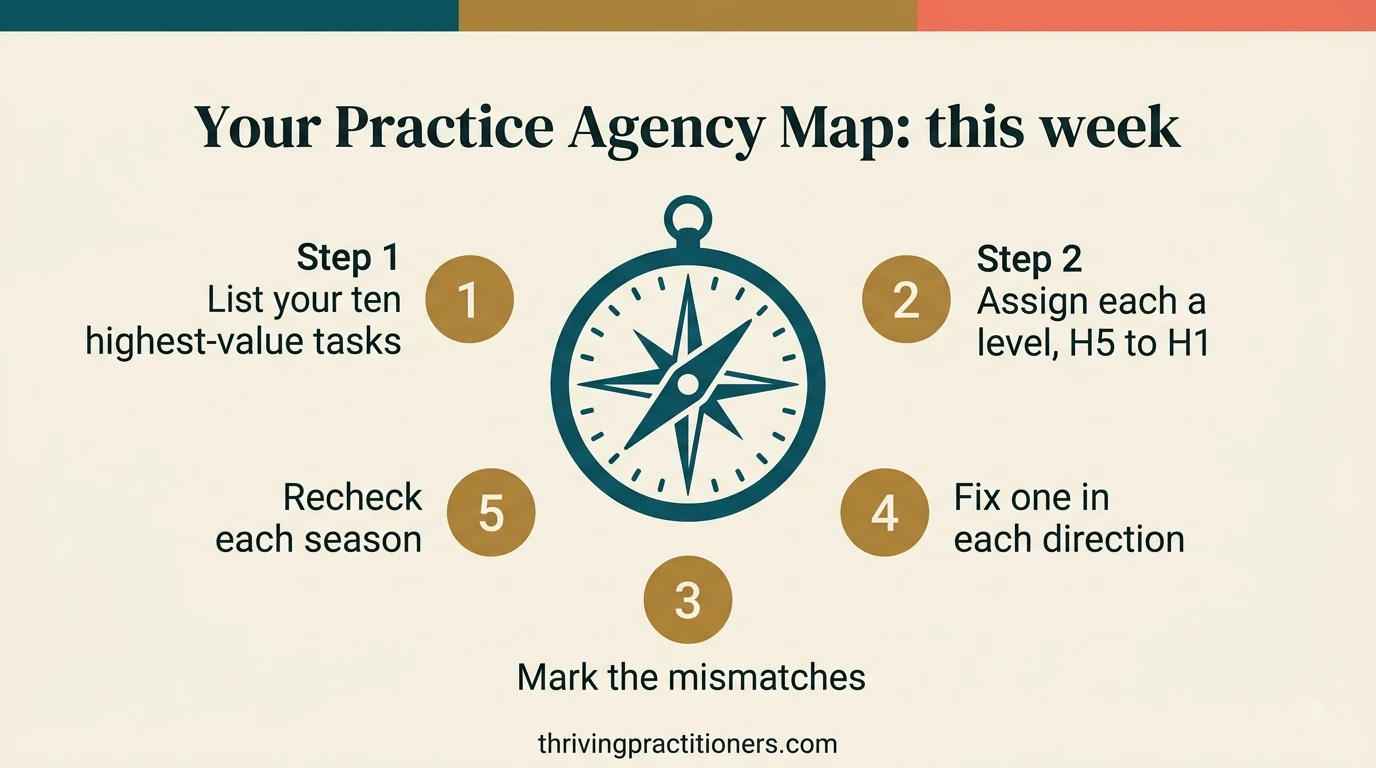
Build a Practice Agency Map: list your ten highest-value weekly tasks, assign each a level from H5 to H1, then compare it with how you currently work. Most practitioners discover they are doing H1 and H2 work by hand while worrying about levels AI was never going to touch.
- List your ten highest-value weekly tasks. Include clinical work, content, client communication and admin. Be specific: “write the fortnightly email” rather than “marketing”.
- Assign each task a level from H5 to H1. Ask one question per task: what does this task actually need from me? Your judgement, your voice, your oversight, or nothing at all?
- Mark the mismatches. Circle every task where your current way of working sits at a different level from where you just placed it. Hand-typing reminders is an H1 task done at H5. Publishing AI content without review is an H2 task run at H1.
- Fix one mismatch in each direction. Automate one thing you have been doing by hand and add your oversight to one thing you have been letting run unchecked.
- Recheck the map each season. As tools improve, some tasks move down the scale. Your H5 core never does.
Copy-paste prompt
Copy-paste prompt to run the exercise with AI: “Here are the ten highest-value tasks in my natural health practice each week: [list them]. For each task, help me decide which level of the Human Agency Scale it belongs at, from H5 (fully human) to H1 (fully automated), by asking me what each task actually needs from me. Then show me where my current way of working does not match the level we chose, and suggest the single easiest mismatch to fix first.”
Frequently asked questions
Where do I start if I want AI working at the right level across my whole practice?
Start with a structured pathway rather than scattered experiments. Our flagship course, Pathway to Practice Visibility, walks you step by step from digital foundations through to content that AI systems cite, so every level of the scale gets set up properly. The founding price of $399 rises to $499 on 1 September, so this winter is the moment to begin.
Will using AI at H3 for my marketing make my content sound generic?
Not if you hold up your side of the partnership. Generic content comes from giving AI generic input. When you supply your clinical stories, your positioning and your voice, AI structures and drafts while the substance stays unmistakably yours. The practitioners whose content gets cited by AI systems are the specific ones, never the generic ones.
Is it safe to let AI write client education content in Australia?
Yes, at H2, meaning AI produces and you review every piece before it is published. Therapeutic goods advertising rules require observation-based language and no outcome claims, and that compliance check is a human responsibility. The level exists precisely so you get the production speed without surrendering the oversight.
Which tasks should I automate completely first?
Booking confirmations, appointment reminders, calendar sync and invoicing. These H1 tasks have no human-connection value, consume real hours, and are the safest possible starting point. Most practice management platforms handle them out of the box once switched on.
Does the Human Agency Scale mean AI will eventually take over the higher levels too?
The levels describe what a task needs, not what technology can do. The Stanford research found workers often want more human involvement than experts judge technically necessary, and the consultation is the clearest example: clients seek you for connection and judgement, not information delivery. Capability rising does not move a task down the scale. Only the nature of the task can do that.
I have never managed staff or delegated anything. Can I still use this?
Yes, and you may find it easier than experienced delegators, because you have no old habits to unlearn. The five-step Practice Agency Map above assumes no management experience at all. One list, one honest question per task, one fix in each direction. That is the whole method.
Where to from here?
Pathway to Practice Visibility
Our flagship on-demand course for natural health practitioners: five weeks of practical, step-by-step training on becoming visible in the age of AI search, from your digital foundations to content that AI systems cite. Founding price $399.
Thriving Practitioners Growth Hub
Twice a month, free Friday Q&A sessions. A full replay library, step-by-step Action Plans, interactive client education resources for your website, and a WhatsApp group where practitioners share what they are building. All available for Growth Hub members $49 per month, cancel any time.
The question was never whether AI belongs in your practice. It was always which seat to give it, for which task, on which day. You have been making exactly these judgements about people your whole career. Now you have the vocabulary for making them about technology too.
James
Founder, Thriving Practitioners. Former naturopath, clinic owner and creator of Metaphysical SEO.
Attribution
The Human Agency Scale was developed by Yijia Shao and colleagues at Stanford University (2025) and published by the Stanford Digital Economy Lab. The driving analogy for AI agency levels is credited to Matt Kesby.