
In the last few months, five of the most powerful people in artificial intelligence said almost the same thing about 2026. Sam Altman from OpenAI. Jensen Huang from NVIDIA. Sundar Pichai from Google. Satya Nadella from Microsoft. Even Elon Musk. Different companies, different audiences, one shared message. And buried inside it is a shift that quietly changes how patients will find you.
The question has quietly changed
For years, getting found online meant one thing: ranking on Google. Practitioners were told to chase keywords and climb the search results. That advice is now incomplete.
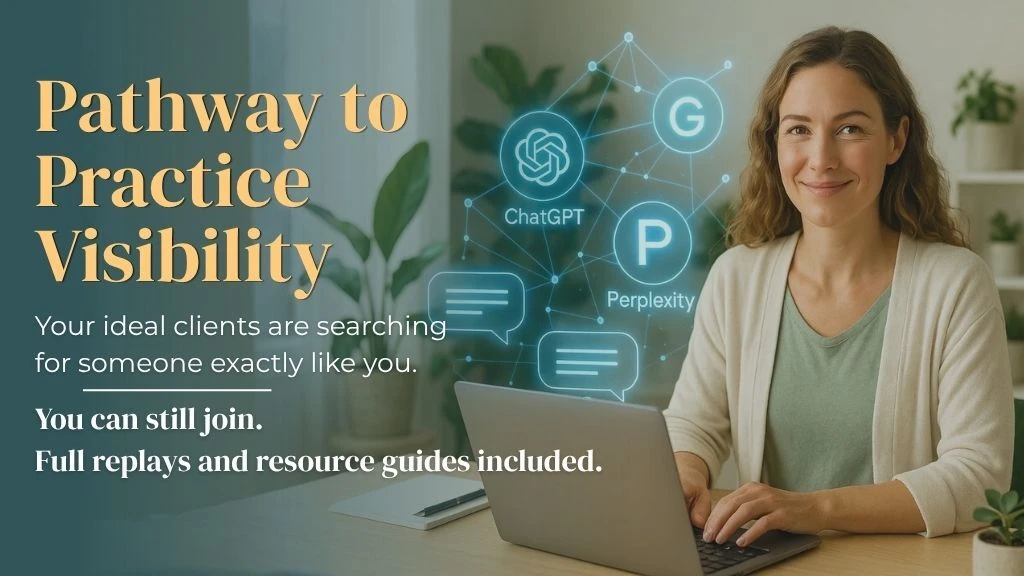
The new question is not “does my page rank?” It is “does the AI recommend me when someone asks for help?”
When a tired mum types “natural support for perimenopause near me” into ChatGPT, she does not scroll through ten blue links. She reads one answer. The AI has already done the research for her. It has decided who to mention and who to leave out.
If this feels like one more thing to worry about, that is fair. Most natural health practitioners spend years mastering clinical skills and far less time on marketing. You did not train to optimise content for machines. But here is the encouraging part: this shift actually rewards the practitioners who have been overlooked. Clear, genuine, well-explained expertise is exactly what these systems are looking for.
James Burgin’s perspective
James Burgin has watched the natural health industry move through every major change of the past two decades, from print to web, web to mobile, and now from search to AI. As a former naturopath and clinic owner turned digital strategist, he sees this moment clearly.
We’re entering an era where timeless wisdom meets cutting-edge technology. The practitioners who thrive will be those who embrace AI as a tool to amplify their authentic voice while maintaining the integrity of their healing practice.
James Burgin, Founder, Thriving Practitioners
The signal from those five AI leaders is consistent. They have stopped talking about AI models and started talking about AI systems and agents. In plain terms, AI is moving from a clever tool you open now and then to an assistant that researches, compares and recommends on a person’s behalf. That assistant pulls its answers from somewhere. The opportunity for practitioners is to become a source it knows, trusts and names.
Three shifts, translated for practitioners
You do not need to follow every twist in the AI industry. You only need to understand three shifts and what they mean for your practice.
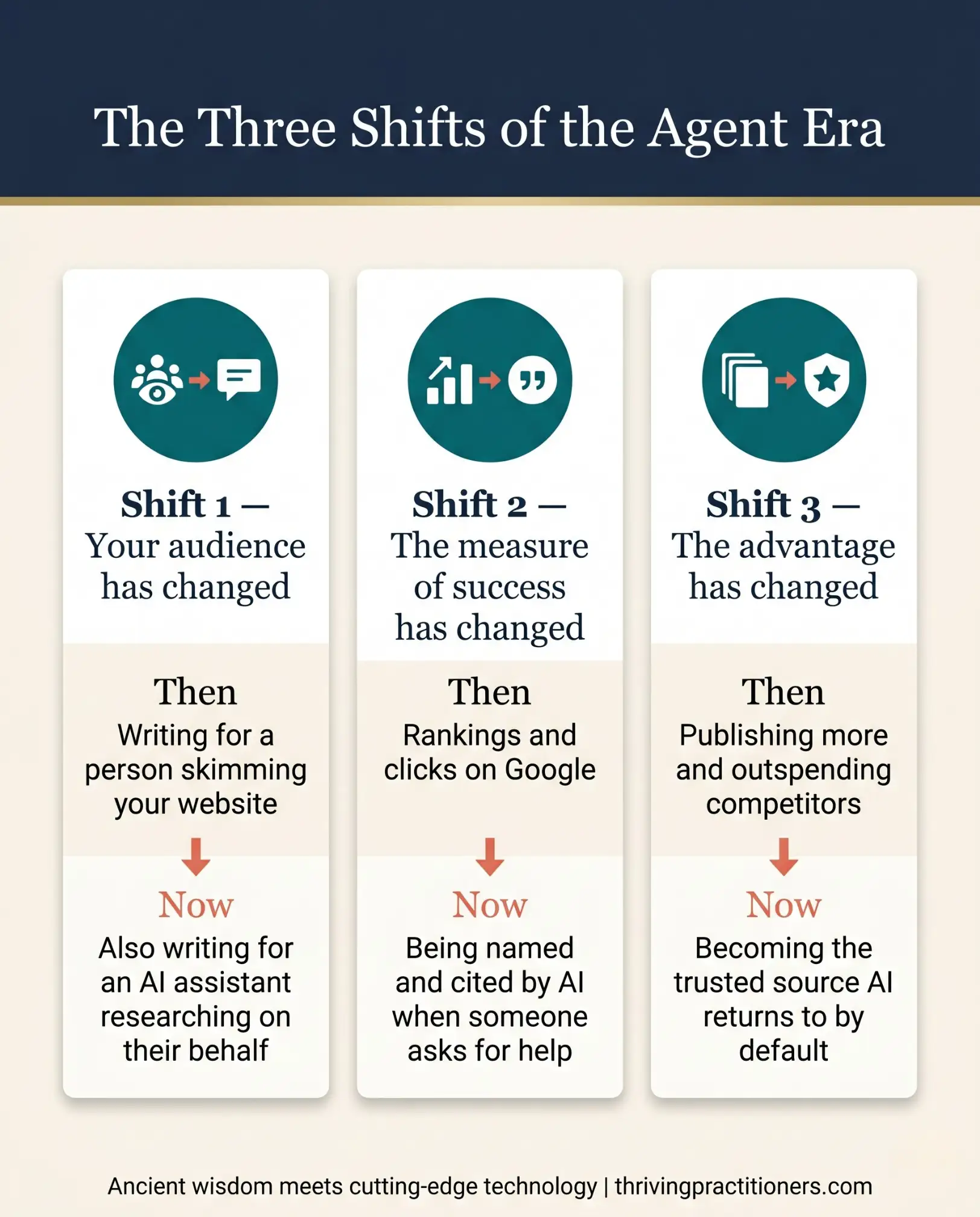
1. Your audience has changed
You are no longer writing only for a person skimming your website. You are also writing for an AI assistant reading on that person’s behalf. People skim. AI dissects. It looks for clear answers it can lift out and trust. Content that buries the point in paragraph twelve gets passed over. Content that answers the question clearly, near the top, gets cited.
2. The measure of success has changed
Rankings and clicks used to be the scoreboard. In the agent era, what matters is whether AI mentions you by name when someone asks a relevant question. Marketing strategist Neil Patel of NP Digital reports that businesses investing in this kind of optimisation saw their return move from negative 28 percent in 2024 to positive 144 percent in 2025. Same approach, one year later, a very different result. He also notes that while AI platforms still send only a small share of website traffic, that traffic tends to convert at a much higher rate than ordinary search, because the visitor has already been pre-qualified by the AI.
3. The advantage has changed
The old advantage was publishing more and outspending everyone. The new advantage is becoming the trusted source AI returns to by default. That is not built with one clever post. It is built with a simple, consistent system: clear, well-sourced content, published regularly, in your real voice.
What AI still cannot do
Here is the part worth holding onto. An AI assistant can tell someone their iron is low. It cannot sit with them and explain why, notice the patterns in their life that contributed, or adjust the plan as their body responds. It cannot hold space for healing. That is your work, and it is safe.
This shift is not about competing with AI. It is about partnering with it, so more of the right people find their way to your door. That is exactly why Thriving Practitioners exists. The frameworks we teach, from the simple AI audit to the GEO Trinity, are built to make a busy practitioner’s genuine expertise visible to the systems patients now rely on. There is also a real window here. The practitioners who build a clear, citable presence over the next couple of years will hold an advantage that is hard for latecomers to undo. Early movers compound. Late movers scramble.
Three things you can do this week
You do not have to do everything at once. Start small and let it build.
- Run a quick AI audit. Ask ChatGPT, Google Gemini and Perplexity a question your ideal client would ask, such as “who can help with gut health in [your town]?” Note whether you are mentioned, and who is.
- Write one citable answer. Pick a single real client question and answer it clearly at the top of a page. Then add the GEO Trinity: an expert quote, a recent statistic, and a credible, named source.
- Think in systems, not bursts. Commit to one quality post a week. A steady rhythm beats an occasional flurry every time.
Give it a few weeks. We have seen practitioners start to show up in AI answers faster than they expected.
Questions practitioners are asking
Is SEO dead for natural health practitioners?
No. Search is not dying, it is changing shape. The work shifts from chasing a keyword ranking to becoming the clear, trustworthy source that AI selects when it answers a patient’s question.
Do I need to be technical to do this?
No. If you can answer a client’s question clearly in conversation, you can do this. The skill is clarity, not coding.
Where should I start?
With an AI audit. Ask the main AI platforms what they say about your specialty in your area. That single step shows you exactly where the opportunity is.
Your next step
Inside the Growth Hub, this article comes with a companion Action Plan that walks you through these three steps in detail, with prompts and niche-specific examples. If you are ready to move from worried to prepared, that is the place to start. And if you want to go deeper, the AI Summit for Natural Health Practitioners in September is built for exactly this moment.
The future is not something happening to you. It is something you can prepare for, starting this week.