
A practical walkthrough of pillar-and-spoke content development for natural health practitioners, using brain health as the worked example.
By James Burgin, former naturopath, digital marketing strategist, and creator of Metaphysical SEO. Founder of Thriving Practitioners.
A content cluster is a connected group of articles, FAQs and a service page all built around one topic, with internal links pointing back to a central pillar page.
For practitioners, content clusters are the fastest way to make Google and AI systems see you as the authority in your niche, because they reward topical depth, not topical breadth.
Write Smart Blog Posts to Get Found and Build Authority
- A content cluster is one pillar page plus 8 to 12 spoke articles plus an FAQ hub, all interlinked.
- Brain health is the perfect worked example because the high-volume search traffic sits at the symptom layer (brain fog, forgetfulness), not the disease layer (dementia).
- You can brainstorm a full cluster in under fifteen minutes using Claude with three prompts: frame the topic, voice in the symptoms, ask for a structured table.
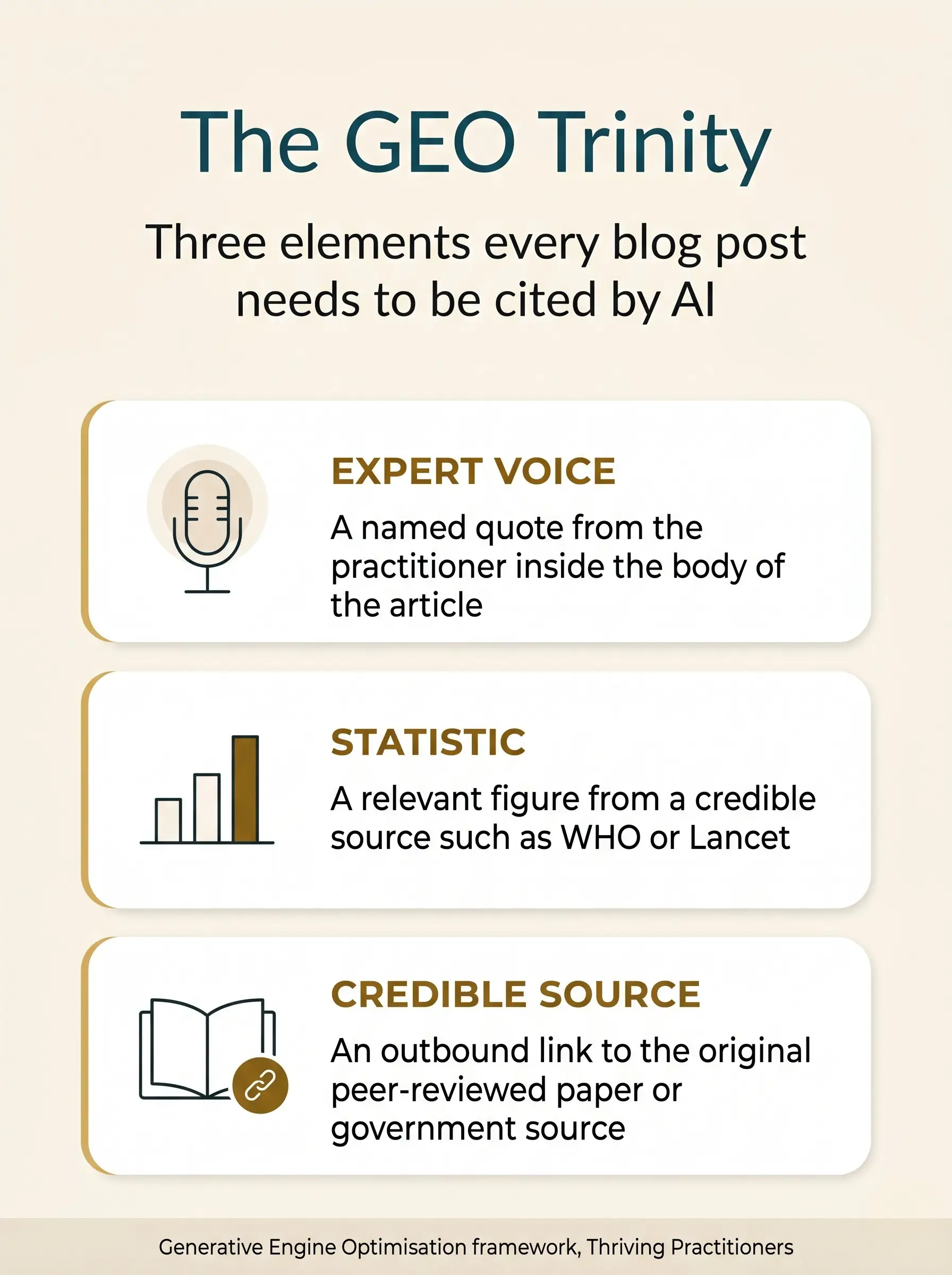
- Apply the GEO Trinity to every piece: an expert voice, a statistic and a credible source.
- Name your signature framework. Without one, you are interchangeable. With one, AI systems pin authority to you.
Why content clusters matter more than ever
There was a time when ranking on Google meant writing one really good article and waiting. That time is over. Both Google and the AI search engines (ChatGPT, Perplexity, Claude, Gemini) now reward depth on a topic far more than they reward depth on a single page.
What that means in practice for a natural health practitioner is simple. You no longer compete on the strength of one blog post. You compete on the strength of a connected library of content that demonstrates you have walked all around a topic. The technical name for that library is a content cluster, sometimes called a pillar-and-spoke model or hub-and-spoke topic structure.
The practitioners who thrive will be those who embrace AI as a tool to amplify their authentic voice while maintaining the integrity of their healing practice.
James Burgin, Thriving Practitioners
What does a content cluster actually look like?
A content cluster is built around three layers:
| Layer | What it is | How many |
|---|---|---|
| Pillar page | A long, comprehensive page that covers the entire topic at a strategic level. Usually doubles as a service pages that convert. | 1 |
| Spoke articles | Focused blog posts that each answer one specific question or sub-topic. Each spoke links back to the pillar. | 8 to 12 |
| FAQ hub | A question-heavy page with 20 to 30 short, conversational answers. Catches voice search and AI Q&A. | 1 |
All three layers are interlinked. The pillar page links out to every spoke. Every spoke links back to the pillar. The FAQ hub links to whichever pieces dig into a particular answer in more detail. This is the structure that signals topical authority to both Google and the language models.
Why brain health is the perfect worked example
In a recent Friday Q&A session, a practitioner named Julie shared that she was interested in brain health and brain fog but had not committed to a niche yet. We used her topic as a live demonstration of how to build a cluster, and the result was instructive enough that it deserves its own write-up.
Brain health works as a teaching example because it sits at the intersection of three big trends practitioners can credibly address: midlife hormonal change, post-COVID cognitive concerns, and the rising “I am worried about my parents (or myself)” sandwich-generation conversation. The most important strategic insight is this:
Lead with the symptom, not the disease
Most of the search traffic happens at the symptom layer (brain fog, forgetfulness, trouble concentrating) before anyone ever types “dementia” into a search bar. Practitioners default to “dementia prevention” content because that is where the clinical risk sits, but that is not where the searches are. Build the awareness-stage content for the symptom searches and let it ladder up to the prevention pieces.
Step 1: Brainstorm the cluster with Claude
You do not need to outline a cluster from a blank page. Claude (or ChatGPT, or any modern AI assistant) will scaffold one for you in under fifteen minutes if you prompt it well. Three parts to the prompt, and the second part is where most practitioners go wrong.
Part 1: Frame the topic
Set the scene in plain language:
We want to brainstorm topics for helping our audience with brain health and to prevent brain health challenges such as dementia and Alzheimer’s. What we are noticing is that these conditions are showing up at younger and younger ages.
Topic frame
Part 2: Voice in the symptoms
Hit the microphone button and speak the symptoms out loud. Do not type them. The reason is the same reason we record consultation notes from voice rather than typing them: speech captures clinical reality more honestly than the keyboard.
Some of the symptoms I am noticing in my practice are memory loss, brain fog, a degree of confusion, and trouble concentrating.
Voice prompt example
You can ramble. You can pause. You can come back to it. AI tools are excellent at cleaning that up. The only thing they cannot improve is generic typed input.
Part 3: Ask for structure
What are brain health topics to help our audience? Please build a list of topics presented in a table including keyword ideas, the prompts that people might be putting into ChatGPT, Perplexity or Google Gemini, and suggest ways we can build content for attracting this audience into my practice.
Structure request
Why this prompt works
You have given Claude three levers in a single prompt. The clinical list anchors it in real practice language. The structured table forces it to think in distribution channels. The “attracting this audience into my practice” framing keeps the output commercially useful instead of academically interesting.
Step 2: Review the cluster Claude returned
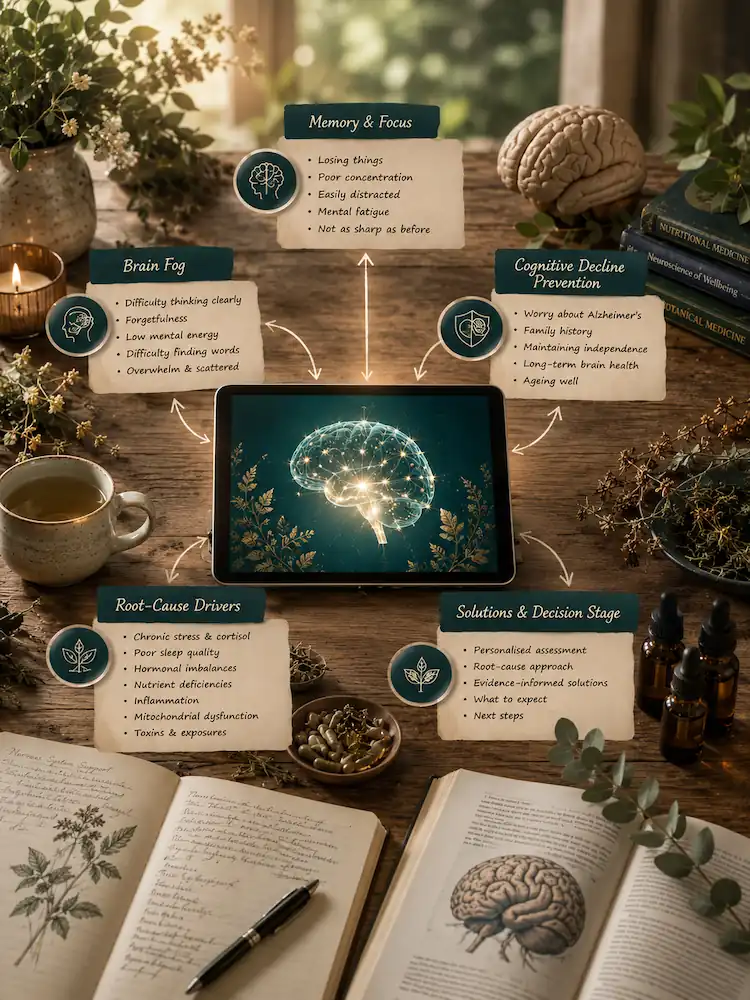
In the brain health demonstration, Claude organised its output into five clusters. The pattern of the five clusters is what matters, because that pattern repeats for almost any niche you choose:
| Cluster | What it serves | Funnel stage |
|---|---|---|
| Brain Fog | The current pain entry point. Highest search volume. | Awareness |
| Memory and Focus | The "is this normal?" worry. | Awareness |
| Cognitive Decline Prevention | Future-self framing. Higher anxiety, higher intent. | Consideration |
| Root-Cause Drivers | Sleep, stress, hormones, nutrients, mitochondria, toxins. | Consideration |
| Solutions and Decision Stage | What to expect from a consultation. Service-page aligned. | Decision |
You will recognise the funnel staging from the Pathway to Practice Visibility course. TOFU (top of funnel) maps to awareness. MOFU (middle of funnel) maps to consideration. BOFU (bottom of funnel) maps to decision. Every cluster needs content at each stage so that you are present whether someone is just starting to wonder or already deciding who to book.
Step 3: Convert the clusters into a pillar-and-spoke plan
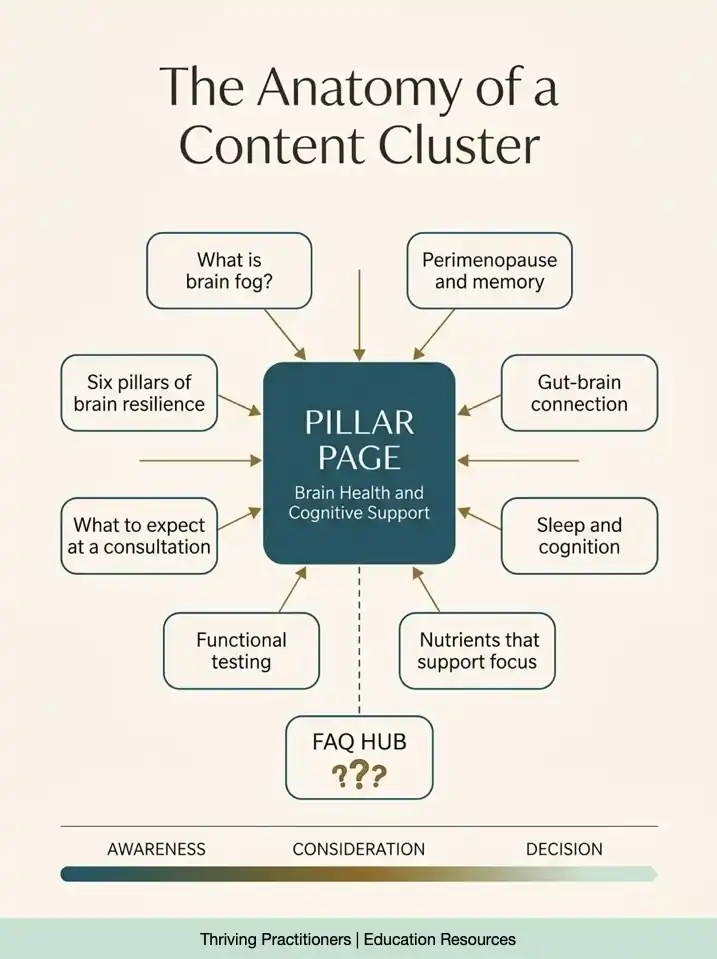
The clusters are the strategy. The pillar-and-spoke is the publication plan. For brain health, the pillar is a single page and the spokes are 8 to 12 articles that feed it. Here is how that looks in practice.
The pillar page (one only)
- Title: Brain Health and Cognitive Support
- Format: Long-form service page with H2 sections covering the symptoms, the root causes, the investigation pathway and the consultation process.
- Job: Bring a confused reader from “I am worried about my brain” to “I want to book an investigation with this practitioner”.
The spokes (8 to 12 articles)
From the Brain Fog cluster (highest-volume, the entry point):
- What is brain fog and is it serious? (Awareness pillar explainer)
- Why am I so foggy in my 40s? (Awareness, hormonal angle)
- Brain fog and perimenopause: how long does it last? (Consideration)
- Post-viral brain fog: a functional approach to long COVID cognition (Consideration)
- Foods that make brain fog worse (Awareness, blood-sugar angle)
- Can gut problems cause brain fog? The gut-brain axis explained (Consideration)
From the Memory and Focus cluster:
- When should I worry about forgetfulness? A practitioner’s decision tree (Awareness)
- Word-finding difficulties: why it happens in your 40s and 50s (Awareness)
From the Root-Cause Drivers cluster:
- Sleep, the glymphatic system and brain health (Consideration)
- Chronic stress, cortisol and the hippocampus (Consideration)
- Nutrients that support cognition: B12, D, omega-3, the practical list (Consideration)
From the Solutions and Decision Stage cluster:
- What happens at a naturopath appointment for brain fog (Decision)
- Functional testing for cognitive concerns: what we actually order (Decision)
The FAQ hub (one page, 20 to 30 questions)
A separate page on your site, organised by H2 questions in the form a real client would type. Each answer is two to four sentences, written in your voice. This page catches the long tail of voice search and AI Q&A queries that the blog posts will not.
Step 4: Apply the GEO Trinity to every piece
GEO (Generative Engine Optimisation) is what we now do alongside SEO. The shorthand for the things every piece of content needs in order to be cited by an AI engine is the GEO Trinity:
| Element | What it looks like | Why it matters |
|---|---|---|
| Expert voice | A named quote from the practitioner inside the body of the article | AI systems pin authority to named entities. Without your name as a voice, you are interchangeable. |
| Statistic | A relevant figure (e.g. World Health Organization or Lancet Commission on dementia data) | Citation-worthy data is what gets the page lifted into AI summaries. |
| Credible source | An outbound link to the original peer-reviewed or government source | Confirms the statistic, strengthens trust signals, and reinforces topical authority. |
Just as we treat the whole person in natural health, we need to approach practice growth holistically. Heart-centred values, smart technology, and proven business principles working together.
James Burgin
Step 5: Name your signature framework
This is the move that separates a practitioner with a great content library from a practitioner who becomes a brand. Pick a methodology you teach inside the cluster and give it a name. For brain health, examples include:
- The Six Pillars of Cognitive Resilience
- The Brain Fog Investigation Framework
- The Cognitive Decision Tree
- The Foggy-to-Focused Pathway
The framework appears on your pillar page, in your service page, in your About page, in your client onboarding and in your social bios. AI systems and humans both need a verbal handle to hold onto when they describe what you do, and a named framework gives them one.
Step 6: Build a lead magnet to convert traffic into list
Brain health is one of the most anxiety-driven topics in natural health. People searching for it want a structured next step. A well-titled lead magnet (delivered in exchange for an email address) converts visitors into a list you can nurture.
Lead magnet ideas for the brain health cluster
- The Brain Fog Investigation Checklist
- 30 Questions to Ask If You Are Worried About Your Memory
- The Six-Pillar Cognitive Resilience Audit
Whichever you pick, deliver it from the pillar page and from the highest-traffic spoke. That is where the highest-intent visitors land.
A note on TGA scope and ethical framing
Brain health, like weight loss and hormones, is a high-scrutiny category in Australia. Frame everything as education, lifestyle support and root-cause investigation rather than treatment or cure. Use language like “many clients find”, “research suggests”, and “supports healthy cognitive function” rather than outcome promises. The same rule applies to whichever niche you focus on.
Frequently asked questions about content clusters
How long does it take to build a content cluster?
Realistically, three to six months at one to two pieces a week. The pillar page comes first, then four spokes covering the most-searched questions, then the FAQ hub, then the rest of the spokes. You do not need to publish all 12 pieces before you start seeing results. Most practitioners notice ranking changes after the pillar plus four spokes are live.
Do I have to do this for every service I offer?
No. Pick one cluster to start. The point of clusters is depth on one topic. Build the brain health cluster first, then start the next one (perhaps perimenopause, or gut health, or anxiety) once the first is humming. Practitioners who try to publish everything for everyone end up with shallow coverage and no rankings.
Can I use Claude to write the actual content, not just brainstorm it?
You can use Claude to draft, but you must edit. The GEO Trinity (expert voice, statistic, credible source) requires you to bring the practitioner voice and verify the citations. Treat the draft as a clay pot you shape into something that sounds like you. The brand voice rules of the practice apply to every word that goes live on your site.
What if I do not have a clear niche yet?
You do not need a fully committed niche before you start a cluster. You need a topic you are willing to write about for the next twelve months. Julie in the Q&A had not committed to a niche, but brain health was where her interest sat and where her clients were already presenting. That is enough to start. The niche emerges from the work.
How does this relate to my Google Business Profile?
Tightly. Every spoke in your cluster should map to a category or service description on your Google Business Profile. Every GBP post should link to a piece in the cluster. The cluster on your website and the categories on your GBP are two halves of the same authority signal. Build them together, not in isolation.
Where to next
If you have a topic in mind, you can have the first version of your cluster scaffolded in under fifteen minutes. Open Claude or ChatGPT, frame the topic, use audio to voice in the symptoms, and ask for the structured table. Print it. Sleep on it. Edit. Then start writing the pillar page.
If you want practical action plans to implement pillar and cluster content, including the pillar page outline and FAQ questions, explore the Thriving Practitioners Growth Hub membership.
Participants in the Pathway to Practice Visibility course get a highly focused, customised Visibility Gold Roadmap, with specific content refinements and cluster suggestions to implement for quick wins and long-term growth.
Check our full Visibility Roadmap article on the features, benefits and Quick-Wins that are part of every Roadmap. Short-term wins and long-term growth are part of the success you can expect with this paint-by-numbers resource. 🚀
Every practitioner I work with has the potential to transform lives. My role isn’t just teaching marketing. It’s about creating a movement where ethical, effective healthcare marketing becomes the norm, not the exception.
James Burgin, Thriving Practitioners Community Leader
About the author
James Burgin is a former naturopath and clinic owner, now a digital marketing strategist with 15+ years of experience helping answer engine optimisation for natural health practitioners grow. He is the founder of Thriving Practitioners, the creator of Metaphysical SEO, and the founder of multi-million-dollar In Essence Aromatherapy. He speaks regularly at industry events including the AI Summit for Natural Health Practitioners.