
Google still matters. But your clients are now searching on YouTube, Instagram, and AI tools like ChatGPT too. Here’s a simple way to think about visibility in 2026.
The biggest mistake right now? Practitioners (and marketers) picking sides – either ignoring AI search entirely, or abandoning Google to chase ChatGPT. Both extremes miss the point.
The reality is simpler: SEO in 2026 = traditional SEO + being visible to AI tools. You don’t have to master both overnight. But you do need to understand what’s changed.
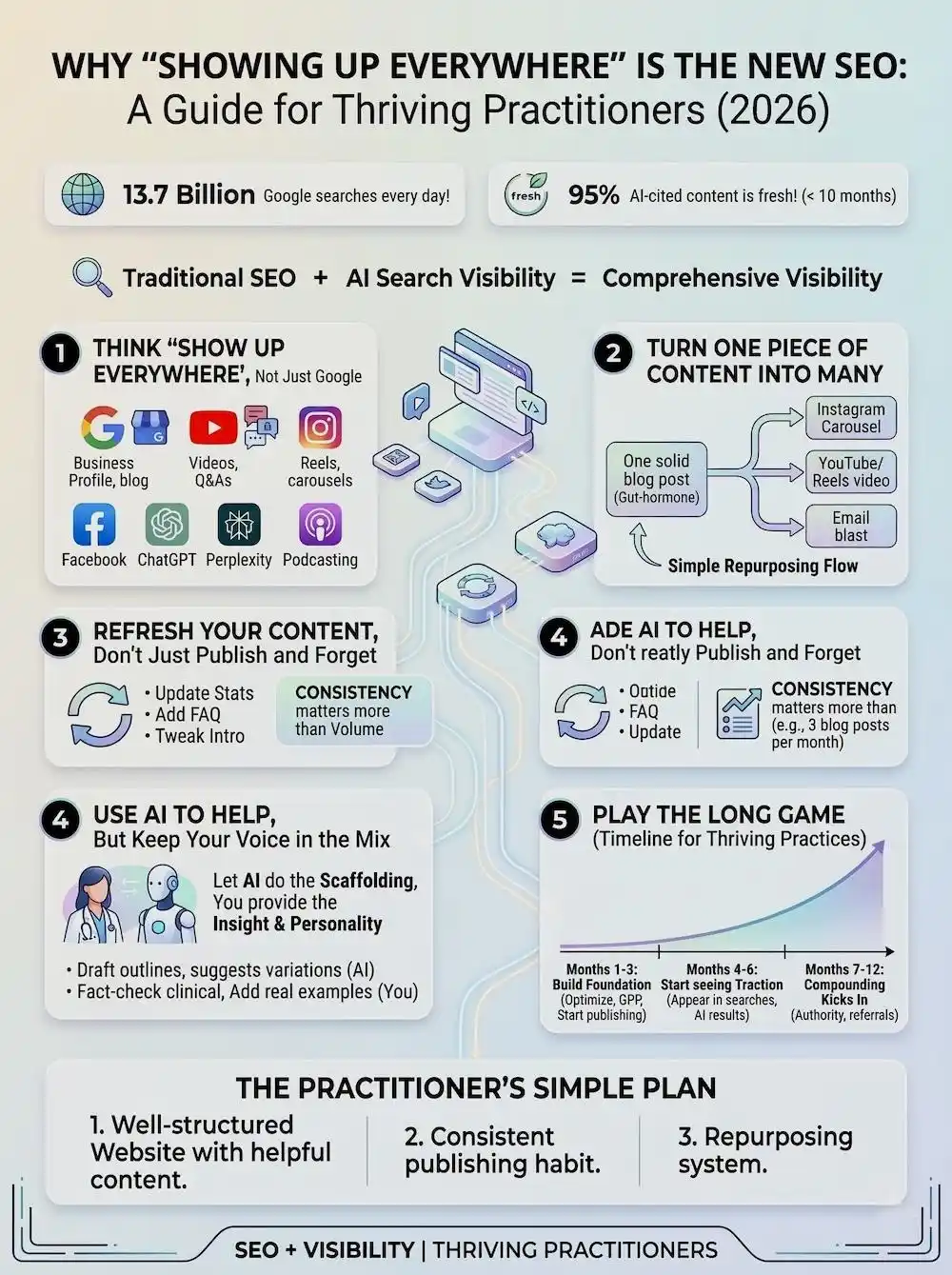
1. Think “Show Up Everywhere,” Not Just Google
Your prospective clients aren’t only searching on Google. They’re asking ChatGPT “what’s the best approach for IBS?”, watching YouTube videos about adrenal fatigue, and scrolling Instagram for content about hormone health.
If your only presence is a website, you’re invisible to a large portion of people who are actively looking for what you offer.
You don’t need to be everywhere at once. But it’s worth asking: where are my ideal clients actually searching?
WHERE PRACTITIONERS CAN SHOW UP
- Google (website, Google Business Profile, blog posts)
- Instagram and Facebook (Reels, carousels)
- AI tools like ChatGPT and Perplexity (via well-structured content on your site)
- Podcast platforms (as a guest or host)
- YouTube (short educational videos, Q&As)
2. Turn One Piece of Content Into Many
This is where it starts to feel less overwhelming. You don’t need to create unique content for every platform – you need to get more mileage out of what you already create.
One solid blog post about, say, the gut-hormone connection can become a short Instagram carousel, a 2-minute YouTube video, an email to your list, and three social media captions. That’s five pieces of content from one idea.
SIMPLE CONTENT REPURPOSING FLOW
- Write one good blog post (800–1,200 words) on a topic your clients ask about
- Pull 3 key points → make them an Instagram carousel
- Record a short video summarising the main message → post to YouTube or Reels
- Send a version to your email list with a link back to the post
3. Refresh Your Content – Don’t Just Publish and Forget
The old SEO playbook was: write something good, rank, move on. That’s no longer how it works – especially with AI tools, which strongly favour recent content.
A quarterly content refresh doesn’t mean rewriting from scratch. It means reviewing your top posts, updating stats, adding a new FAQ, or tweaking the intro. Twenty minutes of work on an old post can breathe new life into it.
Consistency also matters more than volume. Three blog posts a month, published regularly, will outperform a burst of ten posts followed by six months of silence.
4. Use AI to Help – But Keep Your Voice in the Mix
AI writing tools can save you real time – drafting outlines, turning notes into paragraphs, and suggesting topic variations. There’s no reason not to use them.
The catch: AI-generated content that goes straight to publish, unedited, tends to read flat and generic. Your clients chose you because of your expertise and perspective. That’s what needs to come through.
A useful rule of thumb: let AI do the scaffolding, you provide the insight and personality. Fact-check anything clinical. Add a real example from your practice (anonymised). That’s what makes content genuinely useful – and what AI search tools are more likely to surface.
5. Play the Long Game
SEO has always compounded over time. The practitioner who shows up consistently for a year will always outperform the one who goes hard for a fortnight and disappears.
| Months 1–3 | Build the foundation. Optimise your key service pages. Set up your Google Business Profile. Start publishing regularly. |
| Months 4–6 | Start seeing traction. Old posts get picked up. You begin appearing in more searches and occasionally in AI results. |
| Months 7–12 | Compounding kicks in. New content ranks faster. Your site builds authority. Referrals start coming from people who found you through content. |
And what you’re measuring is evolving too. Rankings and traffic still matter – but so does whether your name appears when someone asks an AI tool for a naturopath recommendation, or whether your content gets cited in an AI-generated health overview.
The short version
You don’t need a complicated strategy. You need: a well-structured website with genuinely helpful content, a consistent publishing habit, and a simple system for repurposing what you create. That’s enough to show up – on Google, on social, and increasingly in AI tools – for the clients who need what you offer
Frequently Asked Questions
Is Google still important for SEO in 2026?
Yes — Google still processes 13.7 billion searches per day and remains the dominant search engine. The shift in 2026 is that SEO now means both traditional Google optimisation and visibility on AI tools like ChatGPT and Perplexity. Practitioners need both, not one or the other.
How often should I update my health blog content?
A quarterly content refresh is enough for most practitioners. This means reviewing your top posts and updating stats, adding a new FAQ, or tweaking the intro. AI tools strongly favour content published within the last 10 months, so consistent updates matter more than volume. You do not need to change much – reviewing with a fresh perspective can make a big difference.
Can natural health practitioners use AI to write blog content?
Yes, with care. AI tools are useful for drafting outlines and turning notes into paragraphs – but raw AI output often reads as flat and generic. The best approach is to let AI handle the scaffolding, then add your own clinical insights, real examples from practice, and your authentic voice before publishing.
How long does SEO take to show results for a health practice website?
SEO compounds over time. Most practitioners see early traction between months 4–6, with meaningful compounding from month 7 onwards. Building the foundation in the first three months – optimising service pages, setting up a Google Business Profile, and publishing consistently – is what makes later growth possible.