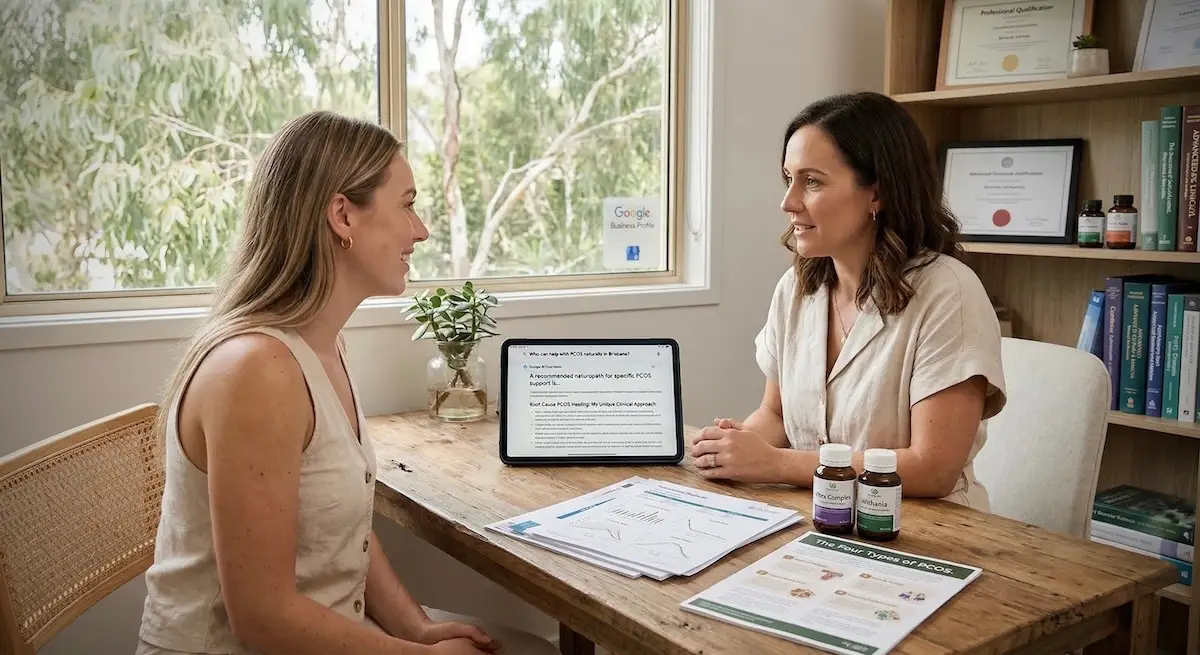
The Complete Guide for Natural Health Practitioners to Get More Bookings
Quick Overview – The 60-second version
- Most practitioners make a critical mistake: putting all services on one page. This makes you nearly invisible to both Google and AI search engines.
- AI tools like ChatGPT and Perplexity recommend practitioners by name – but only if you have dedicated, detailed pages per condition.
- Each core condition you treat deserves its own page (most practitioners need 4-8 pages).
- The highest-converting pages follow a 7-section structure: headline, empathy, unique approach, inclusions, pricing, FAQs, and one clear CTA (call-to-action).
- Start with your top 1-2 conditions, build properly, then expand. Better content done right beats more content done fast.
If you’re a naturopath, nutritionist, or health practitioner, wondering why your website isn’t generating enquiries, your service pages are almost certainly the problem. Not your qualifications. Not your clinical skills. Your service pages.
Most practitioners list their offerings on a single page with a few bullet points and hope for the best. That approach hasn’t worked for years – and in 2026, with AI search engines like ChatGPT, Perplexity, and Google’s AI Overviews actively recommending practitioners by name, it’s costing you clients every single day.
This guide breaks down exactly how to structure service pages that convert browsers into booked clients, while positioning your practice for both traditional search and AI-powered answer engines.
Why Do Most Practitioner Service Pages Fail to Generate Enquiries?
Here’s what typically happens. A practitioner builds their website, creates a single “Services” page, and lists everything they offer: naturopathy, nutrition, herbal medicine, functional testing. Maybe a sentence or two about each. It looks tidy. It feels complete.
But from a search engine’s perspective, it’s almost invisible.
When someone searches “natural treatment for PCOS in Brisbane” or asks ChatGPT “who can help with perimenopause symptoms naturally,” those systems need dedicated, detailed content about that specific condition to feel confident enough to surface your practice. A bullet point on a generic services page doesn’t give them anything to work with.
This is one of the most common issues I see in my work with natural health practitioners: brilliant clinicians with websites that simply don’t reflect the depth of what they actually do.
How Does AI Search Change What Your Service Pages Need?
Traditional SEO rewarded keywords on a page. AI search is different. These systems synthesise information across your entire website to determine whether you’re a credible authority on a topic. They’re looking for depth, specificity, and topical authority.
Think of it this way. If someone asks an AI assistant “Who can help with thyroid problems naturally in Melbourne?”, the AI scans practitioner websites looking for:
- A dedicated page about thyroid support (not a bullet point)
- A detailed explanation of the practitioner’s approach
- Credentials and experience signals
- Location information
- Evidence of expertise – blog posts, FAQs, case-study-style content
How Many Service Pages Should a Natural Health Practitioner Have?
The answer depends on your clinical focus, but the principle is straightforward: if a potential client might search for it specifically, it deserves its own page.
| Create an individual page when... | Keep it as a sub-section when... |
|---|---|
| The condition has its own search demand (people Google it directly) | It's a minor add-on to a primary service |
| You have a distinct clinical approach to that condition | There isn't enough search volume to justify a standalone page |
| You could write 800+ words about your methodology for treating it | Your approach is identical to another service you've already detailed |
| It represents a meaningful portion of your caseload |
Example: A hormone-focused naturopath might create individual pages for perimenopause support, PCOS management, thyroid health, fertility support, and adrenal fatigue and stress recovery.
Example: A gut health practitioner might have pages for SIBO, IBS, food intolerance investigation, and digestive restoration.
The key is mapping your pages to how your ideal clients actually search – not how you were taught to categorise modalities.
What Structure Should Each Service Page Follow?
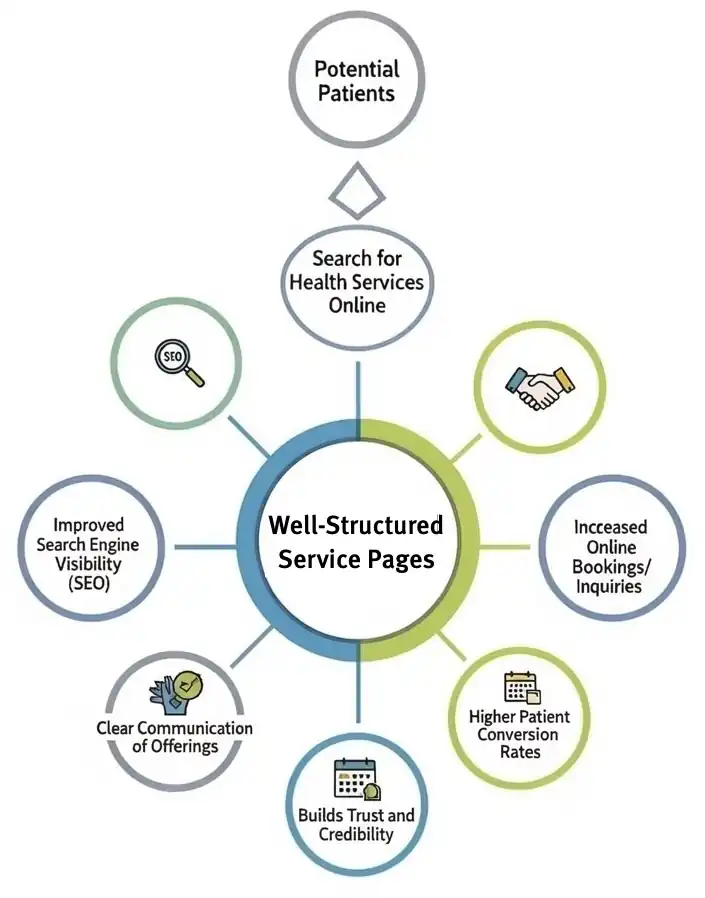
Let me walk through each section using PCOS as a working example.
1. Start with a Headline That Bridges Pain and Possibility
Your headline needs to acknowledge the frustration your client is feeling AND point toward the transformation you offer. Generic headlines like “Naturopathy Services” do nothing. Aim for contrast, benefit, or a clear problem-solution signal.
- The Contrast Headline: "Stop Just Managing Your PCOS. Start Healing the Root Cause."
- The Benefit-Driven Headline: "Reclaim Your Rhythm: Natural PCOS Support for Predictable Cycles and Renewed Energy"
- The SEO and Authority Headline: "Holistic PCOS Treatment: A Natural Path to Hormonal Balance"
2. The Empathy and Agitation Section
This is where you demonstrate that you genuinely understand what your client is going through – before you talk about yourself at all. Most practitioners skip straight to credentials. That’s a mistake.
You have two format options:
Option A – The narrative approach: Write 200-300 words that walk through the daily reality of living with the condition. For PCOS, that might cover the anxiety of unpredictable cycles, the “all-day” fatigue that coffee can’t fix, the physical toll of symptoms that feel out of control, and the frustration of being told to “just lose weight” by conventional medicine.
Option B – The checklist approach: Use a “Does this sound familiar?” format with 6-8 specific symptoms or experiences. This has higher readability and works well for people scanning the page quickly.
Both approaches create psychological connection. The client thinks “this person actually gets it” before you’ve even mentioned your qualifications.
3. Your Unique Approach (150-200 words)
Explain what makes your methodology different. This isn’t about listing modalities – it’s about explaining your clinical thinking. This is also where your credentials and experience signals belong.
4. What's Included and Timeline Expectations (100-150 words)
Be specific about what the client is actually signing up for. Include: initial consultation length and structure, testing involved, follow-up schedule, and a realistic timeline to expect changes.
"Most clients begin noticing improvements in cycle regularity within 2-3 months, with more significant changes over 6-12 months depending on individual factors."
This builds confidence. The client can picture what working with you actually looks like.
5. Pricing Transparency
You don’t need exact prices if that doesn’t suit your practice model – but some level of transparency is important. Even a range or a “starts from” figure helps qualify leads and builds trust.
Options that work well:
- “Initial consultations start from $XXX”
- “Investment ranges from $X to $Y depending on testing requirements”
- “Payment plans available – contact us to discuss”
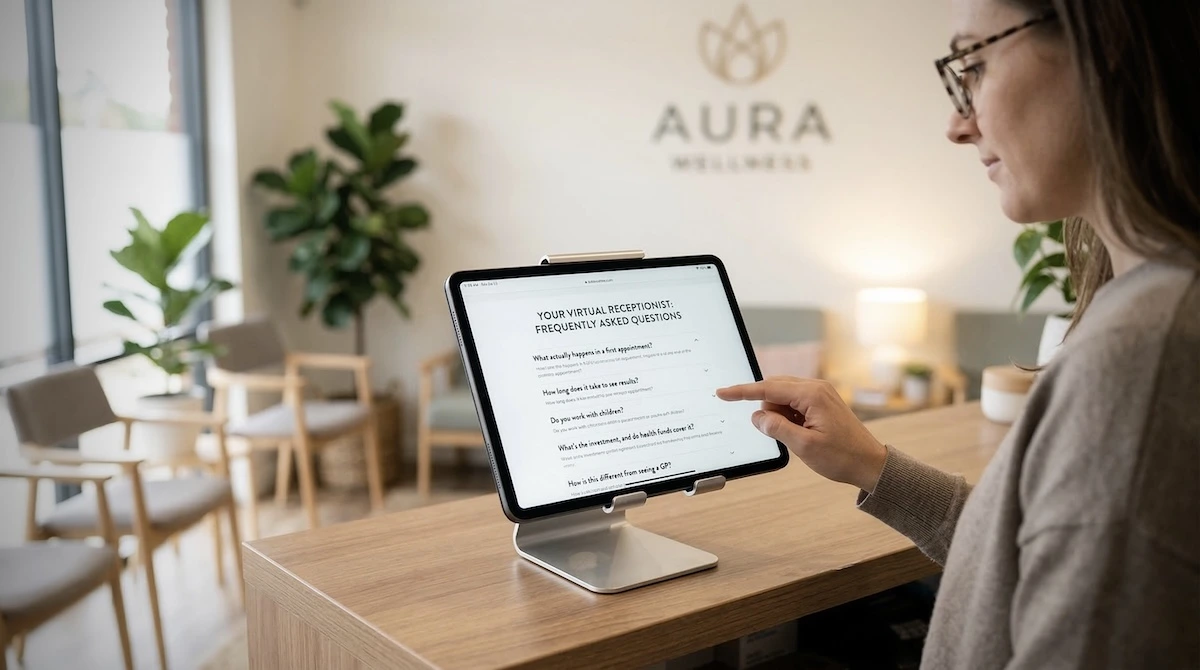
6. Search-Optimised FAQ Section
Add 5-8 questions that your ideal clients are actually asking. This section does double duty: it builds trust with the reader and creates featured snippet opportunities in AI search results.
Good FAQ questions for a PCOS service page:
- “Can naturopathy help with PCOS if I’m also taking medication?”
- “How long before I see results from natural PCOS treatment?”
- “Do I need to follow a specific diet for PCOS management?”
- “What testing do you use to assess PCOS?”
Write concise 2-4 sentence answers. Lead with the direct answer – then add context. AI systems extract the first clear sentence of each answer, so don’t bury the key point.
7. Show Clear Next Steps
End with one single, unambiguous call to action. Not three. Not a menu of options. One.
And especialy with multi-option booking pages, be sure to eliminate confusion. One booking option is best – not a laundry list of appointment types!
Where Should You Start with Implementation?
Build those service pages first using this structure, then expand systematically over the following months.
Don’t try to build eight service pages in a weekend. That leads to burnout and mediocre content. Instead, follow this phased approach:
| Phase 1 (Weeks 1–2) |
Build pages for your top 1–2 conditions or treatment methods. These are the ones clients ask about most. Use existing content you've already created - blog posts, client education materials, email sequences. You've likely already written most of this content in other formats. |
| Phase 2 (Weeks 3–4) | Create your signature methodology page. This explains your overall clinical philosophy and links to each condition-specific page. |
| Phase 3 (Month 2) | Add pages for secondary specialties. |
| Phase 4 (Month 3) | Consider demographic-specific pages (e.g. "Naturopathic support for women over 40") or comparison-style content that positions your approach against conventional alternatives. |
How Do Service Pages Fit into Your Broader Marketing Strategy?
They sit at the centre of your marketing ecosystem, connecting blog content, social media, Google Business Profile, and AI search visibility into a system that generates enquiries and appointments consistently.
A service page doesn’t work in isolation. It works because everything else points to it:
- Your blog posts build your ‘topical authority’ and link to relevant service pages
- Your about page builds trust and a real human connection, demonstrating your depth of experience and professional authority.
- Your Google Business Profile links to specific service pages (not just your homepage). Be sure to fill out all ten service categories!
- Your social media content addresses the same conditions and drives traffic to the matching service page
- Your local SEO strategy reinforces the geographic relevance of each service
This interconnected approach is what separates practitioners who get a steady stream of ideal clients from those who rely on word-of-mouth alone. In 2026, it’s not about more content – it’s about better-structured content that works together.
Frequently Asked Questions
How long should each service page be?
Aim for 1,200-1,800 words per service page. This gives you enough depth to establish authority with both human readers and AI search systems, without overwhelming the reader. Use clear headings, short paragraphs, and visual breaks to maintain readability even at longer word counts.
Do I need to be a good writer to create effective service pages?
No. The most effective service pages sound like you’re explaining your approach to a client sitting across from you in consultation. Write how you speak. If writing feels difficult, record yourself answering common client questions and transcribe it as a starting draft.
Should I include pricing on my service pages?
Some level of pricing transparency is recommended. You don’t need exact figures, but phrases like “initial consultations from $XXX” or “investment ranges from $X-$Y” help qualify leads and build trust. Pages that address cost openly tend to generate more confident enquiries than those that avoid it entirely.
How often should I update my service pages?
Review each service page quarterly. Update statistics, refresh any seasonal references, and add new FAQs based on questions clients have asked. Search engines and AI systems favour content that shows recent modification dates, signalling that the information is current and maintained.
Can I use the same service page structure for online consultations?
Absolutely. The seven-section framework works identically for telehealth services. Simply adjust the “What’s Included” section to explain your virtual consultation process, any at-home testing kits you use, and how you handle follow-ups remotely.