
It’s time we started getting to know and using the terminology and jargon that’s appropriate for growing our practices.
Here’s an overview of terminology for health practitioners. It’s worthwhile to get to know these and start using them in your vocabulary and marketing thinking.
Understanding the terminology of AI-powered search is crucial to modern marketing for natural health practitioners.
PRO TIP: get to know a few at a time – just like our clients, it’s easy to get overwhelmed, so start simple!
Remember when you thought learning the difference between adaptogens and tonics was complicated? Or when you had to memorize the contraindications for St John’s Wort? Welcome to marketing jargon—it’s like pharmacognosy all over again, except instead of herb-drug interactions, you’re learning algorithm-practitioner interactions. The good news? At least this terminology won’t cause adverse reactions if you get it slightly wrong.
Marketing for Natural Health Practitioners in the AI Era
- AI Changes Search: Traditional SEO is failing, as over 60% of searches now result in "zero clicks," with AI providing the answer directly.
- Be a Verified Entity: If AI systems do not recognise you as a credible, verified practitioner entity, you will be invisible to potential clients.
- E-E-A-T is Key: Health is YMYL content, demanding a higher trust threshold. Strong Experience, Expertise, Authoritativeness, and Trustworthiness are essential.
- Act Now for Visibility: Shift your marketing from keywords to entity-focused authority within the next 12-24 months to gain a competitive advantage.
Think of this glossary as your marketing materia medica—except instead of therapeutic actions and traditional uses, you’re learning how to make Google actually understand what you do for a living.
Here’s your comprehensive guide:
AEO (Answer Engine Optimisation)
The practice of optimising content to be selected and cited by AI systems that provide direct answers rather than lists of links. Unlike traditional SEO which aims for high rankings, AEO focuses on becoming the authoritative source AI systems quote and reference. For natural health practitioners, this means creating content that directly answers client questions in clear, credible, structured formats.
Clinical Translation: Think of AEO as writing your patient education handouts, except your patient is an AI system with the reading comprehension of a very literal medical student who only remembers exactly what you tell them.
Conversational Search
Search queries phrased as natural questions rather than keywords. Instead of “naturopath Sydney PCOS,” users ask “What naturopath in Sydney specialises in PCOS treatment?” AI systems are designed to understand and respond to these human-like queries, requiring practitioners to optimise for natural language rather than keyword strings.
Reality Check: Yes, you spent years learning to speak in precise clinical terminology (‘presenting with chronic relapsing-remitting inflammatory bowel syndrome’), and now you need to write for people asking ‘why does my tummy hurt all the time?’ Welcome to the wonderful world of meeting clients where they actually are.
Data LLM
The underlying AI language model (like GPT-5 or Google’s PaLM) has been trained on massive datasets of text from across the internet. This includes practitioner websites, health directories, research papers, and forum discussions.
The Data LLM is the “brain” that generates responses based on patterns it learned during training. For practitioners, this means your online presence during the model’s training period affects how AI understands and references you.
Clinical Parallel: The Data LLM is basically like your clinical reference library—except it read everything on the internet in about 3 weeks, retained most of it perfectly, but occasionally gets confused about which naturopath wrote which article about adrenal fatigue. Also, it has no bedside manner.
E-E-A-T (Experience, Expertise, Authoritativeness, Trustworthiness)
Google’s quality framework for evaluating content and websites, particularly critical for YMYL topics like health. The framework was updated to include “Experience” (first-hand knowledge) alongside the original E-A-T. For natural health practitioners, strong E-E-A-T signals include:
- Experience: Clinical practice history, patient case studies (anonymised), first-person practitioner content
- Expertise: Professional qualifications, certifications, specialty training
- Authoritativeness: Recognition by professional bodies, citations in directories, and professional memberships
- Trustworthiness: Verified credentials, transparent business information, secure website, professional standing
Entity
In search and AI systems, an entity is a distinct, identifiable thing – a person, place, organisation, or concept – that exists independently and has specific attributes. For example, “Dr Sarah Johnson” is an entity with attributes like “naturopath,” “Sydney,” “women’s health specialist,” “ANTA-registered,” etc. Entity recognition is crucial because AI systems increasingly think in terms of entities and their relationships rather than just keywords. A practitioner who is recognised as an entity can be confidently cited by AI; one who isn’t may be invisible.
Clinical Comparison: Being recognized as an entity is like being listed in the practitioner directory at your local health food store—except the directory is invisible, constantly updated by robots, and determines whether 60% of your potential clients ever know you exist.
The Absurdity: You are a real person treating real patients, but until an algorithm agrees you’re ‘an entity,’ you might as well be practicing medicine in a parallel universe.
Entity-Based Search
A search approach where algorithms understand and retrieve information about specific entities and their relationships, rather than just matching keywords. For instance, understanding that “Dr Sarah Johnson” (entity) “specialises in” (relationship) “gut health” (entity) in “Bondi” (entity). This is foundational to how AI systems recommend practitioners.
GEO (Generative Engine Optimisation)
The practice of optimising content and online presence specifically for AI systems that generate original responses rather than just ranking existing pages. While SEO focused on ranking in search results, GEO focuses on being cited in AI-generated answers. This requires structured data, clear entity signals, verified credentials, and authoritative content that AI systems trust enough to reference.
Knowledge Graph
A database that stores entities and the relationships between them. Google’s Knowledge Graph, for example, understands that “naturopathy” is a “type of complementary medicine,” that “ANTA” is a “professional registration body,” and that “Sarah Johnson” is a “naturopath” who “practices in” “Sydney.” When AI systems generate answers, they query knowledge graphs to verify facts and relationships. Being recognised in these graphs is essential for AI citation.
What This Actually Means: Google has created a massive relationship web that looks suspiciously like those mind maps you made in naturopathy college connecting body systems. Except Google’s version connects you, your specialty, your location, your qualifications, and your competitors into one giant ‘who’s connected to what’ database.
The Irony: We spent years explaining to clients that ‘everything in the body is connected,’ and now we’re having to prove to Google that we’re connected to naturopathy, which is connected to gut health, which is connected to Sydney. The body-mind-spirit connection was easier to explain.
Knowledge Panel
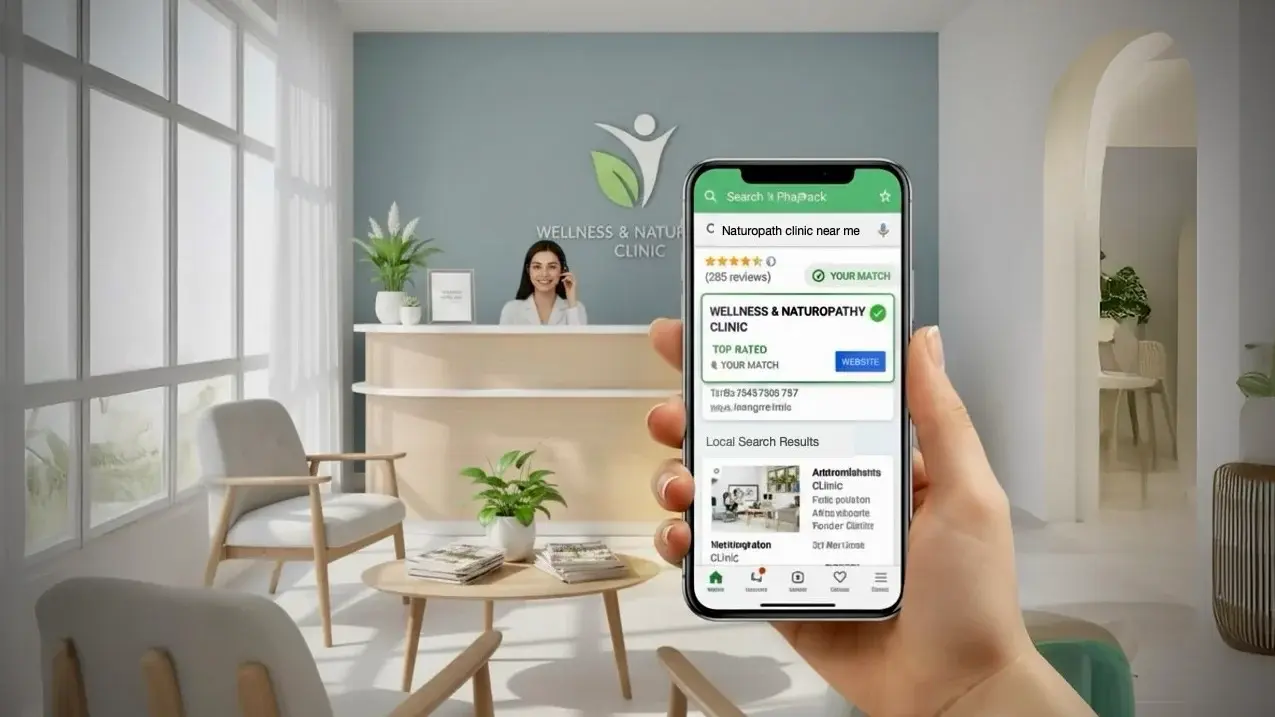
The information box in Google search results displays verified details about an entity. For practitioners, this might include your name, credentials, clinic location, phone number, website, and professional affiliations. Having a Knowledge Panel is a strong signal that you’re recognised as a verified entity, significantly increasing the likelihood that AI systems will cite you.
Translation: A Knowledge Panel is like having your business card permanently displayed on Google’s desk. Except the desk is visible to everyone searching for you, and you don’t get to choose the photo Google uses. Good luck with that.
LLM (Large Language Model)
An artificial intelligence system trained on vast amounts of text data to understand and generate human-like language. Examples include ChatGPT (GPT-4), Google Gemini, Claude, and others. LLMs power the conversational AI tools that potential clients are increasingly using instead of traditional search. Understanding how LLMs “think” about authority and credibility is crucial to modern marketing for natural health practitioners.
Clinical Parallel: An LLM is essentially a very well-read colleague who attended every conference, read every journal, memorized every blog post… and occasionally suggests homeopathy for broken bones because someone on the internet said it worked once. Use with appropriate professional skepticism.
Natural Language Processing (NLP)
The AI technology that enables computers to understand, interpret, and generate human language. NLP enables AI systems to understand questions such as “Which magnesium supplement is best for sleep?” and generate relevant, contextual answers. For practitioners, this means creating content that sounds natural and conversational rather than keyword-stuffed.
Prompt Engineering
The practice of crafting effective questions or instructions to get desired results from AI systems. Your potential clients are (often unconsciously) doing prompt engineering when they ask AI systems about health concerns. Understanding common prompt patterns helps you optimise content for how questions are actually being asked.
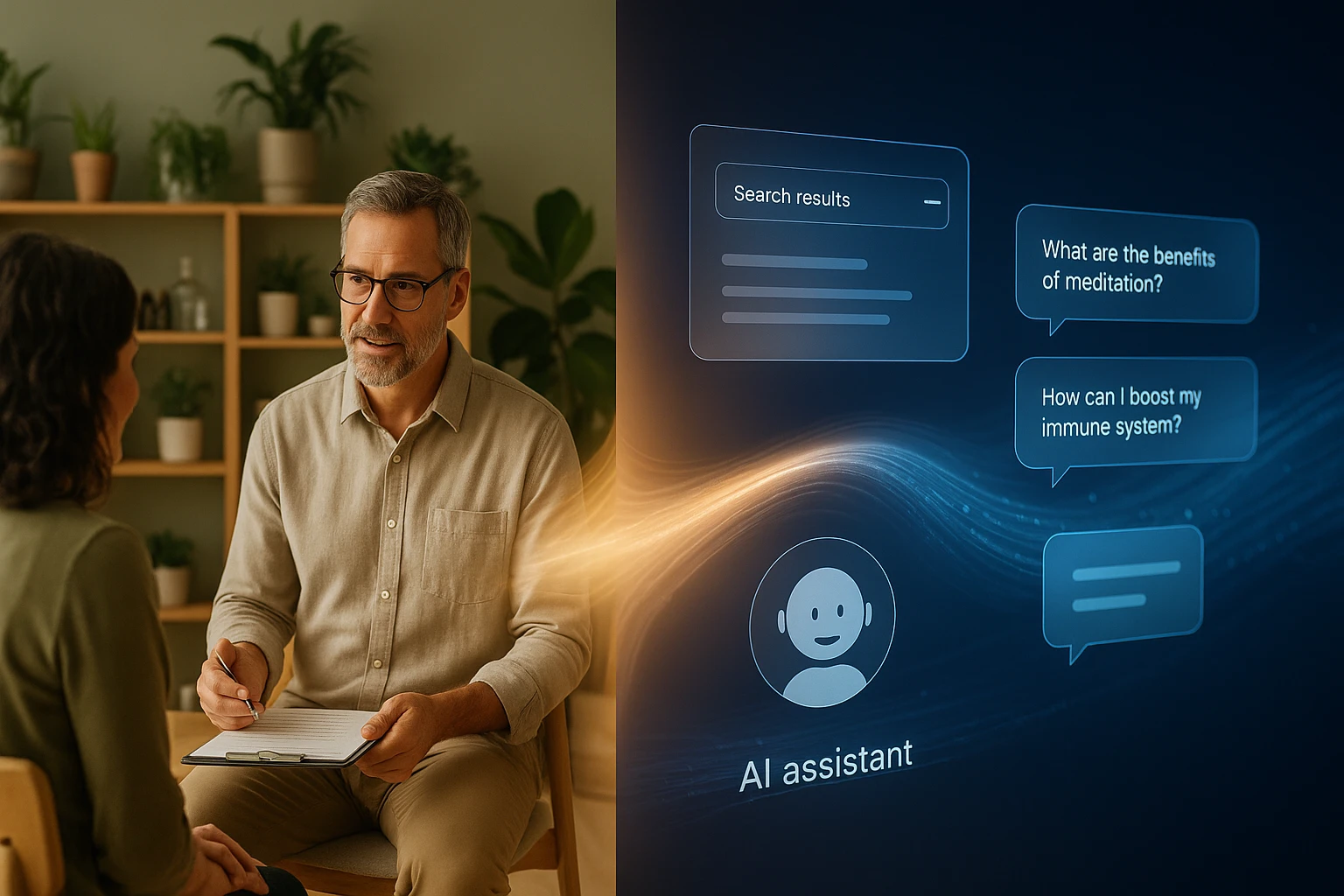
Reality Check: Your clients are basically conducting their initial consultation with an AI before they ever contact you. And unlike your thorough case-taking process that takes 90 minutes, they’re getting answers in 3 seconds. This is the world we live in now.
Schema Markup / Structured Data
Code added to your website that helps search engines and AI systems understand your content’s meaning and relationships. For practitioners, relevant schema types include:
- Person schema: Identifies you as an individual with credentials
- MedicalOrganization schema: Defines your clinic or practice
- Physician schema: Specifies your medical/health credentials
- LocalBusiness schema: Provides location and contact details Schema markup is the “language” you use to speak directly to AI systems about who you are and what you do.
Search Intent
The underlying goal behind a search query. Understanding search intent is crucial for natural health practitioner marketing because it determines what type of content to create:
- Informational intent: “What causes thyroid issues?” (needs educational content)
- Navigational intent: “Sarah Johnson naturopath Bondi” (needs practitioner profile)
- Transactional intent: “Book naturopath appointment Sydney” (needs booking functionality)
- Commercial investigation: “Best naturopath for gut health Sydney” (needs comparison/authority content)
SEO (Search Engine Optimisation)
The traditional practice of improving website visibility in search engine results pages (SERPs) through keyword optimisation, backlinks, technical improvements, and content creation. While SEO isn’t dead, it’s evolving – modern natural health practitioner marketing requires SEO plus entity building, AI optimisation, and answer engine strategies.
The Exhausting Truth: Just when you mastered SEO (or outsourced it), the rules changed. It’s like finally understanding the TGA advertising guidelines, then having them updated. Again. For the fifth time. In two years.
Semantic Search
Search technology that understands the meaning and context of queries rather than just matching keywords. For example, understanding that “natural hormone balancing” and “bioidentical hormone therapy” are related concepts. AI systems use semantic understanding to connect your expertise to varied ways clients might phrase their questions.
SERP (Search Engine Results Page)
The page of results shown after a search query. Historically, natural health practitioner marketing focused on ranking high on SERPs. With AI-powered search, many queries no longer generate traditional SERPs – instead, AI provides direct answers, making entity recognition more important than rankings.
Topic Clusters / Topical Authority
An SEO and AEO strategy where you create comprehensive content around a core topic (pillar page) linked to related subtopic pages (cluster content). For example, a pillar page on “Women’s Hormonal Health” might connect to clusters on PCOS, perimenopause, thyroid function, and adrenal health. This structure helps both traditional search and AI systems recognise you as an authority on the broader topic.
Why This Sounds Familiar: Remember creating treatment protocols with primary interventions and supporting therapies? Congratulations—you’ve been thinking in topic clusters the whole time. You just didn’t know Google wanted you to organize your website the same way you organize your clinical thinking.
Training Data
The massive collection of text, images, and information that AI language models learn from during development. Most LLMs have training data cutoffs (dates after which they do not know). If your practice information exists in high-quality form in training data, AI systems are more likely to “remember” and cite you. However, they also use real-time search to access current information.
The Uncomfortable Reality: Everything you’ve ever posted online—every blog, every comment in a Facebook group, every answer on a forum—became AI training material. That throwaway comment you made about coffee enemas in 2019? Yeah, ChatGPT read that. Hope it was accurate.
Verification / Verified Entity
The process by which AI systems confirm that an entity is real, credible, and accurately represented. For health practitioners, verification signals include:
- Professional registration in recognised directories
- Consistent information (NAP: Name, Address, Phone) across platforms
- Recognition by authoritative sources (professional associations)
- Verified Google Business Profile
- Clear credential documentation. Without verification, AI systems may consider your information too uncertain to cite.
YMYL (Your Money or Your Life)
Google’s classification for content that could significantly impact users’ health, safety, financial stability, or wellbeing. All natural health practitioner content falls into YMYL, which means:
- Higher trust requirements than other content types
- Greater scrutiny of credentials and expertise
- Stronger emphasis on E-E-A-T signals
- Increased risk of being filtered out if verification is weak YMYL classification is why generic wellness blogs are being suppressed while verified practitioner content is prioritised.
Zero-Click Search
A search that provides the answer directly on the search results page or through an AI interface, eliminating the need for the user to click through to a website. The rise of zero-click searches (now over 60% of all searches) means traditional natural health practitioner marketing strategies focused solely on website traffic are becoming less effective. Instead, being cited in these zero-click answers becomes the primary goal.
The New Reality: People are getting health advice from AI without ever visiting your website, reading your qualifications, or understanding your treatment philosophy. They’re basically self-prescribing based on an algorithm’s interpretation of your expertise.
What This Means: Your carefully crafted ‘About’ page explaining your holistic, individualized approach? Nobody’s reading it. The AI summarized it in one sentence. Welcome to 2025.
Your Job Now: Make sure that one sentence is accurate. And citations you. And makes you sound competent. No pressure.
Taking Action: Your Next Steps
Understanding these concepts is the first step. The infographic below provides the complete strategic framework for adapting your natural health practitioner marketing to the AI era.
After reviewing it, consider conducting a quick audit of your current online presence:
1. Google yourself as a potential client would – do you appear as a recognised entity?
2. Check if you have a Knowledge Panel on Google
3. Review your professional directory listings – are they complete and consistent?
4. Assess your website content – does it answer specific client questions in conversational language?
5. Evaluate your E-E-A-T signals – are credentials, experience, and expertise clearly visible?
The practitioners who thrive over the next 2-5 years won’t be those with the most keywords or the most backlinks. They’ll be the ones recognised as verified, authoritative entities by AI systems that are increasingly becoming the “first point of contact” for prospective clients.
The window to establish this recognition is open now. But it won’t stay open forever.
Ready to dive deeper? Scroll down to explore the complete visual guide on adapting your natural health practitioner marketing strategy for the AI-powered search revolution.
About the Author: James Burgin is the founder of Thriving Practitioners, specialising in digital marketing strategy for natural health practitioners across Australia. With expertise in SEO, AI optimisation, and practice growth, James helps naturopaths, nutritionists, and complementary health practitioners build sustainable visibility in an evolving digital landscape.
Join the Thriving Practitioners Community
Ready to implement these principles in your practice with expert guidance and peer support?
Connect
Thriving Practitioners Growth Hub membership
Connect
Thriving Practitioners Facebook community
Learn
Monthly workshops on practice growth and AI visibility