
The Parallel AI Revolution: When Both You and Your Clients Are Learning AI Together
You're getting comfortable with AI for your practice. Have you considered how your clients' AI experiments are influencing your consultations?
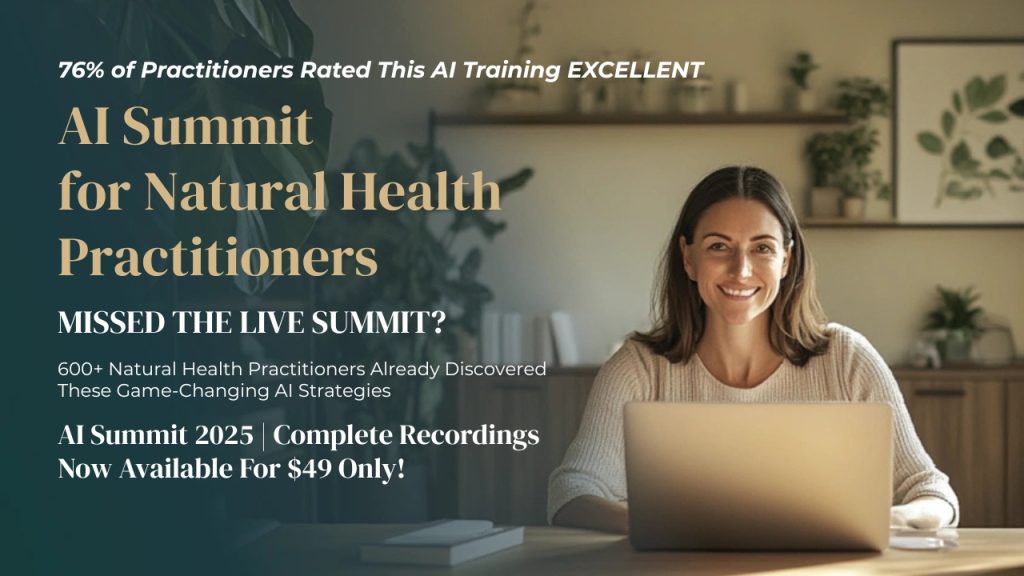
You’ve just finished creating your third blog post this month using Claude. You’re finally seeing how AI can amplify your voice and save hours of content creation time. You’re even getting comfortable asking ChatGPT to help structure your treatment protocols. The 2025 AI Summit for Natural Health Practitioners expanded the possibilities so many practitioners are still exploring.
Then your 2 pm client arrives for her appointment. She’s researched her hormonal symptoms using Perplexity. She has created a symptom tracking system using ChatGPT. She has questions about the supplement protocol that Gemini suggested. You both smile, realising you’re having a very different kind of consultation than was possible even six months ago.
Welcome to the parallel AI revolution. Both practitioner and patient are learning to navigate AI together.
Key Takeaways:
-
Ideal Patients Emerge
AI-informed clients are your most engaged patients. They ask better questions, understand treatments faster, and invest readily in their health. -
One Question Changes Everything
Ask "What have you already discovered?" instead of educating from scratch. This transforms resistance into collaborative partnership immediately. -
Parallel Learning Advantage
Both you and your clients are learning AI simultaneously. This alignment creates deeper consultations and natural practice growth opportunities. -
Integration, Not Competition
Your role isn't competing with AI. You personalise generic information, identify what AI misses, and guide through overwhelm effectively.
What Is the Double Learning Curve in Natural Health Practice?
Here’s what’s fascinating about this moment in natural health practice: while you’re learning to use AI for content creation, client communication, and practice management, your clients are simultaneously learning to use the same tools. They’re researching symptoms, exploring treatments, and making health decisions.
According to James Burgin, founder of Thriving Practitioners: “We’re seeing something unprecedented. Practitioners and patients are learning AI capabilities at roughly the same pace. This creates both incredible opportunities and interesting challenges that traditional healthcare education never prepared us for.”
The practitioners who attended the AI Summit for Natural Health Practitioners discovered something powerful. AI isn’t just a practice management tool. It’s fundamentally changing the informed consent conversation, the treatment planning process, and the entire therapeutic relationship.
How Are Practitioner and Client AI Journeys Different?
What You’re Learning:
- How to create content more efficiently
- Ways to streamline practice administration
- Methods to improve your online visibility
- Transcribing consultations and getting AI summaries
- Techniques for treatment protocol development
- Strategies to build authority and attract ideal clients
What Your Clients Are Learning:
- How to research symptoms at 2 am when they’re anxious
- Ways to understand complex health information in simple language
- Methods to track patterns AI might identify before they do
- Techniques to compare treatment approaches
- How to find practitioners who “speak their language”
The insight most practitioners miss: these aren’t competing journeys. They’re parallel paths that can either clash or align beautifully, depending on how you approach them.
Why Do AI-Informed Clients Actually Make Better Patients?
Practitioners who attended the AI Summit for Natural Health Practitioners reported a fascinating discovery. When they started paying attention to their clients’ AI usage rather than just their own, they noticed a clear pattern.
Clients who mentioned AI research in consultations were, in fact, their most engaged patients. They asked better questions. They understood treatment rationales more quickly. They were more compliant because they’d already researched why protocols mattered.
But many practitioners also noticed friction. When they used traditional “patient education” language, these AI-informed clients felt talked down to. When they assumed no knowledge, clients felt their research was being dismissed.
The breakthrough came when practitioners started their consultations differently:
| Old Consultation Approach | New AI-Aware Approach | Result |
|---|---|---|
| "Let me explain how perimenopause works..." | "What have you already discovered about what you're experiencing?" | Client feels validated, research acknowledged |
| Assume client knows nothing | Ask "Where do you have questions or confusion?" | Targets gaps rather than repeating known information |
| Present treatment plan | "What makes sense to you about what you've learned?" | Creates collaborative decision-making |
| Educate from scratch | Build on existing research | Faster rapport, deeper trust |
| Position as an integration guide | Position as an integration guide | Reduced resistance, better compliance |
This simple shift transformed her practice. AI-informed clients felt validated. Rebecca’s expertise was positioned as guidance through complex information rather than basic education. Consultations became collaborative explorations rather than one-way information transfers.
What Questions Are Both You and Your Clients Asking AI?
Here’s where it gets interesting. When you understand what questions your clients are asking AI systems, you can structure your practice and content to bridge both learning curves.
Common Client Questions to AI:
- “What are the symptoms of perimenopause?”
- “Best natural treatments for SIBO”
- “How to choose a naturopath in [location]”
- “What tests do I need for a hormonal imbalance?”
- “Can I see a naturopath while on medication?”
Your Questions to AI:
- “Create a blog post about perimenopause symptoms”
- “Write an FAQ for my SIBO treatment page”
- “What keywords should I target for local visibility?”
- “Generate a client intake form for hormonal issues”
- “Draft an email sequence for new clients”
See the alignment? Your AI-created content can directly address the questions your clients are asking AI. This creates a perfect meeting point where your learning curve supports their learning curve.
How Do You Build a Competitive Advantage from Mutual AI Literacy?
Practitioners who understand BOTH sides of the AI learning curve are creating remarkable competitive advantages:
They’re visible where research happens: Their content appears when potential clients ask AI about conditions they treat.
They validate modern health research: Rather than dismissing AI-informed clients as “problematic,” they celebrate engaged partners.
They guide through information overwhelm: They help clients contextualise and personalise AI-generated information within their unique health picture.
They build instant credibility: They demonstrate understanding of the modern health discovery journey.
They attract ideal clients: AI-informed clients are proactive, engaged, and ready to invest in their health.
James Burgin reflects: “Just as flower essences work on subtle energy levels, understanding your clients’ AI research journey works on the subtle level of trust and credibility. When clients feel you understand how they discover and validate health information, they’re far more receptive to your guidance.”
What Practical Strategies Support Both Learning Curves?
1. Create Your AI Audit Practice
Once a month, test the questions you think your ideal clients are asking:
- Run them through ChatGPT, Gemini, and Perplexity
- Note what information they receive
- Identify gaps, misconceptions, or opportunities
- Create content that addresses what AI tells them
2. Update Your Consultation Approach
Add these questions to your intake:
- “What have you already researched about this concern?”
- “What made the most sense to you in your research?”
- “Where do you have questions or confusion?”
Listen without judgment. You’re understanding their information landscape, not correcting their research.
3. Position Yourself as the Integration Expert
Your role isn’t to compete with AI. Your role is to:
- Contextualise AI-generated information within their unique situation
- Personalise generic protocols based on their specific constitution
- Identify what AI misses – energetic factors, constitutional patterns, and subtle presentations
- Guide decision-making when information feels overwhelming
4. Build Content That Bridges Both Curves
Create resources that acknowledge your audience’s AI literacy:
- “What ChatGPT Gets Right (and Wrong) About PCOS”
- “The SIBO Protocol AI Suggests – And Why Yours Might Be Different”
- “Using AI for Symptom Tracking: A Practitioner’s Guide for Clients”
5. Share Your Own AI Learning Journey
Your community at Thriving Practitioners understands this: transparency about your AI learning builds connection, not skepticism. Share:
- Tools you’re experimenting with
- Content you’re creating more efficiently
- Insights you’re discovering
- Mistakes you’re learning from
When clients see you’re on a learning journey too, they feel safe sharing their own AI explorations.
What Questions Should You Ask Before Your Next Consultation?
Before you create your next piece of content or prepare for your next consultation, ask yourself:
- What AI research has my next client probably already done?
- How can my AI-created content address their AI-generated questions?
- Am I positioning myself as threatened by informed clients or energised by engaged partners?
- Where can I add unique value that AI alone cannot provide?
- How can I make my AI learning curve support my clients’ AI learning curve?
How Do You Start Embracing the Parallel Journey?
This Week:
- Test your visibility in AI systems: Use Action Plan #1 to discover what AI tells your potential clients about conditions you treat.
- Review your last 5 client consultations: How many mentioned prior research? How did you respond? What would you do differently now?
- Create one piece of “bridge content”: Write something that acknowledges both your expertise AND your clients’ research capabilities.
This Month:
- Join or deepen engagement in the Thriving Practitioners community: Share your experiences navigating client AI conversations. Learn from practitioners who are transforming parallel learning into practice growth.
- Experiment with AI consultation preparation: Try asking new clients about their research before appointments. Notice how it changes the consultation dynamic.
- Build your AI question library: Document the questions clients ask that reveal AI research. Use these to guide content creation.
What Makes the Parallel Journey a Competitive Advantage?
Here’s what the most successful practitioners from the AI Summit discovered. When you stop seeing client AI research as competition and start seeing it as collaboration, everything shifts.
Your consultations become deeper because you’re not starting from zero. Your content connects more powerfully because it addresses real questions clients are asking. Your authority strengthens because you demonstrate you understand the modern health discovery journey. Your practice grows because AI-informed clients are actively seeking practitioners who validate rather than dismiss their research process.
As James Burgin notes: “We’re entering an era where ancient wisdom meets cutting-edge technology. The practitioners who thrive will be those who embrace AI as a tool to amplify their authentic voice while maintaining the integrity of their healing practice. But they’ll also understand that their clients are on the same journey. That’s actually the biggest opportunity of all.”
Frequently Asked Questions About Practitioners and Clients Both Using AI
Should I tell clients I use AI for content creation?
Transparency builds trust. You don’t need to announce it, but if asked, be honest. Most clients appreciate that you’re using modern tools efficiently. Focus on the outcome: “I use AI to help me create more educational content for my community.”
What if a client's AI research contradicts my treatment approach?
This is a teaching moment, not a threat. Ask: “What about that approach appeals to you?” Their answer reveals their health priorities. Then explain your clinical reasoning: “Here’s why I recommend something different for your specific situation.”
How much AI research should I acknowledge in consultations?
Make it a standard intake question: “What have you already learned about this?” Then listen. Acknowledge valuable research, gently correct misinformation, and position yourself as the guide who personalises generic information.
What if I'm still learning AI myself?
Perfect. So are your clients. Mutual learning creates connection. Share your journey authentically: “I’m exploring how AI can help practitioners like me serve clients like you better.”
How do I compete with free AI health advice?
You don’t compete – you complement. AI provides information. You provide personalisation, clinical intuition, energetic assessment, constitutional analysis, and the therapeutic relationship. These cannot be replicated by AI alone.
The Beautiful Alignment
You’re already learning AI for your practice. Your clients are already using AI for their health. This parallel learning isn’t a problem to solve. It’s already happening.
The question is whether you’ll recognise it as the competitive advantage it truly is.
The alignment of practitioner AI literacy and client AI literacy isn’t something to fear. It’s a revolution to embrace.
When both paths meet, something powerful happens. Consultations deepen. Trust builds faster. Clients feel genuinely heard. Practitioners feel energised by engaged partners rather than exhausted by resistant patients. Practice growth becomes natural rather than forced.
This is the future of natural health practice. And you’re perfectly positioned to lead it.
Ready to turn parallel AI learning into practice growth? Start with Action Plan #1: The AI Audit to discover what AI systems tell your clients before they meet you. Then join the Thriving Practitioners community to share insights with practitioners navigating this same journey.
About the Author: James Burgin is a former naturopath, clinic owner, and founder of Thriving Practitioners. With 15+ years in digital marketing and deep practitioner experience, he helps natural health professionals bridge clinical excellence with modern practice growth – including understanding how both practitioners and patients are learning to navigate AI together.