
You spend years mastering clinical skills to help people heal. But here’s the uncomfortable truth: being brilliant at helping people means nothing if the right people can’t find you. Most practitioners market to “everyone with gut issues” or “women going through menopause.” The results are usually disappointing.
But what if you could use the same diagnostic skills you apply in consultations to identify exactly who benefits most from your approach? What if you could speak directly to your ideal clients in a way that makes them feel instantly understood, even before they book? That’s the power of creating customer personas for natural health practitioners. And unlike most marketing exercises, this one plays to your strengths as a practitioner.
Why Creating Customer Personas for Natural Health Practitioners Improves Practice Growth
Customer personas aren’t marketing fluff – they’re clinical insight applied to practice growth. By reviewing 20 recent consultations and noting patterns in who you serve best, you can create detailed client profiles that guide all your content decisions. Creating customer personas involves using AI to identify commonalities in demographics, psychographics, and health journeys. Then create 1-2 specific personas (like “Corporate Sarah” or “Exhausted Emma”) that represent your ideal clients. These personas inform your blog topics, FAQs, service pages, and social content—making your marketing feel authentic while helping AI systems understand precisely who you serve. Start with one persona, test content for a month, and refine based on results. The practitioners who grow sustainably aren’t trying to help everyone—they’re crystal clear about who they serve best.
1. Good News: You're Already Doing This
Creating Customer Personas for Natural Health Practitioners Is a Clinical Skill
You wouldn’t treat every patient the same way – so why market to everyone identically? As a natural health practitioner, you already know how to read people, understand their unique situations, and tailor your approach accordingly. Creating customer personas simply applies this clinical skill to your practice growth.
A persona is a realistic portrait of your ideal client – the type of person who naturally benefits most from your approach. When you understand who you’re serving, your content becomes clearer, your marketing more authentic, and even AI systems better understand who to recommend you to. And it can be surprising how, by analysing methodically, you discover extra insights about customers, beyond the hunches you already have.
2. The Practitioner's Advantage: Mine Your Clinical Experience
Your consultation notes contain marketing gold. You don’t need expensive research; instead, focus on the patterns you’re already seeing.
When reviewing your last 10-20 client consultations, look for:
- Questions new clients ask most frequently – “How long until I see results?” “Do I need to give up coffee?”
- Common misconceptions you correct – “Actually, hormone balance isn’t about eliminating all symptoms…”
- Patterns in who gets the best results – Are they action-takers? Research-oriented? Seeking natural alternatives after conventional medicine failed?
- The emotional journey – From “something’s wrong” to “I need help” to “this practitioner understands me”
Don’t just note symptoms. Capture their situation: Are they juggling work and family? Exhausted from years of searching? Frustrated by conflicting advice online? These emotional drivers guide their decision-making far more than demographics alone.
A Practical Approach to Creating Customer Personas for Natural Health Practitioners
3. Building Your First Persona: The Simple Method
This step-by-step method for creating customer personas for natural health practitioners is designed to be simple, repeatable, and grounded in real clinical experience.
Start with ONE clear persona, not five vague ones. Creating customer personas for natural health practitioners starts with a single, focused profile. Here’s what information to gather for each client in your review:
Demographics (the framework):
- Age and gender
- Occupation and work situation
- Family makeup (single, partnered, children, caring for parents)
- Location (suburb, lifestyle indicators)
- Income/financial situation (affects investment decisions)
Psychographics (the depth):
- Personality type (analytical, intuitive, action-oriented, cautious)
- Health philosophy (natural-first, integrative, last resort after conventional)
- Information consumption (podcasts, Instagram, research papers, friend recommendations)
- Decision-making style (quick, thorough researcher, needs validation)
- Values and priorities (prevention, performance, family health, longevity)
Their Health Journey:
- Current symptoms or situation
- What they’ve already tried
- Their frustrations and fears
- What they’re hoping to achieve
- How they found/would find you
Using AI to Find Patterns:
Once you’ve reviewed 20 consultations and captured this information, use AI to identify commonalities:
Prompt example for ChatGPT: “I’m a [specialty] practitioner. I’ve reviewed 20 client consultations and captured the following information [paste your notes]. Please identify 2-3 distinct client personas by finding patterns in: demographics, personality types, health journeys, decision-making styles, and what makes them choose natural health solutions. For each persona, create a detailed profile that I can use to guide my marketing content.”
The AI will spot patterns you might miss – like how your most successful clients tend to be highly-researched professionals in their 40s, or how you naturally attract intuitive decision-makers who value preventative approaches.
Essential Elements for Your Final Persona:
- Give them a memorable name (not “Persona 1” – try “Research-Ready Rebecca” or “Burnt-Out Brad”)
- Tell their story in a paragraph, not bullet points
- Make it specific – “43-year-old marketing manager” beats “40s professional”
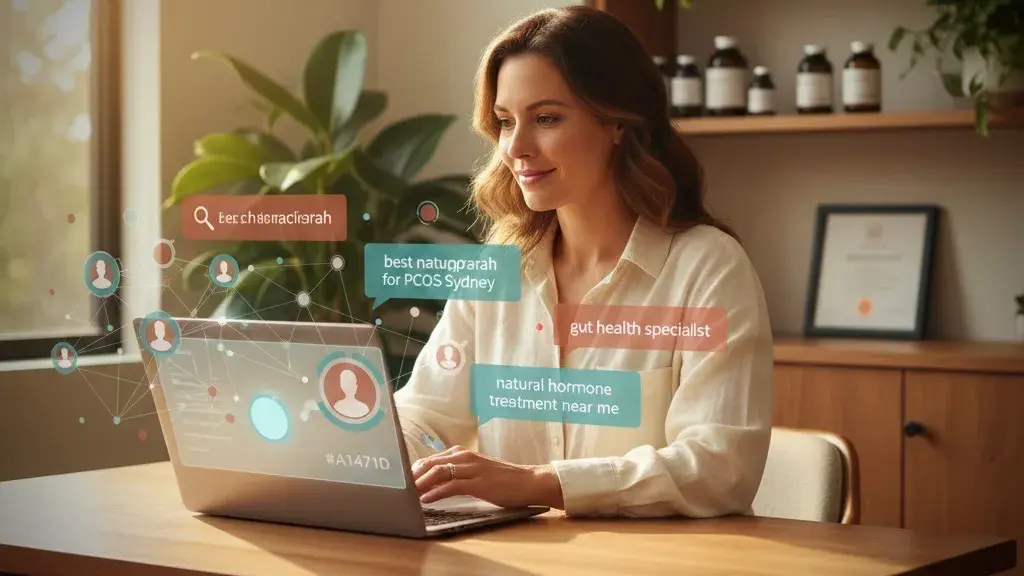
- Include their search behaviour – what questions would they ask AI or Google?
- Capture their decision factors – what creates trust for them?
4. Example Personas: Two Specialties in Action
For Hormone Specialists:
Persona 1: “Corporate Sarah” – The High-Achieving Executive
Sarah is 47, a senior marketing director at a financial services firm in Melbourne’s CBD. She lives in Hawthorn with her husband (a lawyer) and their two teenage children. For the past 18 months, she’s been struggling with brain fog during important presentations, night sweats disrupting her sleep, and unexpected weight gain despite her regular F45 routine.
Sarah is analytical and research-oriented – she’s already read three books on perimenopause and follows several women’s health Instagram accounts. She tried HRT through her GP but felt “not quite right” on it and wants to explore a more holistic approach. She’s frustrated because she can’t think clearly anymore, and her confidence at work is suffering.
She searches for “naturopath perimenopause Melbourne CBD” and “natural hormone balancing for executives.” When choosing a practitioner, she looks for professional qualifications, evidence-based approaches, and someone who understands the demands of a high-pressure career. She requires appointments outside business hours and seeks a practitioner who can explain the science behind their recommendations. She’s willing to invest in premium care if she can see a clear pathway to regaining her mental clarity and energy.
Persona 2: “Exhausted Emma” – The Overwhelmed Mum
Emma is 42, a part-time primary school teacher in Frankston, married with three children aged 6, 9, and 12. She’s constantly tired despite sleeping 7-8 hours, struggles with mood swings that she hates her kids seeing, and has gained 12kg over the past two years. Her periods have become unpredictable and heavy, making her anxious about getting through her teaching days.
Emma is intuitive and values natural approaches – she’s used natural remedies for her children and prefers to avoid medication when possible. She’s tried various online advice (magnesium, cutting out dairy, mindfulness apps) but nothing seems to work consistently. She feels guilty about being “cranky mum” and just wants to feel like herself again so she can enjoy her family.
She discovers practitioners through local mums’ Facebook groups and searches for “natural hormone help for mums” or “naturopath for mood swings Frankston.” She needs flexible appointment times (school hours or Saturday mornings), clear pricing information upfront, and a practitioner who understands the juggle of family life. She connects with practitioners who show empathy and make her feel heard rather than judged. She wants to know that other mums have been through this and come out the other side.
Creating Customer Personas For Gut Health Practitioners:
Persona 3: “Detective David” – The Frustrated Food Investigator
David is 35, a software developer working remotely from his apartment in Brunswick. He’s single, health-conscious, and has been dealing with bloating, alternating constipation and diarrhoea, and fatigue for three years. He’s already tried low-FODMAP, eliminated gluten and dairy, and spent hundreds on probiotics, but seen minimal improvement.
David is highly analytical and systematic in his approach. He’s tracked his symptoms in an app, read about SIBO and histamine intolerance, and even paid for some functional testing through overseas companies. He follows gut health specialists on social media and listens to health podcasts during his runs. But he’s overwhelmed by conflicting information and frustrated that despite all his efforts, he’s not significantly better.
He searches for “SIBO specialist Melbourne” or “functional medicine gut health.” He seeks a practitioner who can interpret his test results, acknowledges his prior research, and provide a clear, evidence-based protocol. He’s looking for someone methodical who won’t make him start from scratch but can help him connect the dots he’s missing. He prefers telehealth for convenience and values detailed treatment plans with scientific rationale. He’s willing to invest in comprehensive testing if it means finally getting answers.
Persona 4: “Overwhelmed Lisa” – The IBS Sufferer Seeking Relief
Lisa is 29, works as a primary school teacher in Geelong, lives with her partner, and has struggled with IBS symptoms since her early twenties. She experiences painful cramping, urgent bathroom needs (often at inconvenient times at school), and constant bloating that makes her self-conscious. She’s anxious about eating out or travelling because of unpredictable flare-ups.
Lisa isn’t naturally research-oriented; the sheer amount of information online about gut health overwhelms her rather than empowering her. Her GP diagnosed IBS, prescribed antispasmodics, and suggested stress management, but nothing has really helped. She’s tried various diets suggested by friends (cutting out gluten, going vegan) but found them too hard to maintain and wasn’t sure if they helped.
She searches for “IBS help Geelong” or “naturopath for digestive problems” and often finds practitioners through recommendations from her yoga teacher or work colleagues. She needs a practitioner who can simplify things for her, provide clear step-by-step guidance, and not overwhelm her with too much information at once. She connects with warmth and reassurance more than detailed science. She wants someone who understands the embarrassment and isolation that come with gut issues and can offer her hope that a normal life is possible. She needs practical meal ideas and support, not just a list of foods to avoid.
5. Putting Your Personas to Work
Now that you have detailed personas, they become your content compass. Every blog post, FAQ, social media update, and service page description should speak directly to one of your personas.
Blog Topics: Emma needs “5 Signs Perimenopause Is Affecting Your Mood (And What Actually Helps)” while Sarah responds to “Brain Fog at Work: The Perimenopause Connection Executives Need to Know.”
FAQ Sections: David’s questions are about testing protocols and supplement interactions. Lisa’s questions are about managing symptoms at work and what a typical treatment journey looks like.
Service Pages: Write separate sections or pages that speak to different personas. Sarah needs to know you offer early morning and evening appointments and understand the demands of corporate life. Emma needs to see that you’ve helped other mums reclaim their energy and patience.
Social Media Content: Share Emma’s story (anonymised) on Facebook where local mums connect. Post research-backed insights on LinkedIn where Sarah and David spend their time.
AI Visibility: When AI systems analyse your content, they’ll see you serve specific types of clients with specific needs – making you much more likely to be recommended when someone asks “Who can help a professional woman in Melbourne dealing with perimenopause brain fog?”
“The practitioners who thrive aren’t trying to be everything to everyone. They understand exactly who they serve best, and they create content that speaks directly to those people. That clarity helps both humans and AI systems connect the right clients with the right practitioner.”
James Burgin
6. Your Quick Start Action Plan For Creating Customer Personas
Step 1:
- Block out some time to review your last 20 client consultations
- Note patterns in demographics, situations, search behaviour, and success factors (for suggestions, see Section 3 above)
- Identify your most common client type
Step 2:
- Use the AI prompt provided in Section 3 to identify 2-3 distinct personas
- Choose your primary persona (most common or most aligned with your expertise)
- Flesh out their complete story using the framework from Section 3
Step 3:
- Write 3 pieces of content speaking directly to your primary persona
- Update your website’s FAQ section with their most common questions
- Create 5 social media posts addressing their specific concerns
Checking for responses:
- Notice which content resonates and attracts enquiries
- Refine your persona based on actual responses
- Consider developing another persona
- Update personas based on new patterns you see
Key Takeaways from Creating Customer Personas for Natural Health Practitioners
Remember: Your personas aren’t static. They evolve as you learn more about your clients and as your practice naturally develops its strengths. Start with one detailed persona, use it consistently for a month, and refine based on what you learn.
Creating customer personas for natural health practitioners isn’t marketing perfection – it’s clarity about who you serve best so you can help more of the right people find you.