
GEO Trinity: The 3-Part Framework to Build Your Authority in 2026
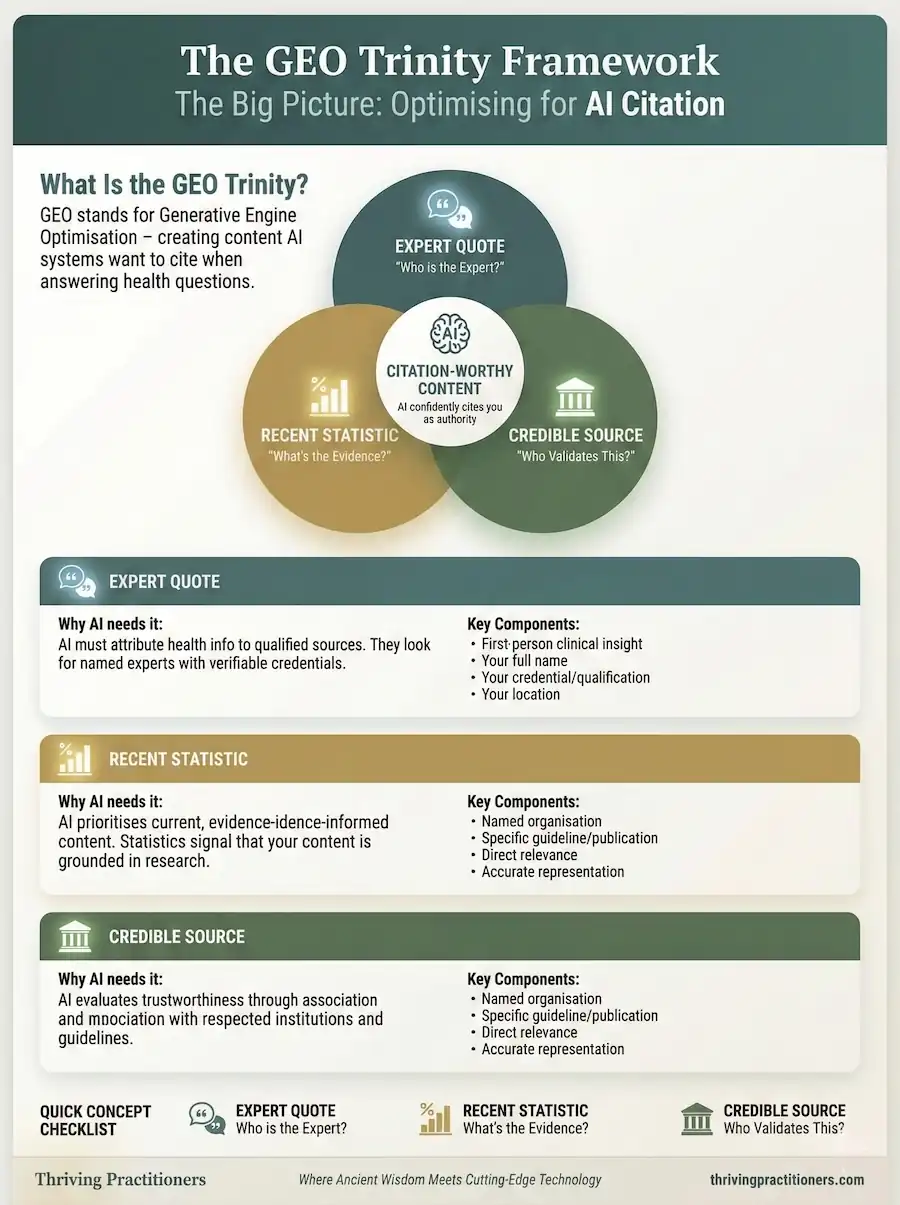
GEO stands for Generative Engine Optimisation – the practice of creating content that AI systems like ChatGPT, Perplexity, and Google’s AI Overviews want to cite when answering health questions.
The GEO Trinity (also called the GEO Framework) is a simple formula for making every piece of content citation-worthy. When AI systems evaluate sources to reference, they’re essentially asking:
- Is this credible?
- Is this current?
- Is this from a real expert?
The three elements of the GEO Framework answer all three questions in a single framework.
Element 1: Your Expert Quote
What it is: Your professional insight, attributed to you with your name and credentials.
Why AI needs it: AI systems must attribute health information to qualified sources. They’re looking for named experts with verifiable credentials. Anonymous content or generic advice without attribution gets passed over for sources that clearly identify who is speaking and why they’re qualified.
What it looks like:
Key components:
- First-person clinical insight (not generic information)
- Your full name
- Your credential/qualification
- Your location (for local search relevance)
The principle: You’re not just sharing information. You’re positioning yourself as the source of that information. AI learns to associate your name with expertise in your topic area.
Element 2: Include a Recent Statistic
What it is: Quantifiable data from the last three years, with its source clearly identified.
Why AI needs it: AI systems prioritise current, evidence-informed content. Statistics signal that your content is grounded in research, not opinion. The recency matters because AI is trained to favour up-to-date information, particularly for health topics where guidelines and understanding evolve.
What it looks like:
Research from the Australasian Menopause Society indicates that approximately 80% of women experience vasomotor symptoms during the menopausal transition, with severity varying significantly based on individual factors (Australasian Menopause Society, 2024).
Key components:
- Specific number or percentage
- Named source (research body, study, professional organisation)
- Publication year (ideally 2022 or later)
- Context for what the statistic means
The principle: Statistics transform opinion into evidence. They give AI systems something concrete to reference and signal that you engage with current research in your field.
Where to find statistics:
- Professional body publications (NHAA, ATMS, ANTA)
- Government health departments
- Peer-reviewed research (PubMed, Google Scholar)
- Industry reports and surveys
- Australian Bureau of Statistics health data
Important: Always verify statistics before publishing. AI can hallucinate data, so never use an AI-generated statistic without confirming its accuracy from the original source.
Element 3: Quote a Credible Source
What it is: A reference to an authoritative body, institution, guideline, or publication that supports your content.
Why AI needs it: AI systems evaluate trustworthiness partly through association. Content that references respected institutions inherits some of that credibility. For health content, especially, AI looks for alignment with established guidelines and recognised authorities.
What it looks like:
According to the Royal Australian College of General Practitioners (RACGP) guidelines on preventive health, adults should undergo cardiovascular risk assessment every two years from age 45, or from age 35 for Aboriginal and Torres Strait Islander peoples.
Key components:
- Named organisation or institution
- Specific guideline, publication, or resource
- Direct relevance to your point
- Accurate representation of their position
Types of credible sources for natural health practitioners:
- Professional associations (NHAA, ATMS, ANTA, ARONAH)
- Government health bodies (TGA, NHMRC, state health departments)
- Medical colleges (RACGP, RANZCOG, relevant specialty colleges)
- Research institutions (universities, CSIRO)
- International bodies (WHO, Cochrane)
- Peer-reviewed journals
The principle: You’re borrowing authority from established institutions while adding your clinical expertise. This combination makes your content more trustworthy than either element alone.
How the Three Elements Work Together
Each element answers a different trust question:
| Element | Trust Question It Answers |
|---|---|
| Expert Quote | "Who is saying this, and are they qualified?" |
| Recent Statistic | "Is this current and evidence-based?" |
| Credible Source | "Is this aligned with recognised authorities?" |
When all three appear together, AI systems have everything they need to confidently cite your content. You’ve demonstrated expertise, currency, and alignment with established knowledge.
- ✓ First-person clinical insight
- ✓ Full name with credentials
- ✓ Location for local relevance
- ✓ Your unique perspective
- ✓ Data from last 3 years
- ✓ Source clearly identified
- ✓ Accurate & verifiable
- ✓ Adds genuine value
- ✓ Professional associations
- ✓ Government health bodies
- ✓ Research institutions
- ✓ Peer-reviewed journals
The GEO Trinity in Action
A complete FAQ answer using all three elements:
Q: How long does it take to see results from naturopathic treatment for digestive issues?
Most clients notice initial improvements in digestive symptoms within two to four weeks of starting treatment, though complete resolution of chronic conditions typically requires three to six months of consistent care.
“Gut healing doesn’t happen overnight. I tell my clients to expect the first month as a recalibration period – we’re changing dietary patterns, introducing supportive supplements, and allowing the microbiome to begin shifting. The real transformation usually becomes evident around the eight to twelve week mark.”
Sonya Thorn, Gut Health Naturopath (AdvDip Naturopathy, MRC Certified Healthy Gut Practitioner), Barossa Valley, SA
Research published in Science Daily found that dietary interventions for IBS led to clinically meaningful improvement in 76% of participants within six weeks (2023). The NHMRC guidelines on complementary medicine acknowledge that natural therapies often require longer treatment windows than pharmaceutical interventions to achieve sustained results.
Individual response varies based on condition severity, treatment compliance, and underlying factors. Your naturopath will establish realistic expectations during your initial consultation and adjust protocols based on your progress.
Quick Reference Checklist
Before publishing any content, verify:
Expert Quote
- Includes first-person clinical insight
- Names you with full credentials
- Adds something only a practitioner would know
- Sounds like you (not generic AI voice)
Recent Statistic
- Data is from 2022 or later
- Source is named and verifiable
- Statistic is accurately represented
- Number adds genuine value (not filler)
Credible Source
- Organisation is a recognised authority
- Reference is relevant to your point
- You've accurately represented their position
- Source is accessible if readers want to verify
Why This Framework Matters Now
AI systems are increasingly how potential clients discover practitioners. When someone asks ChatGPT, “What natural approaches help with perimenopause symptoms in Melbourne?”, the AI constructs an answer from sources it deems trustworthy.
The GEO Trinity ensures your content meets AI’s trust criteria. Every FAQ answer, blog post, and service page that follows this framework becomes a potential citation source.
Most practitioners create content that includes one or two of these elements. Very few consistently include all three.
That gap is your opportunity.
Connect
Thriving Practitioners Growth Hub membership
Connect
Thriving Practitioners Facebook community
Learn
Monthly workshops on practice growth and AI visibility